
Hey friend, I attended this year’s Armory Show at the Javits Center in Manhattan, New York City and I want to share the experience with you. I was very interested in seeing textile art at the Armory Show. How well is it being shown? How widely shown is it? What are some of the the techniques being used? And what is the overall collector interest in purchasing textile art at the armory show? These are the questions I had.

In this post I’ll share with you some of the works I was able to see and enjoy. I must say the Javits Center is a really large space. After two hours of walking the fair grounds I can’t say I saw everything that was on display. It was a truly invigorating visual experience. Galleries from all over the world were present with a variety of artworks to keep you constantly engaged for as long as you could walk around to discover them. Like I said, after two hours I was beat. Maybe, I should have taken a break and gone back for a second tour to see some of the works I missed the first time around.

Techniques: Textile Art at the Armory Show
Overall, my experience was a great one. I was pleased to see a strong showing of textile art at The Armory Show presented by both US galleries and international galleries as well. Discovering the different ways in which artists are using the textile medium to create art was really fascinating to me.
I saw works by an artist – JP Mika- who uses sewn fabric as his canvas and then paints on top of that with acrylic and glitter. I also saw works by the artist – Anthony Olubunmi Akinbola. He uses durags (fabric head coverings for Black hair), sewn together in intricate ways and stretched on canvas. There were also the works of Cornelieus Annor who uses fabric transfer and acrylics on canvas.

Another set of fascinating works of textile art at The Armory show were by Norwegian artist Ane Graff. Her works were wall hangings of hand painted and printed silk as well as sculptures. Her glass sculptures are each filled with colorful mixtures and they reference mental illnesses like Memory loss, Brain fog and depression.
Furthermore, some other textile based artists at the show you should definitely check out are Jordan Nassar who creates hand embroideries on cotton. And that of Sagarika Sundaram who creates exquisite works with wool and botanical dyes .

Praise for Textile Art at The Armory Show
Like I said, textile-based work made a very strong showing at the show. Here’s a blog that shows some of the “textured” art at the Armory Show. And finally, here’s an article that points out what a strong showing of textile art was at this year’s Armory Show. Below is a quote from that article
[They] created a harmony between textiles and figurative painting—which was a larger trend seen across the fair. Strong support for textile-based work seen in many booths may be due to museum exhibitions in recent years that have course-corrected the art historical canon. Craft-based work at The Armory Show was not only selling, but selling well, accounting for some of the top sales of the day.
Ayana Dozier, The 10 Best Booths at The Armory Show 2022

In conclusion, it was definitely worth my time to go see and experience all of this amazing textile art at the Armory Show. The Show is definitely on my list to visit again. Friend, if you ever get a chance to visit the Armory Show, take it. You won’t be disappointed.
Warmest Regards,

The fiber exhibition “Handmade: Women Reshaping Contemporary Art” which I recently wrote about is a very finely-curated exhibit. You’ve got to see it. There are well-known fiber artists in the show and some names I hadn’t yet heard of. Also, there are varied types of fiber arts on view including hand embroidery, weaving, quilting, mixed media, and “digital sewing”.
In this article, I’m going to give you a visual review of most of the works on view in the exhibit. I took and sorted through 200 plus photos in order to bring you this photo review (which added up to well over 12 hours of computer work). I’m missing a couple of artists because I couldn’t get good photos of their displayed pieces.
Don’t forget to click on each artist’s name to see even more of their works in addition to the photo galleries I’ve created for you here.
Orly Cogan Exhibiting in “Handmade”
Ok. let’s get to it. My favorite artist in the show is Orly Cogan. She combines drawing with sewing and that’s exactly where my interests are. She uses vintage fabrics and some found embroideries. Then she hand embroiders on them. Her outlines are hand embroidered and then she colors within the outlines with paint.
Her subjects are often nude women. She says, “my quest is to tell a story about the role of women in our ever-changing society. Who do we want to be?”
Her work is so rich in detail. I just love her creativity. I’ve enjoyed seeing her work online. Seeing her work in person at this exhibit, was the highlight of my visit. Enough talking. Go ahead and view her work in the photo gallery below.

Faith Ringgold Exhibiting in “Handmade”
Faith Ringgold is a distinguished African American artist who is known for her narrative quilts. She is the recipient of 22 Honorary Doctor of Fine Arts degrees, She started by making oil paintings in the 1960s. Then in the 1970s her work evolved and she started making unstretched acrylic paintings on canvas with quilted borders. Then a decade later, she began to combine her story quilts with hand-written text.
She’s quoted as saying,
“I’m not presumptuous enough to feel that people are going to feel what I have in mind, so I tell a story, you know, let them read something, that doesn’t change, that as I have said it, you know, so that’s the way I feel about the viewer, the viewer has a mind of their own and eyes of their own and they’re going to see it their way, I just hope they look.”
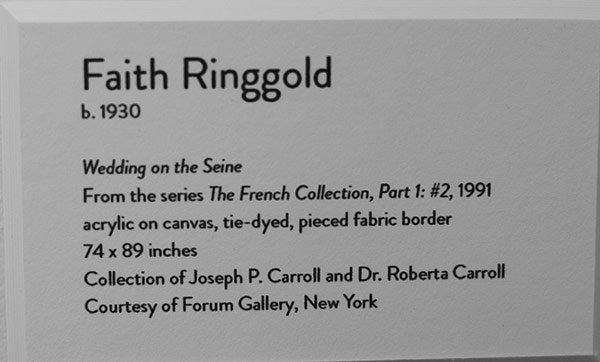
It was my honor to see her work in person for the very first time. Notice the pieced and quilted border in her piece “Wedding on the Seine” which was on view in this exhibit.
Chiyoko Tanaka Exhibiting in “Handmade”
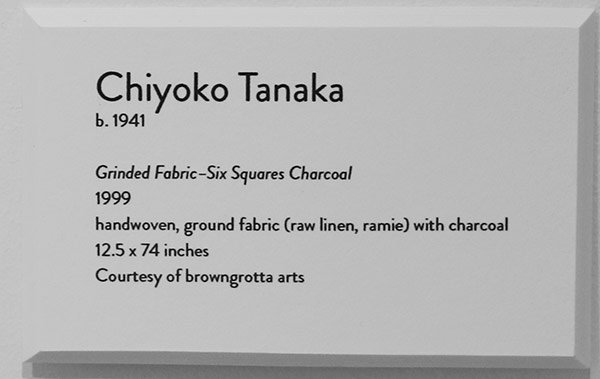
“Placing the fabric on the ground, I trace out the ground texture and surface of the fabric. The act of tracing is a transformation of time coherence into space and grinding is the transformation of space coherence into time. The final color of the surface is not so important, more the effect achieved by the application of a certain soil, charcoal or choice of tool which helped translate the texture of the ground more readily into my “canvas.”

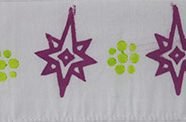
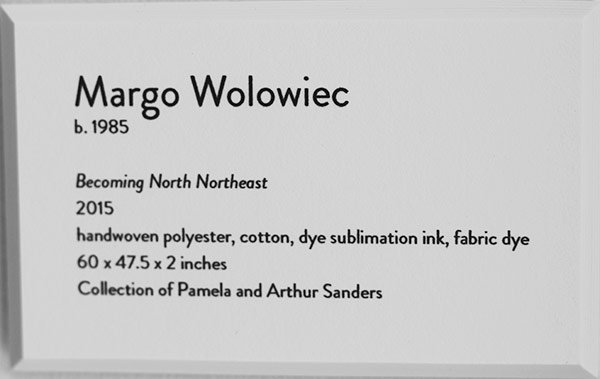
Margo Woloweiec Exhibiting in “Handmade”
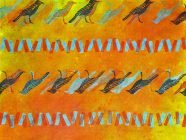
“Her hand-woven panels use data sourced from the Internet that she finds through hashtags, geotags, google searches and news feeds. In her woven work, Wolowiec selects images and text which she puts through a multi-step process that begins with a dye-sublimation transfer onto polymer threads. She then weaves on a traditional floor loom to create woven panels which she continues to dye and paint throughout the weaving process.”

For the rest of the article, I’ll leave you to view the individual artist galleries in “Handmade“, while I make comments only occasionally. Enjoy!!!
Carolina Yrarrázaval Exhibiting in “Handmade”


Judith Scott
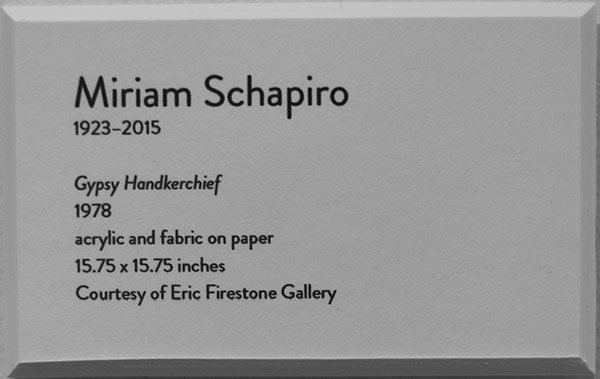
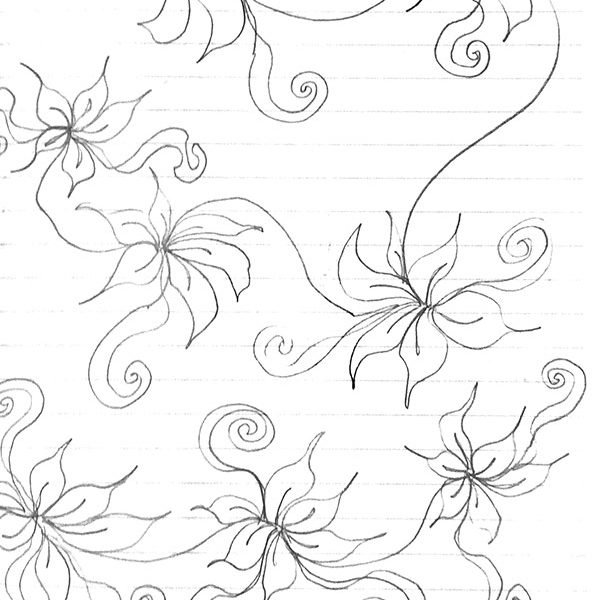
Miriam Schapiro

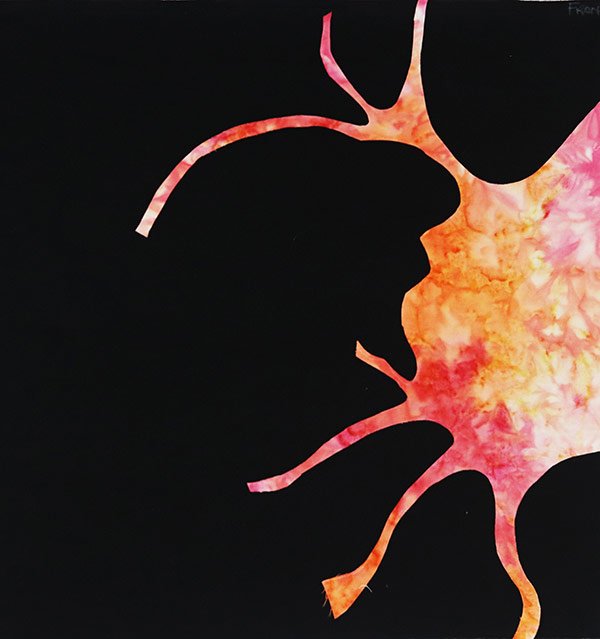
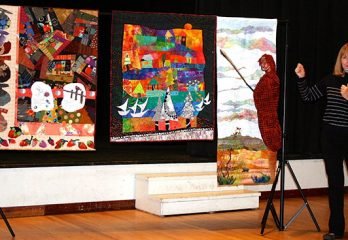
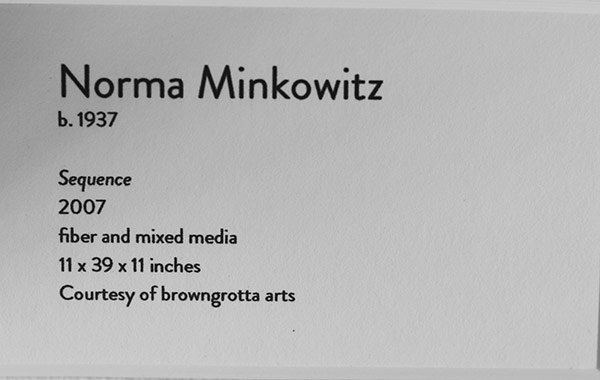
Norma Minkowitz
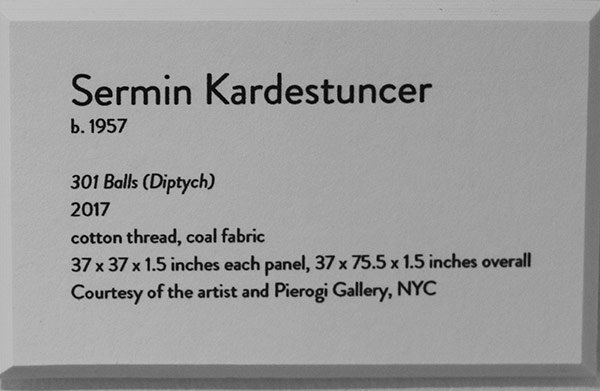
Sermin Kardestuncer


Sophia Narett
I’ve previously written a review about Sophia Narett. She was one of the artists who exhibited in Intimate Lines. You can read that review here. She and Faith Ringgold, among others, are mentioned in a recent New York Times article entitled: “Some of the Most Political Art is Made with Fibers”. She’s got an upcoming solo exhibition in Brooklyn’s BRIC Arts/Media center in May, 2018


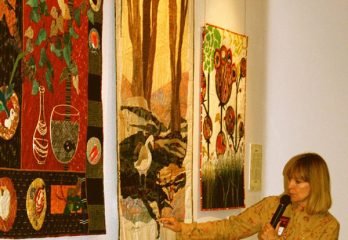
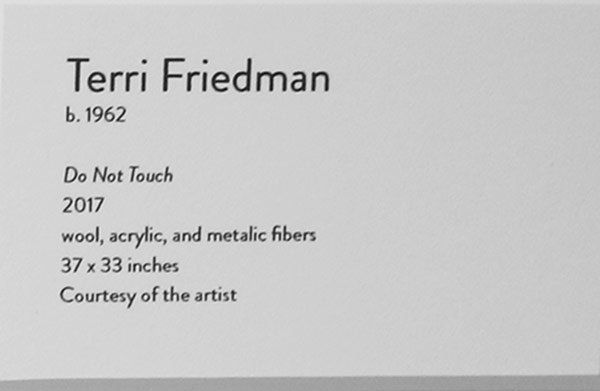
Terri Friedman

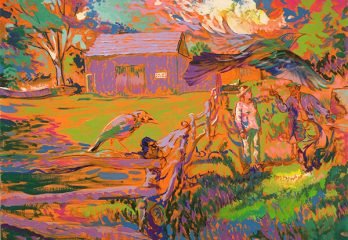
Anna Betbeze
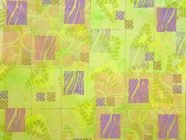
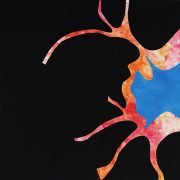
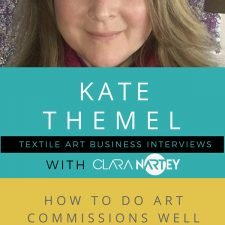

Leslie Dill
Ghada Amer with Reza Farkhondeh
I’m not sure what they mean by “digital sewing” but I sure would love to find out. Could it be piecing in Photoshop?


And there you have it. A visual review of “Handmade: Women Reshaping Contemporary Art”. I hope you enjoyed this review. The exhibit is on view through June 2, 2018. And there will be a curator’s talk and panel discussion led by “Handmade” curator Elizabeth Gorayeb on April 21 from 11:00 am to 1:00 pm.,
Get more info from the Westport Art Center.
Warmest Regards,

And, as always, if you know someone that might benefit from this post, please do share it with them – they won’t be mad at you for providing them value. Promise!
Is Fiber Art An Engine For Women Reshaping Contemporary Art?
There are many people who have no idea what textile art is. Many of them are not interested in art at all, some are art enthusiasts, and some art professionals.
“I’ve been in contemporary art for 20 years and I didn’t know anything about fiber art”, said an art professional to me.
That didn’t surprise me because of the many times I’ve had to explain myself to folks about what exactly I do. Fiber art which has long been associated with feminine work has struggled to be accepted as art rather than craft. Given this backdrop, does fiber art have the chance of ever becoming a recognized art form in contemporary art circles? I believe so.

Last week, the New York Times published a prominent article/obituary about the passing of textile artist Katherine Westphal (if you’re on my mailing list you got a heads up on that article). Fiber artists were pleased to see the recognition this art form was receiving. And those in contemporary art who had never heard or had paid little attention to fiber art recognized it was time to tune in to this medium.
And there is a lot happening in this field of art for sure. You’d never know if you didn’t pay attention. In another article, the New York Times states “fiber art looks fresh again“. For me, my way of paying attention and getting informed about what’s going on is by exhibiting my own work, curating textile art shows and attending fiber art exhibitions.
An exhibition in Westport, CT caught my attention so I mentioned it in my weekly newsletter last week. And this week, I decided to go see the exhibit for myself.

The exhibition, curated by Elizabeth Gorayeb, former SVP in the Impressionist and Modern Art Department at Sotheby’s, is titled “Handmade: – Women Reshaping Contemporary Art”.
The Venue for Women Reshaping Contemporary Art
The venue for this exhibit is Westport Arts Center. It is easy to drive by it without noticing because of how it’s nestled among other businesses on a busy street. Yet, it is located at a beautiful location right on the Saugatuck River. After I had parked my car, I had to ask for help in navigating my way to the front entrance. However, immediately, I entered, I was greeted by the friendliest art gallery or museum staff I’d ever met. I stayed for well over two hours and they were friendly throughout the entire period.
The Westport Art Center is a well-lit medium-sized gallery and the installation of the exhibit was obviously done with attention to detail. Enough room was left between pieces so that you can enjoy each piece by itself. In total, 17 artists participated in this exhibit. The works on view include weavings, knitting, hand embroidery, quilts, sewing and mixed media. The presentations were as varied as you can have them. Some works were on pedestals, others attached to wooden frames, there was one framed in a huge Plexiglas box and there was video also.
The Exhibit
I made two observations from this exhibit and the one I attended in New Jersey, “Intimate Lines: Drawn with Thread”. The first Is, the exhibit includes a lot of artists I had previously not heard about as well as some popular ones. Faith Ringgold’s piece: “Wedding on the Seine”, was on view here. And Orly Cogan had one of her newest pieces of work, “The Feast”, on display too. Another observation I made is most of the pieces in both exhibits were more about storytelling – people and places- than abstract works.
Having said that, “Women Reshaping Contemporary Art” is an excellent exhibit of the varied artworks being created by women (the artists in this exhibit are all women) in the fiber art industry. I was so enthralled by the creativity on display, I spent hours carefully admiring each piece. They each need to be explored in depth and I’m going to do that in a separate article.
Amanda Innes, Executive Director of the Westport Arts Center, stated,
“There is an unexpected timeliness to this exhibition that resonates within the community at large. These established artists, working in non-traditional media, are clearly making an impact within the conversation of Contemporary Art. Their work unapologetically embraces the sensory aspects of fiber, and defies any attempt to diminish the work as craft.”
So, the question is how can society stop diminishing fiber art as craft? In other words, how can women reshape contemporary art? I’ve got four ideas on how that can be done. Let’s take a look at each one of them.
How Women Can Truly Reshape Contemporary Art
- Create More Fiber Art
I charge fiber artists to continue to create more work. The more artwork we create, the more excellent we become at what we do. And the harder it becomes for the art world not to stop and take notice.
- Educate the Public
Frankly, many people have no idea what fiber art is. We have a responsibility to educate the people around us about what fiber work is all about. Just talking about what we do and explaining how we conceive ideas and transform them into creations will help people learn about this medium. The onus lies on all of us who know what it is to educate more people about it. Creating publications (books, magazines), online presence, professional organizations and TV programs will go a long way to achieving this purpose.
- Ascribe Value to Fiber Artwork
This is a tough one. In my interview with Joe Cunningham, he talks about the possibility that more men would enter into fiber arts if the economics worked. We have to find a way of making textile art valuable and worthy of being paid for. One of the reasons it’s been hard to accomplish this is because of the art versus craft debate. As a result of this, gallerists and other art professionals have been hindered from seeing value in fiber art.
I believe the second reason is that the creators of fiber art (fiber artists) do not ascribe a high enough value to their creations. The way we perceive our work is how others will too. If you spend 1,000 hours creating a piece of work and you value it at $400, then $400 is what it’ll be worth in the eyes of those who view it.
- Art Venues & Professionals Need to Embrace and Promote Fiber Art
Finally, more art venues and art professionals who curate shows need to support the fiber arts. They need to give fiber artists opportunities to showcase their talents and skills in some of the major art exhibitions around the world. The more talk, support, and action from art galleries, museums, and also from art professionals, the more chances for fiber art to become mainstream art and reshape contemporary art.
Conclusion
All four of these things need to happen for women to be successful in reshaping contemporary art.
I applaud Westport Arts Center and the curator Elizabeth Gorayeb for their initiative in putting together an extraordinary display of the skills of women artists, pooling from the artists themselves, galleries and private collections. They’ve also planned fiber-related programs for the duration of the exhibit. For example, on April 21, 2018, there’ll be a Curator’s Talk & Panel discussion related to the show. The exhibit, Hand Made: Women Reshaping Contemporary Art is a testament to the possibility of women truly reshaping contemporary art. We’re not there yet. But we’re making great strides towards it.
Warmest Regards,
PS: Here’s my review of the individual artworks included in “Women Reshaping Contemporary Art”.
A Review of 7 Artists Showing at Hunterdon Art Museum
In part one of this series, I showed you the works of four artists exhibiting at the Hunterdon Art Museum. In this second part of my review of “Intimate Lines: Drawing with Thread”, I’ll show you more of the exhibiting artists and their thread works.
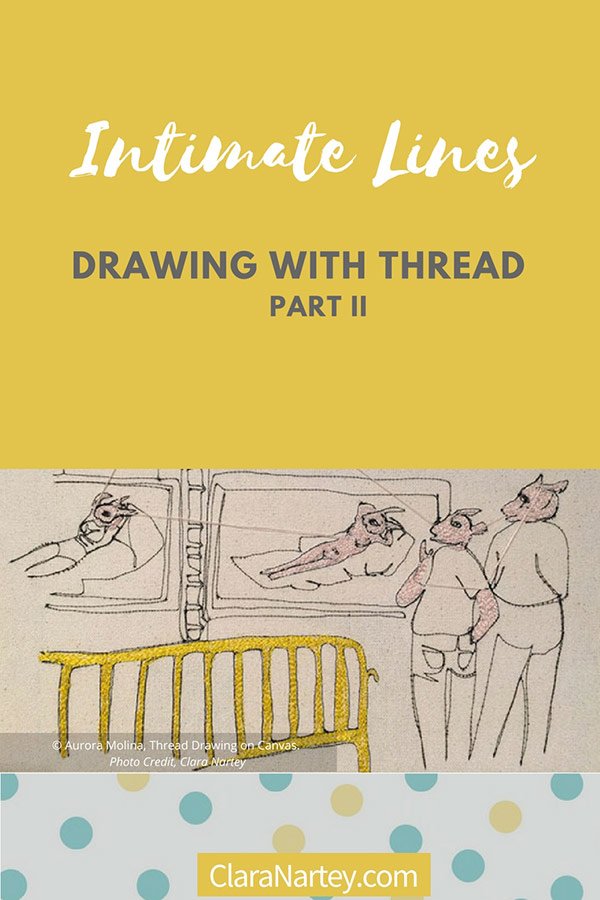
In part one of the series, I neglected to mention Carol Eckert – the mastermind and curator of this exquisite show. Eckert is herself an accomplished textile artist. She creates sculptural forms using a basketry technique called coiling. Eckert creates her pieces with the help of gauges of coated wire and with cotton and linen threads. See more of Eckert’s works.
Drawing with Thread – Kelsey Viola Wiskirchen
Kelsey Wiskirchen combines storytelling, imagery, and weaving to create her art.
She starts with a story, weaves the fabric, then draws or writes text on a water-soluble material. Next, she pins the water-soluble material with her drawing onto the fabric she wove. And then she’ll go over the lines with her sewing machine. After that, she’ll soak the fabric in hot water to wash away the water-soluble material, leaving the woven fabric with her thread drawings on top.
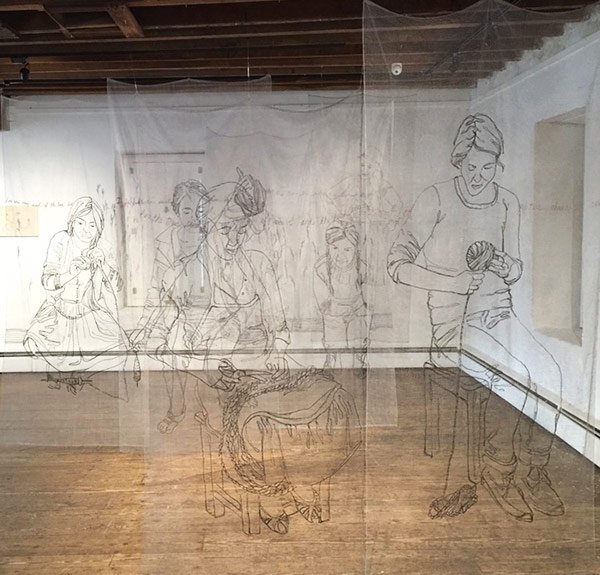
She subscribes to the idea of “Cloth as a metaphor for society, and thread for social relations.” So communities are a major part of her work.
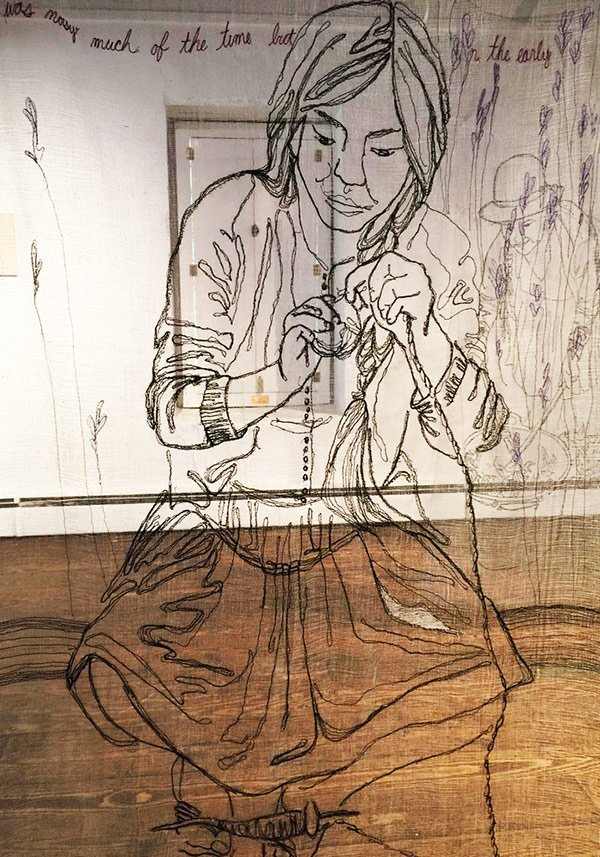
She says, “I stitched the life-sized figures onto transparent fabric so that layering and shadow would become elements of the work, and so the physical presence of a viewer walking through would also become a layer in the installation.”
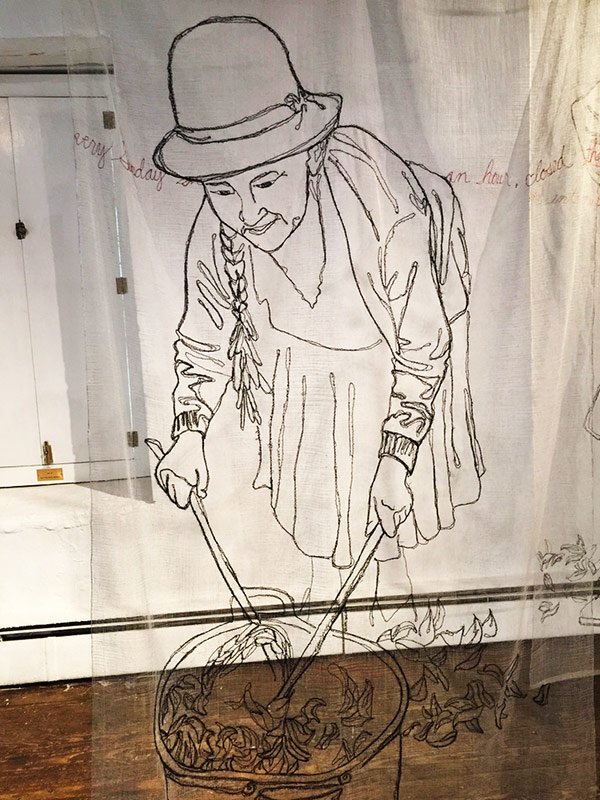
And that’s exactly what happens with her work. I found it quite difficult to individually photograph her pieces. Because they interact so well with each other and with you the viewer. Since her pieces are hung from the ceiling not on walls, as a viewer, you get the chance to walk all around each piece.
When I walked among her pieces, the life-sized subjects in her drawings took on a life of their own. And you feel as though you are directly interacting with the subjects of Wiskirchen’s drawings, and not simply looking in as an outside viewer.
I loved Wiskirchen’s work a lot and I spent a lot of my time with them. I was particularly intrigued by her ability to create “sturdy” thread drawings on such loosely woven and transparent fabrics.
See more of Kelsey Wiskirchen’s work here. (Her site was undergoing construction at the time of writing)
Aurora Molina
Aurora is another artist who uses her sewing machine as a drawing tool. She starts on a blank canvas and she uses threads as both “natural and metaphorical” connections between elements in her composition.
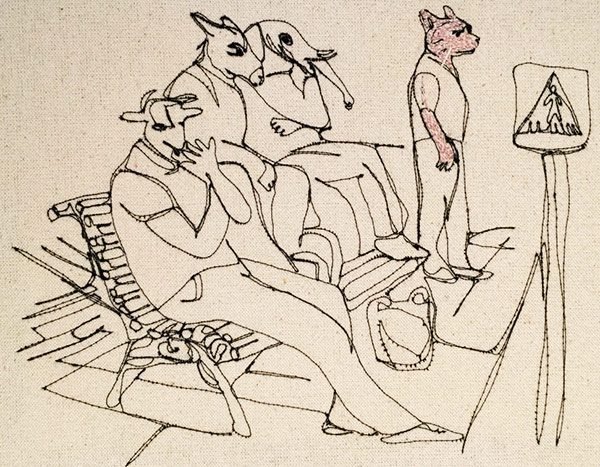
I liked the simplicity of Aurora’s work. The graphic nature and the very thoughtful splashes of color reminded me of some of my own work like “Lemonade Makers” seen here in this post.
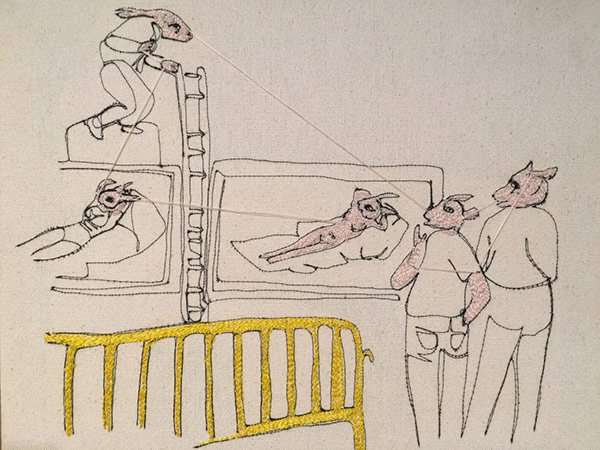
Also, she intentionally leaves the threads at the end of her stitches to connect to the next drawing element. See more of Aurora Molina’s work.
Daniel Kornrumpff
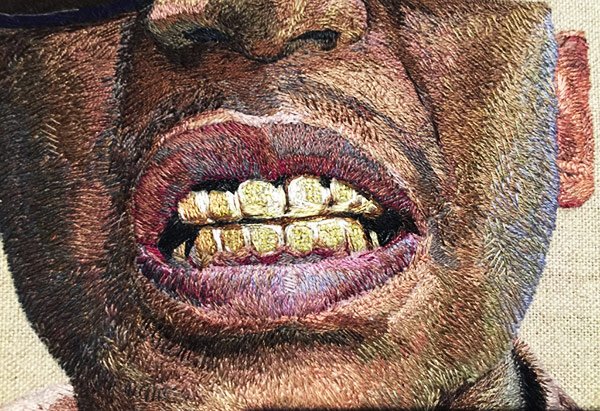
Daniel Kornrumff holds a BFA in fine arts and is an adjunct professor at Mount Ida College. He paints as well as does embroidery. His works on display in the Drawing with Thread exhibit are only his embroidery work.
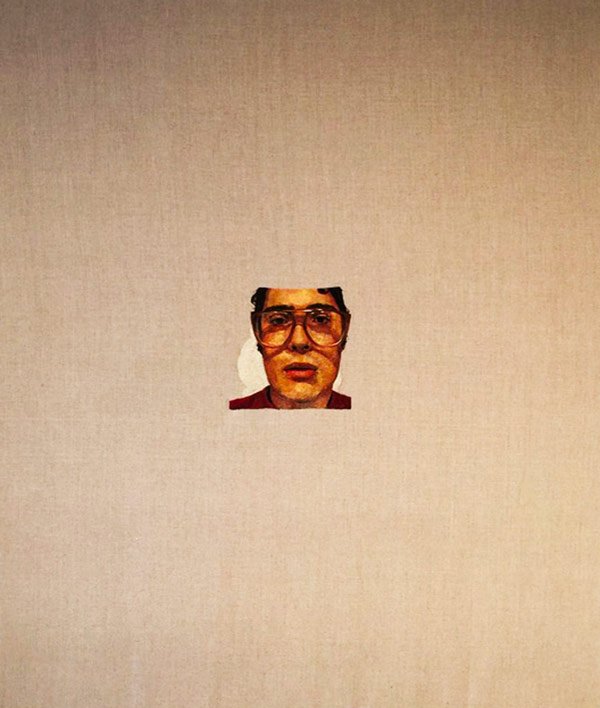
He has a unique way of creating small embroidery pieces and mounting them on large canvases with a lot of negative space around them.
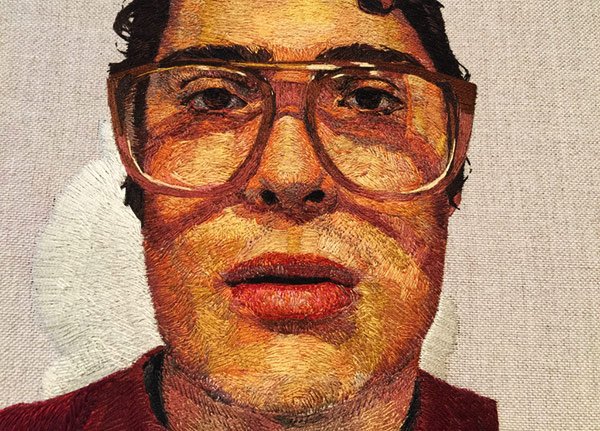
His piece, “No Mold Gold Teeth” was used as the show icon on all the printed exhibition materials.
I love his paintings. Especially, how he leaves some of his sketches unpainted/ partially painted.
See more of Daniel Kornrumpf’s work
Michelle Kingdom
Kingdom creates tiny landscapes in which she uses allegory and symbolism to “explore relationships and self-perceptions”.
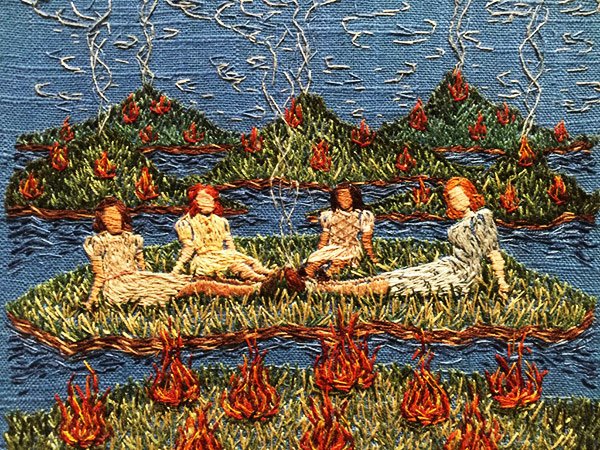
The color in Kingdom’s work is amazing and the detail is mindboggling. Right down to the little tiny buttons on the dresses of the women in her scenes.
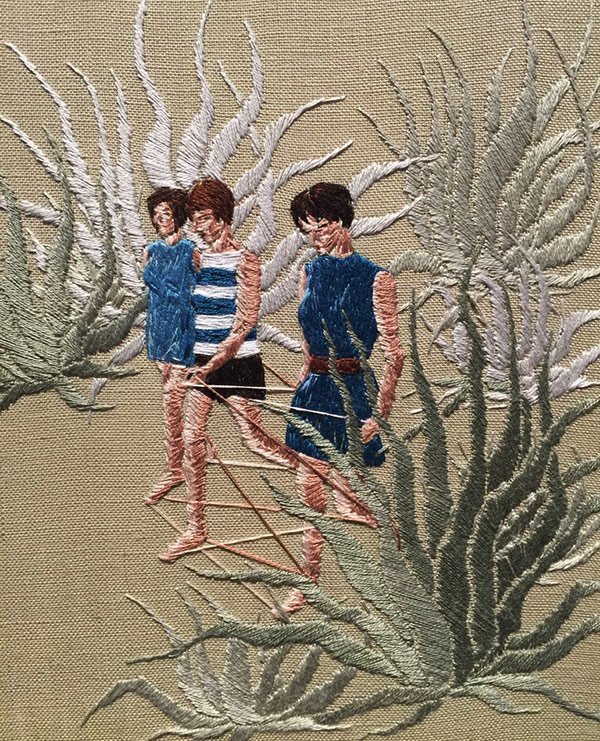
Kingdom’s pieces are intricate, to say the least. I find that although hand embroidery is different from free motion stitching, there’s so much that you can be learn from studying the way hand embroidery is used to draw. And Kingdom’s work will be a really good study for how to draw with a sewing machine.
See more of Michelle Kingdom’s work.
Patricia Dalhman
Patricia Dalhman’s installation in this exhibition was based on the story of her mom’s life from her early years during World War II in London to the USA.
Working with her mom, she created 20 “pages” of thread work to tell the story of their family.
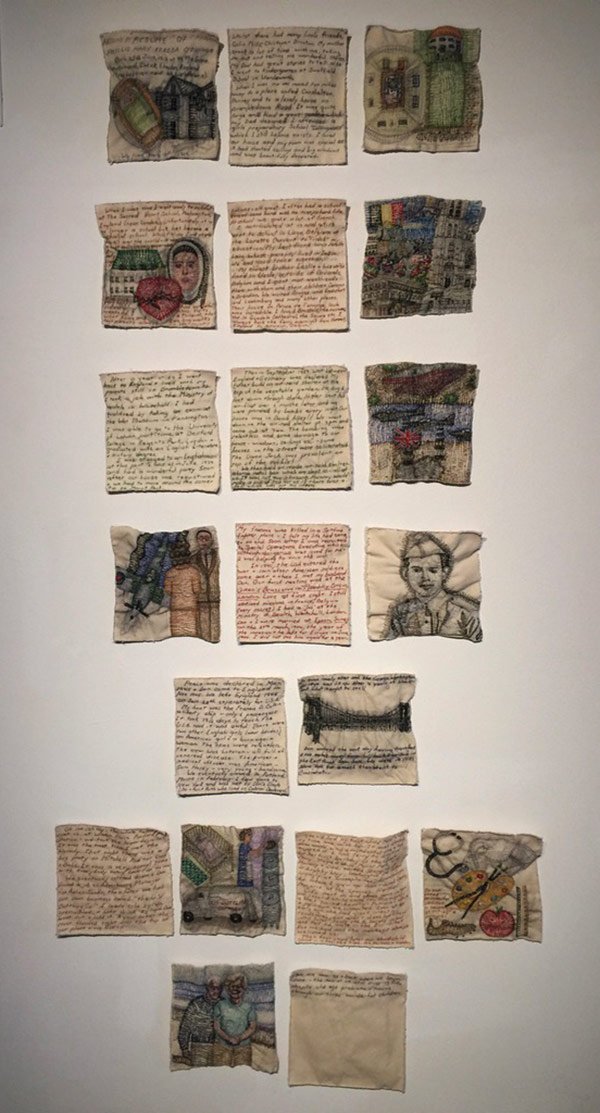
When I took a closer look at the stitches Dalhman used to create her pieces, I noticed that her style is very different from most of the ones I ‘d seen in the exhibition.
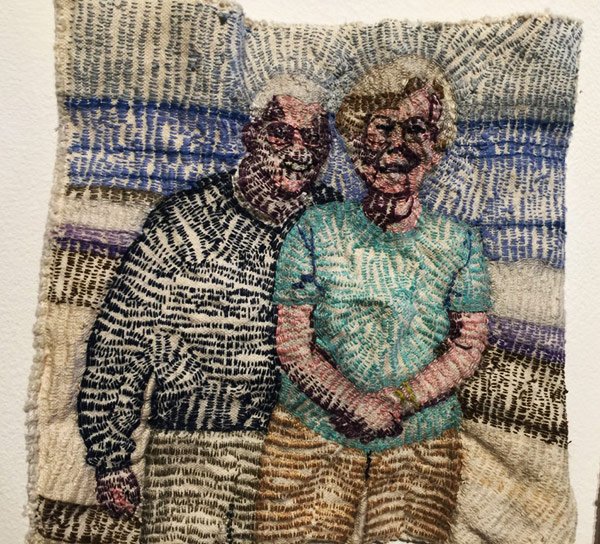
Dahlman uses a sort of zigzag stitch to define the outlines of her drawings – a very interesting technique indeed.
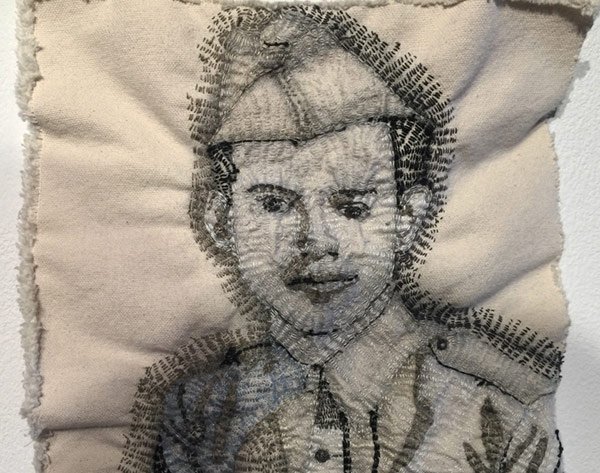
In addition, to the hand embroidered drawings, Dahlman also had written text to help better tell the story of her life.
See more of Patricia Dahlman’s work.
Iviva Olenick
Olenick combines embroidery, watercolor, and antique textiles to create her work. She tells stories with her artwork using text, sometimes in the form of poems.
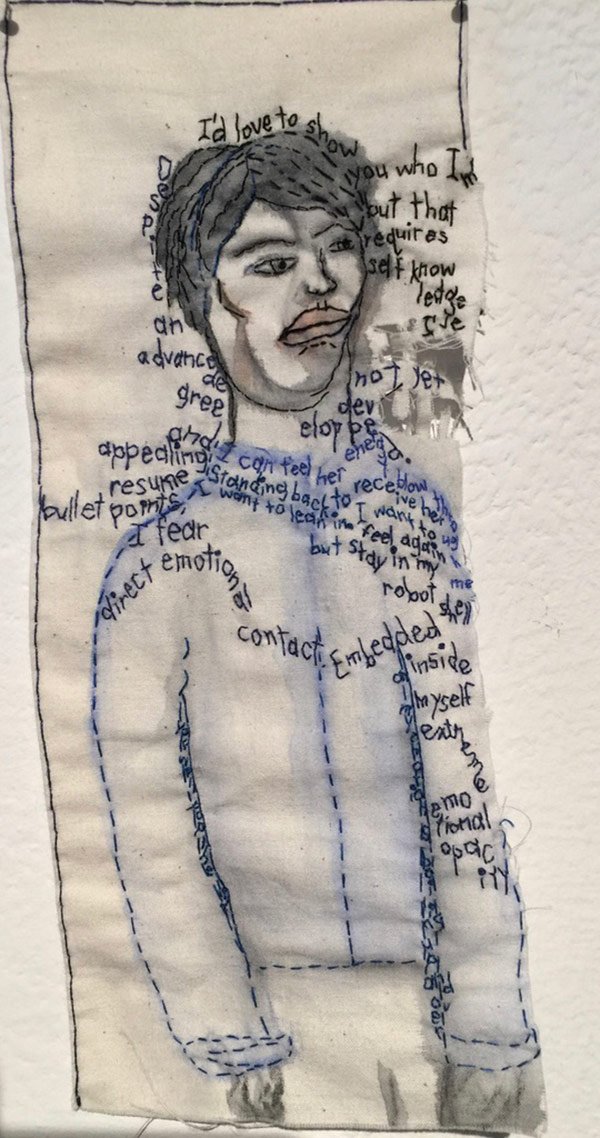
Her pieces have this look of “not trying too hard to create a polished look”, which is very charming. I think her watercolor washes are responsible for this unique look.
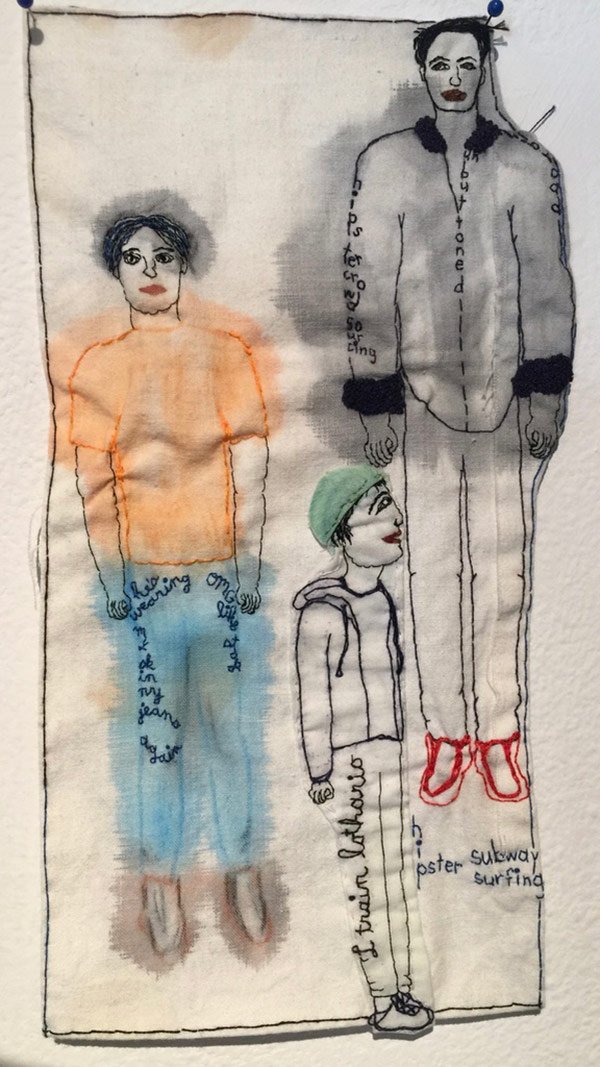
She’s very big on using text – specifically, handwritten text – in her artwork. Her handwritten notes also add to the “unpolished look:” – artist’s hand of her work. She’s even got a twitter campaign going on where she collects poems which she incorporates into her stitched drawings at her twitter handle @EmbroideryPoems. See more of Iviva Olenick’s works.
Sophia Narrett
Narrett likes to tell stories with a needle and thread. She creates sculptural thread works with embroidery techniques.
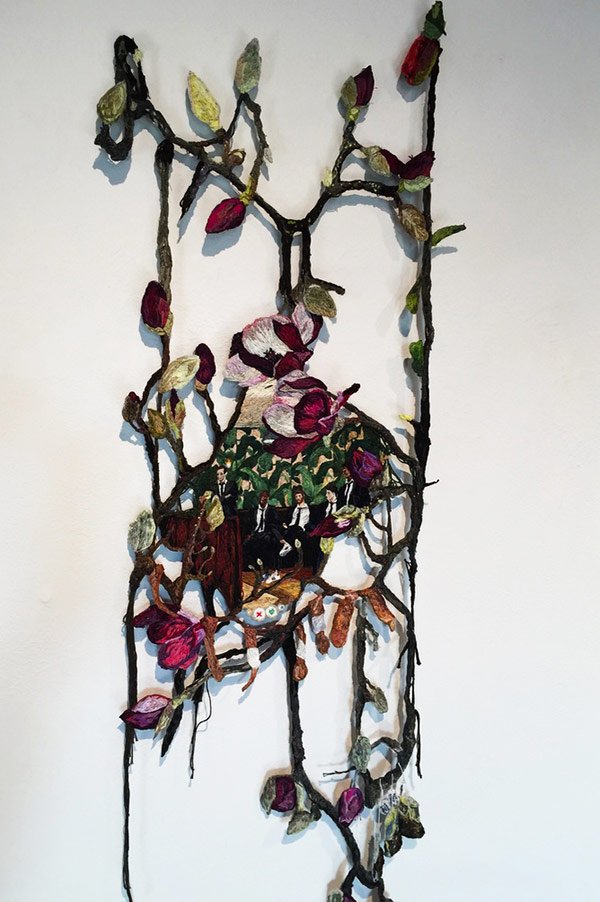
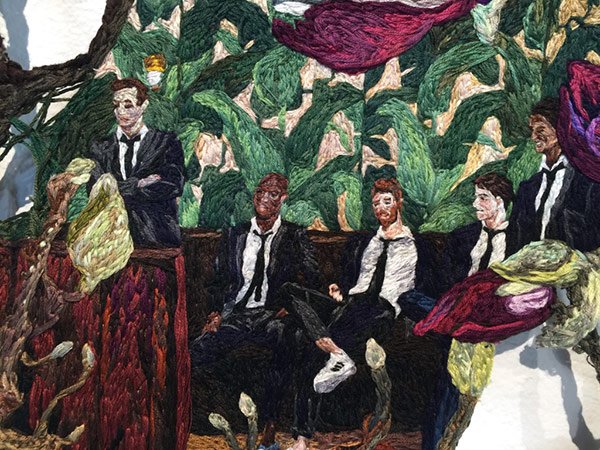
Her works have vivid color and intricate details. The level of detail on such relatively small-sized works is astonishing.
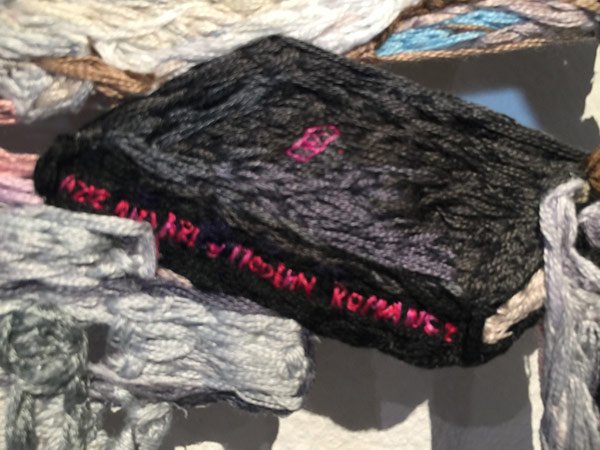
Narett’s works are very expressive. You don’t get the full benefit of the extent of her creative skills unless you take a closer look at each piece to see the details.
See more of Sophia Narrette’s work.
That’s it with my review of Intimate Threads: Drawing with Threads at the Hunterdon Art Museum. Go and see it before the exhibition is taken down.
at Exhibition at Hunterdon Art MuseumHunterdon Art Museum
Warmest Regards,
Related Post:
Intimate Lines: Drawing with Thread Part1
SaveSave
Intimate Lines – Drawing with Thread is a wonderful exhibition of thread art by some 16 talented artists. When I saw the promotion online, I knew I was going to go see this exhibition because of my interest in thread sketching. So, I traveled to Clinton, New Jersey to see the exhibit and I’m going to share the experience with you in this post.
I spent a lot of time viewing the exhibit because I was enjoying the exhibit as well as recording it in detail so I could share it with you all. By the time I was through with the show, I was truly wiped and I couldn’t see the other exhibits currently on display in the museum. If you’re really interested in this art form – drawing with thread – I encourage you to go see it for yourself if you can. It is truly worth it.
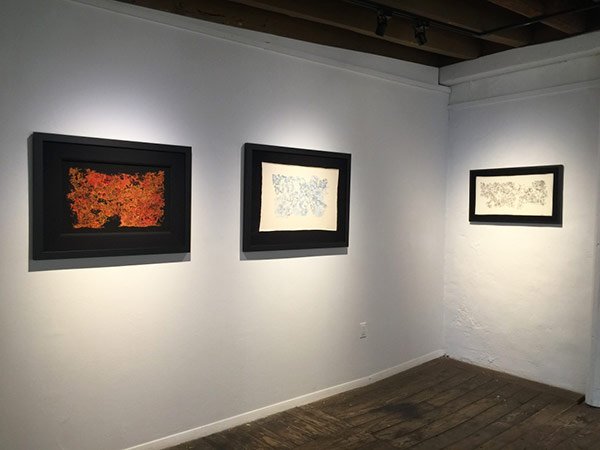
So let’s get started.
Intimate Lines – Paul Nosa
Paul Nosa works on a solar-powered sewing machine to draw on fabric. He designed this machine himself which is attached to a bicycle. 10 minutes of biking gives him 1 hour of sewing power.

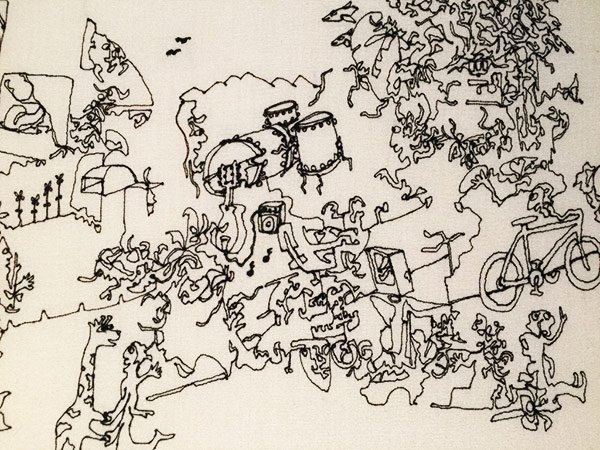
From a distance, his work looks like abstract art. But on closer examination, you see figures, shapes, people, animals, bicycles, and all kinds of realistic images in his work – all drawn with thread.
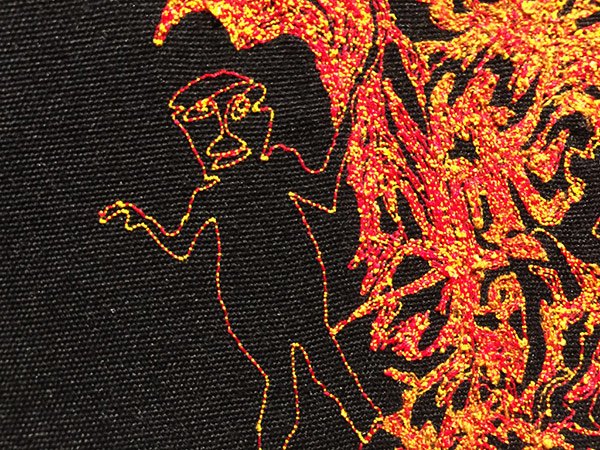
You should see him at work. It’s simply fascinating!!! He can even spell and draw words backwards. What I noticed about his sewing machine is that he doesn’t use a presser foot when he’s drawing, which makes absolute sense to me.
But I wonder how it’ll work on a regular sewing machine. Nosa uses a commercial grade sewing machine. He used a Singer CG 590 sewing machine to engineer his “Solar Sewing Rover”.
See more of Paul Nosa’s work.
Next, let’s take a look at the work of Mark Newport
Intimate Lines – Mark Newport
Mark Newport is an accomplished artist and the head of the Fiber Department of Cranbrook Academy of Art.
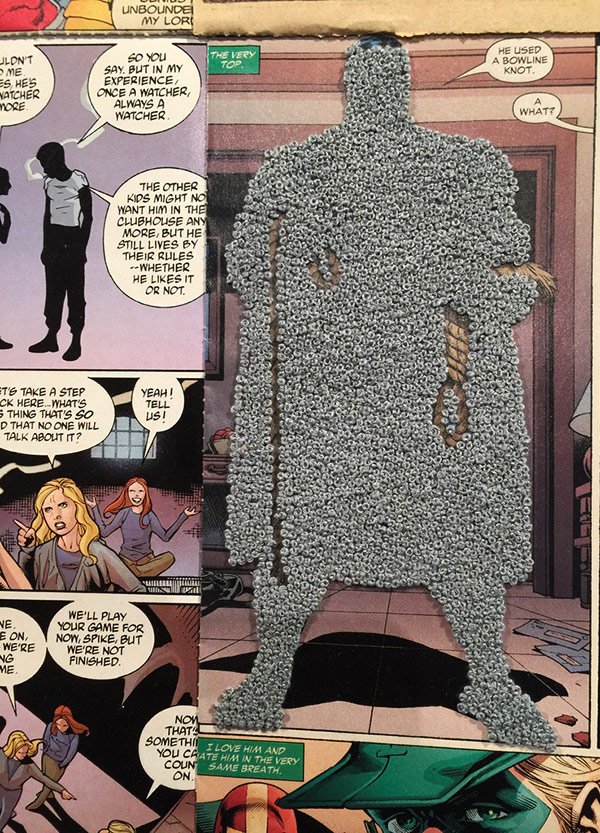
His artworks which were on display at the Intimate Lines Exhibit in Hunterdon Museum are part of a series called the “Freedom Bedcover Series / Sampler Series Series”.
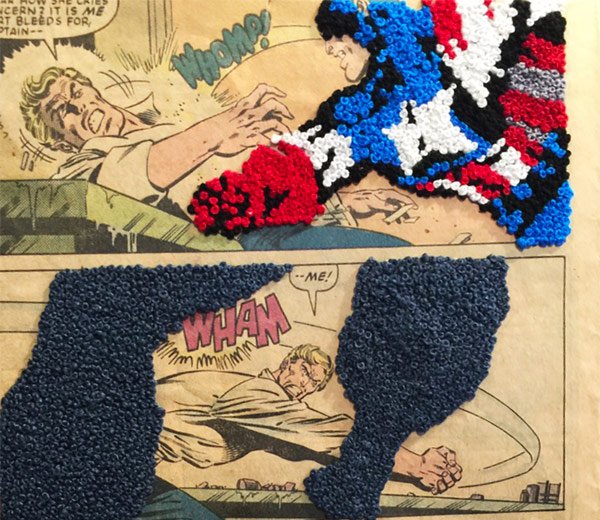
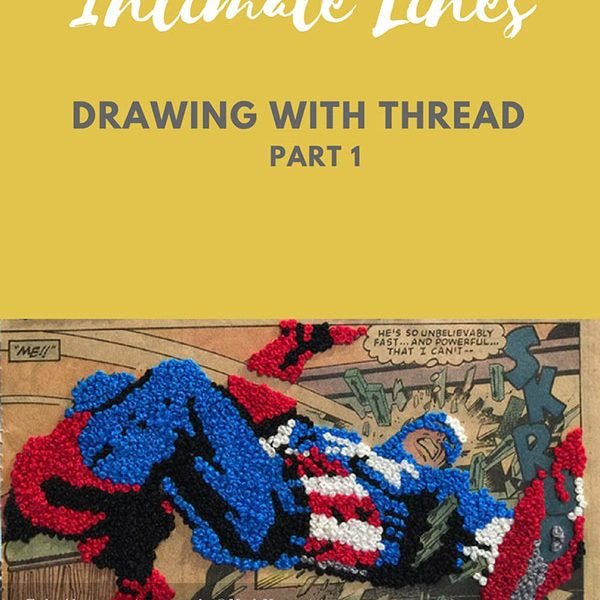
This is how he explains this series. The Freedom Bedcover is based on quilts given to a young man as he attains adulthood and social and economic independence from his father. He created the Sampler Series by hand embroidering on cartoon book covers. My youngest son was so happy to see the superheroes in Newport’s works. He could easily identify each one of them.
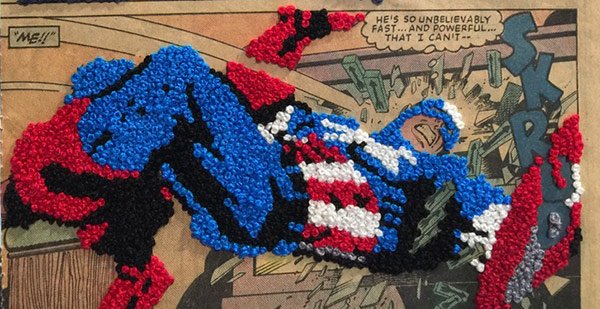
I really liked two things about his work. I liked that he was using a narrative that already existed in terms of cartoon stories which people could easily identify with. And I loved that he was sewing on paper, something I’ve been admiring for a while. Although he used hand embroidering, he challenged me to figure out how to do machine stitching on paper.
See more of Mark Newport’s work.
Intimate Lines – Richard Saja
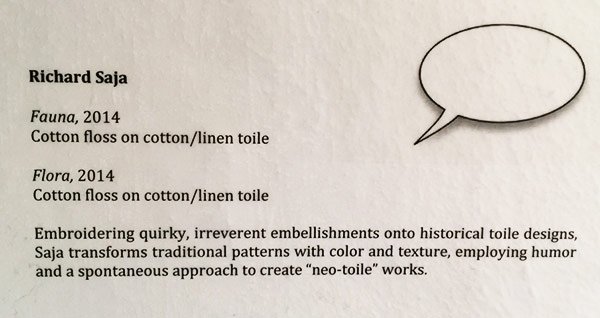
Richard Saja just like Mark Newport is an artist who doesn’t start with a blank canvas. His canvas is the fabric toile.
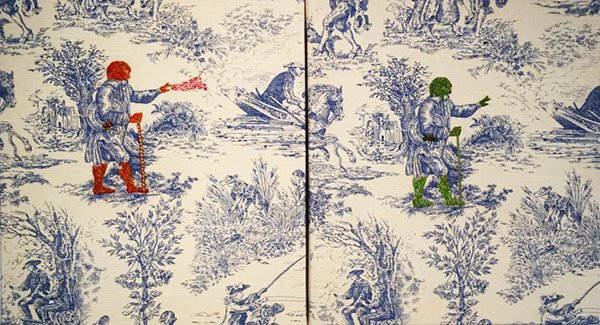
A piece of toile fabric features a printed design depicting a scene or activity of some kind. But “toile” is a French word which means canvas. So it makes perfect sense that Saja uses toile as his canvas.
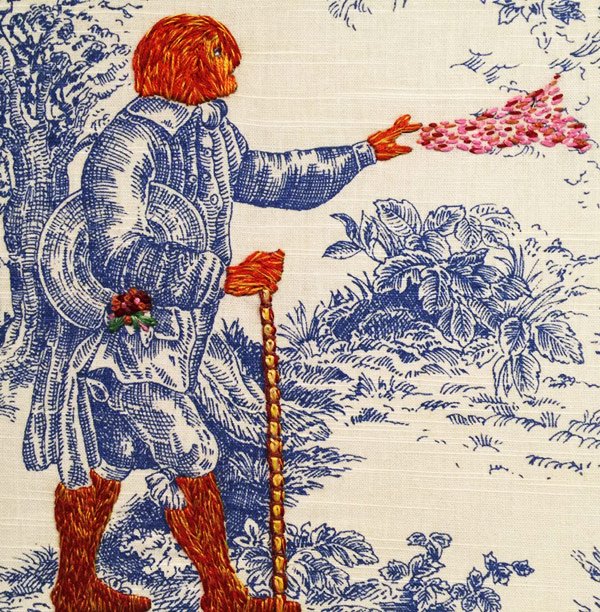
He uses cotton floss to embroider the images and scenes on toile fabrics. He describes his embroidery as “quirky, irreverent embellishments”
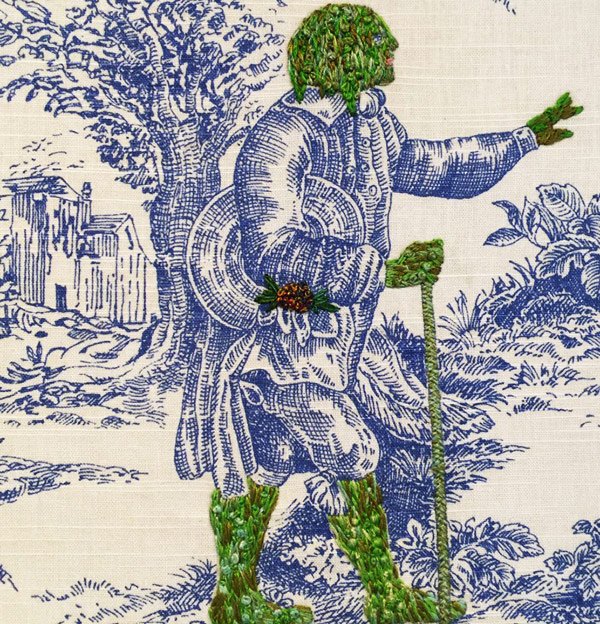
Learn more about Richard Saja’s work.
Intimate Lines – Melisa Zexter
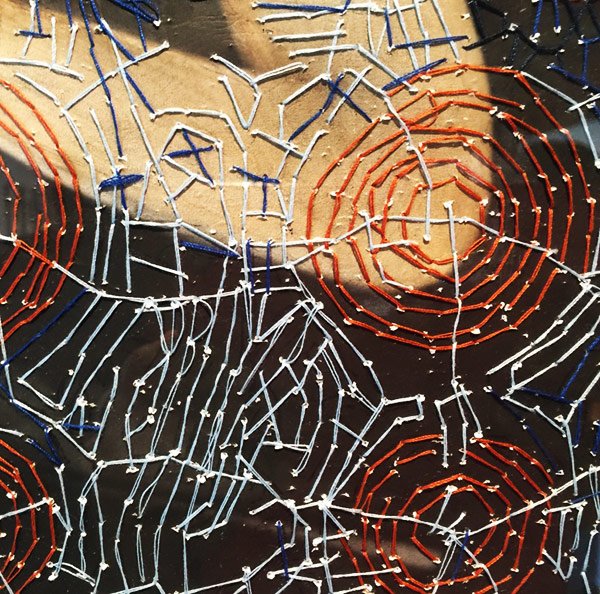
Melisa Zexter uses photographs as her canvas. She combines her photography with embroidery. She hand sews stitches on the photos to intensify the images in them.
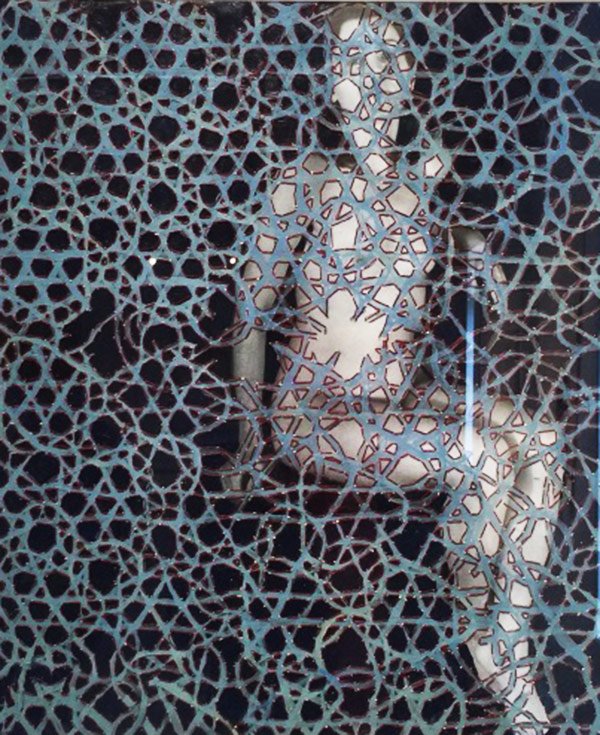
Unlike the other artists we’ve looked at in this exhibition, Melissa doesn’t embroider the details of the images in her photographs. Rather, she creates an intricate network of stitches “on top” of the entire surface of her photographs. This adds a separate “framework” on top of the original photo – a very interesting concept.
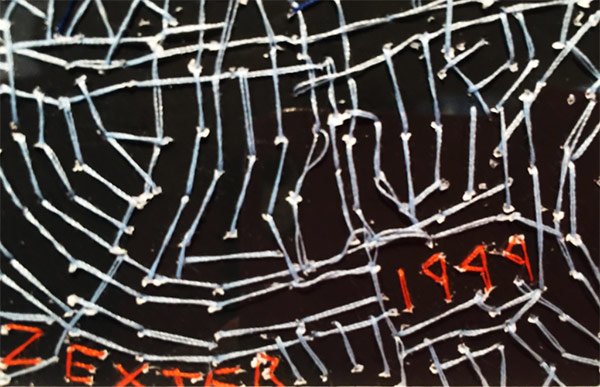
It’s as though Zexter wants to leave her photographs untouched while at the same time, she uses them as a background to tell a story which cannot be told without their presence in the scene.
Learn more about Melissa Zexter’s work.
I could go on and on to show you more of the work in this great exhibit. This exhibition is a wonderful testimony to the excellent talents available in this art form – drawing with thread. However, I’m going to give you a chance to enjoy this first part and I’ll come back with the part 2 later.
Finally, let me know what you think about this exhibit. It’s absolutely fabulous. And if you can, don’t forget to check it out. It’s ongoing until January 7, 2018, at the Hunterdon Art Museum in Clinton, New Jersey.
Chat soon.
Related Post:
Intimate Lines: Drawing with Threads (Part 2)
A Visit to the Mattatuck Museum
I had a fantastic trip to the Mattatuck Museum in Waterbury last Saturday. This was the second weekend in a row that I’d been to the Matt.
There were four exhibits on view and I had an art group meeting with my Connecticut friends from SAQA at the Mattatuck Museum.
SAQA Meeting at the Mattatuck Museum
I made a short presentation to my group about our upcoming Inspired by Science Exhibition. I encouraged members to create and submit their works and answered a few questions. After our meeting, we got a tour of all four shows, which was wond-er-ful.
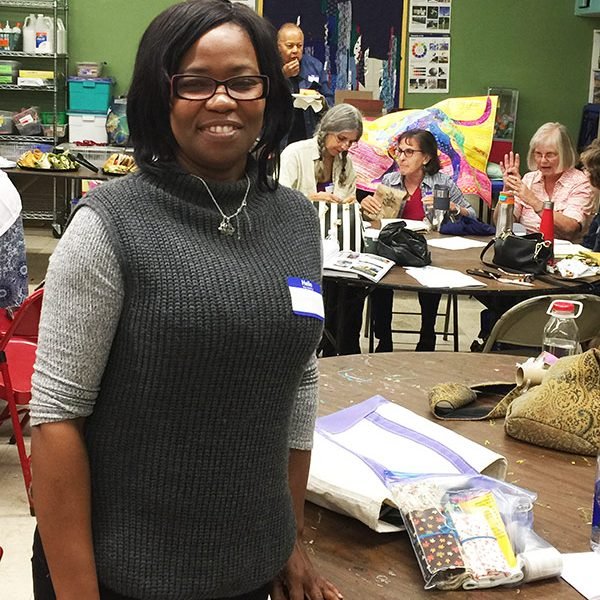
Some artists often struggle with how to get inspired in order to create new work. And I like to say that inspiration is every where. But one of the specific ways to get inspired is so obvious I wonder how anyone can miss it. To get inspired just look at other people’s work. Simple!!!
I had an awesome time at the Mattatuck Museum. As I was looking at the artworks I was also thinking about ways in which I could translate some of them into textiles.
Winslow Homer’s Exhibition at the Mattatuck Museum
One exhibit, in particular, was interesting to me in the sense that I could easily see how that would work in my style. It was Winslow Homer’s engravings.
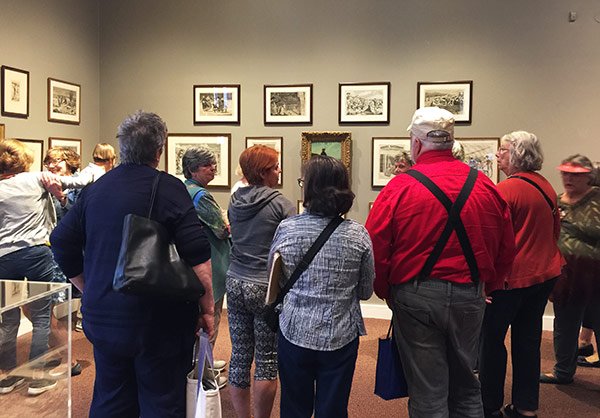
Although Homer is mostly known for his oil and water color paintings, earlier in his life he took to printmaking and engravings.
To create the engravings, he drew on wooden blocks and then all the areas between the lines were carefully cut out to make the lines themselves stand out in relief. This then becomes a wood block/stamp used in printing copies of his drawings, mostly in newspapers.
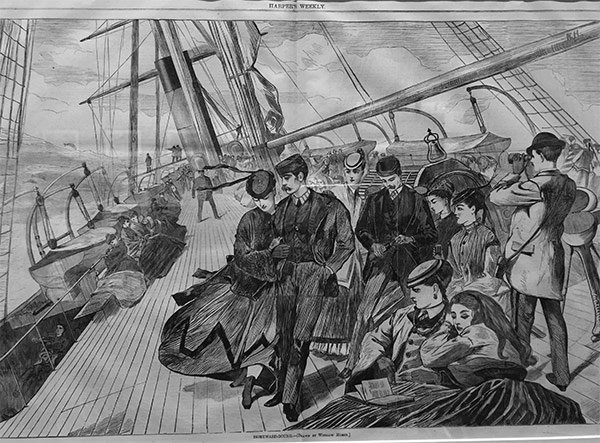
The repeated straight lines looked like my stitch lines and I thought to myself, “that’s something I can do with thread”. So, I wasn’t surprised when one of my SAQA friends found me studying a Homer engraving said, “wow, that looks like the kind of work you do.”
Dmitri Wright’s Exhibition at the Mattatuck Museum
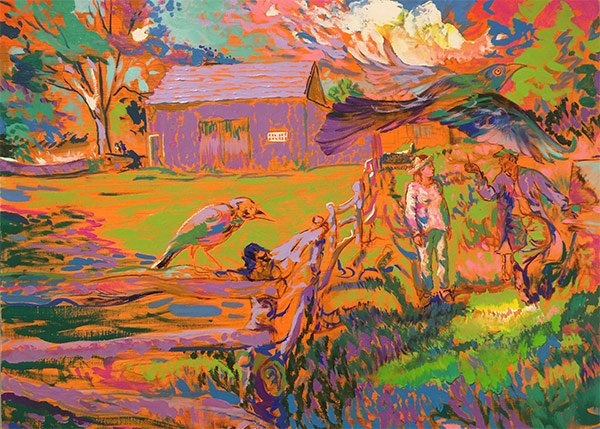
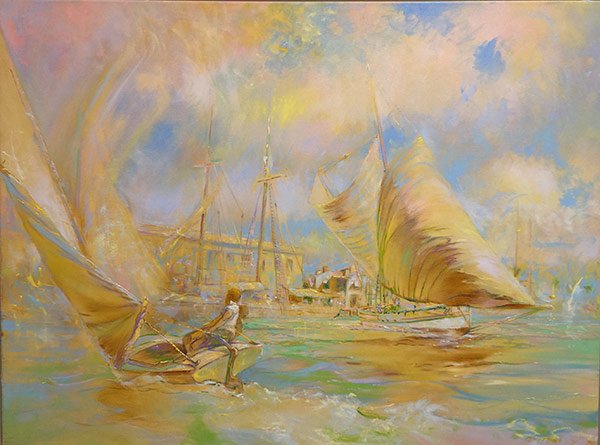
Another exhibition that I enjoyed at the Mattatuck Museum, was Dmitri Wright’s which was located on the second floor of the Matt. Wright’s was a retrospective of a lot of the work he’d done over his art career.
Some of the pieces were on loan from collectors while others were supplied by the artist himself. He uses a bright color palette which elicits joy and excitement.
Although I love Dmitri’s bright color palette, I was most intrigued by one of his pieces called, “Nocture”. It was contrary to his signature bright color.This color scheme was very dark, mostly dark blues, but it had a presence around it that was just engulfing.
Important Observations from The Mattatuck Museum
I made two important observations from both the Homer Exhibit and the Wright exhibition at the Mattatuck Museum.
It Takes Practice to Find Your Voice
The first was that with all the talk about finding your voice as an artist and sticking to it, the retrospective of these two artists show that they both worked on different things prior to finding the voices for which they were eventually known for.
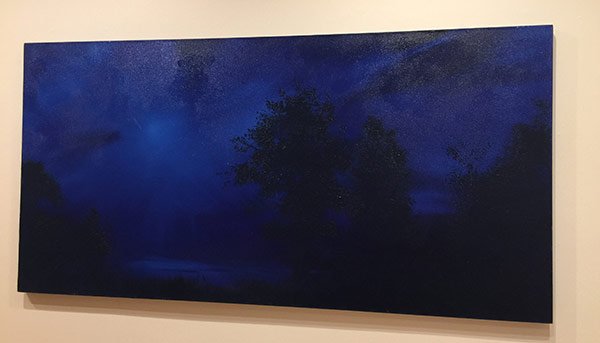
It Takes Time to Find Your Voice
Secondly, I noticed that it took at least 10 years for each artist to dabble in different techniques until they found the voices for which they’ll later be remembered.
I think these are two very important observations which should be helpful to anyone who is still on their path of discovering their voices.
In his early career, Winslow Homer created engravings and later paintings. Early in Wright’s life he painted portraits and some stills. But later, he focused on landscapes in the impressionist style.
Wright is a poet in addition to being a painter. Here’s one of his poems:
Dmitri Wright’s Poem
Painting with the eye simply makes one a camera
Painting with the intellect makes one a philosopher
Painting with the heart makes one a poet
Painting with the spirit touches the divine ~ Dmitri Wright
Wright’s writings also reminded me of the importance of keeping notes in your daily sketchbook practice.
The Makings of an Enthralling Museum Visit
I must admit that I was so enthralled with Wright’s paintings that the first time I saw the exhibit, I spent over an hour on the second floor just enjoying his works alone. Also, his writings, poems, and artist statements created a wonderfully engaging experience. When I stepped out of the door of the second-floor gallery, I suddenly realized I’d come back to reality.
It was so surreal. I’d never before felt this way seeing art. It’s the kind of feeling you get when you’re so engrossed in a fiction book. And then suddenly someone interrupts you and you realize you’re still sitting in a chair in a very familiar place and not in a scene in the book you’re reading. It was a good feeling.
This is explained in the Sept/Oct issue of Art New England, in an article entitled “Our Brains on Art: Neuroscientists Investigate“. In it, Emily Avery-Miller, the author, explains why museums should aim at engaging museum visitors on multiple senses because it makes for a better experience. I couldn’t agree with her more.
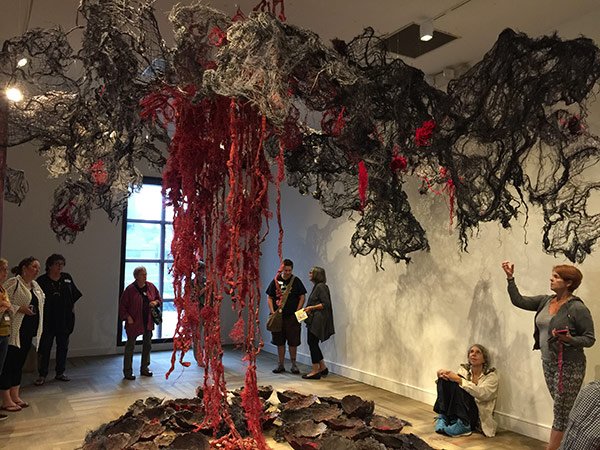
Now, let’s talk about the textile installation, which was the main reason for our SAQA meeting at the Mattatuck Museum. It is breathtaking.
In the last couple of years, I’ve been getting interested in textile installations. If you’re on my mailing list, you know I often find and showcase installation artists in my weekly notes.
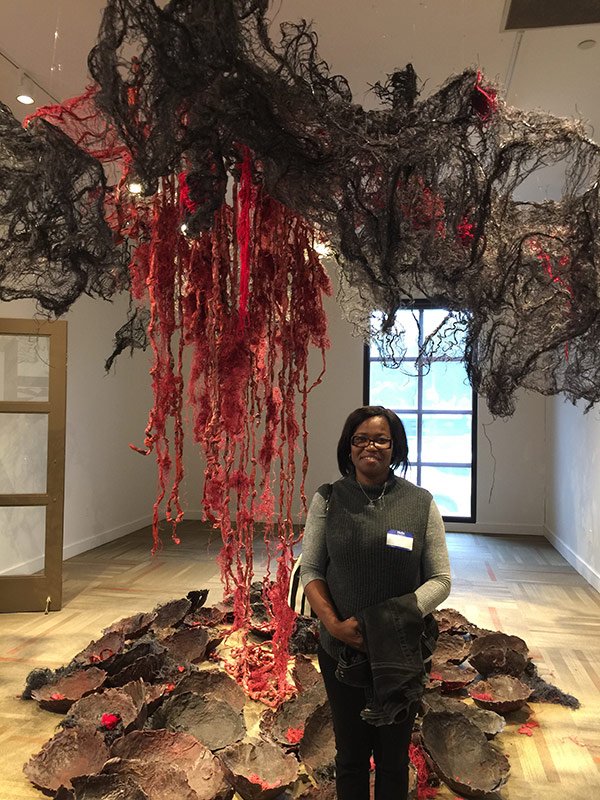
Nenne Okore’s Exhibit at the Mattatuck Museum
The artist for this installation is Nenne Okore. Nenne was born in Autralia, raised in Nigeria and now lives and works in Chicago. The title of her installation is “Ututu“. It is comprised of handmade paper, burlap, wax, dye, wire, and yarn.
Okore frays burlap and other fabrics. Then she dyes, stiffens and dries them for hours to create her installations. These time-consuming processes are reminiscent of many laborious women tasks which she encountered daily during her formative years in Nigeria.
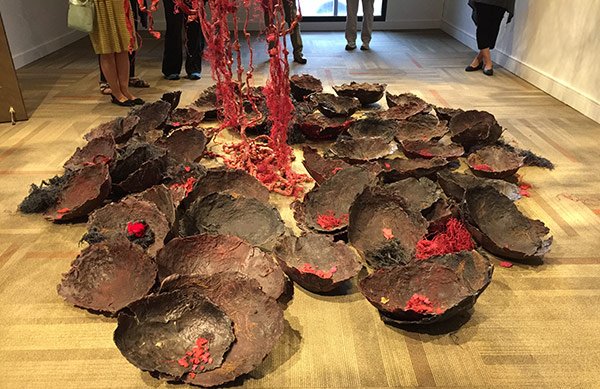
“Ututu“, the title of her installation means “morning”, or new beginning. The objects on the floor are belly castings from different stages of her two pregnancies.
To make serious work you have to be able to articulate what you are doing and why. ~ Joe Cunningham
The Undeniable Lesson to be Learned
To Create Engaging Works, You Must Articulate What You’re Doing and Why
That quote right there is what these three exhibits display. For each of them, there was a narrative articulating a storyline – the why behind the artworks. So that when you’re viewing the exhibit, you’re enjoying the exhibit on more than one level – not just visually.
By the time, I got to the fourth exhibit which was by the Valley Girls, I’d been so visually stimulated, I couldn’t take in much more.
I enjoyed two pieces of work in that exhibit. One was a paper collage which had been made from cutouts and a watercolor of colanders.
I must admit I may have missed some other great pieces in this exhibit because, by this time, I was visually exhausted and ready for a break.
All-in-all, it was a good day. A good time with friends and great artwork to see.
Warmest Regards,