
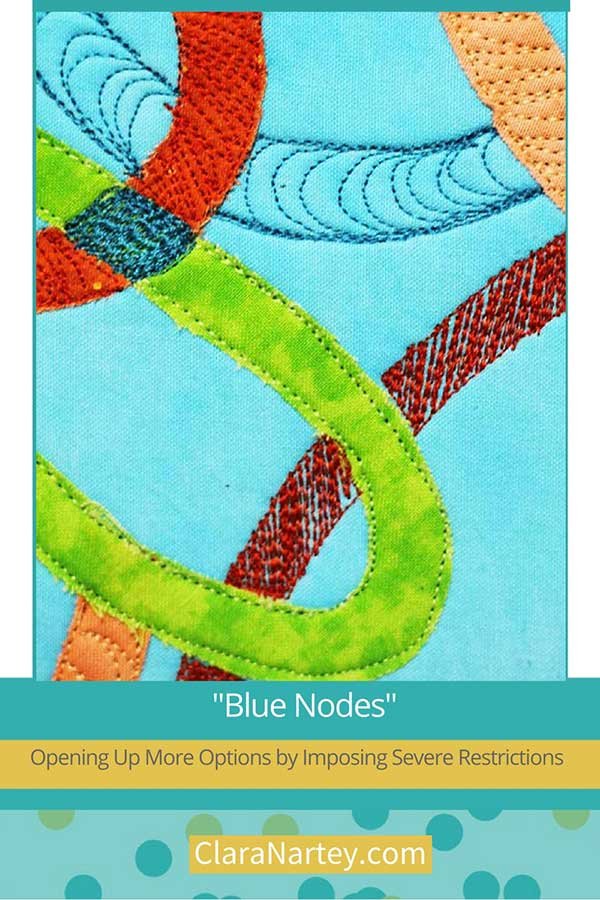
The year 2017’s first piece – “Blue Nodes”- is done. Woo hoo!!! I continued with my Circular Blocks series from last year here. This time I went back to using a different color other than black as my background. As you’ll notice, I’m using a color scheme that you might recognize from some of my earlier work.
Refine, Repeat, and Reorganize
In the final pieces of this series, what I’m trying to do is to “tighten” the parameters with which I work. I’ve explored a lot of angles in this series and I feel like it’s time to refine, repeat, and reorganize the last few pieces to more clearly fit into a recognizable pattern. So “Blue nodes” begins this effort.
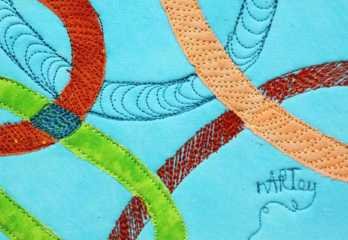
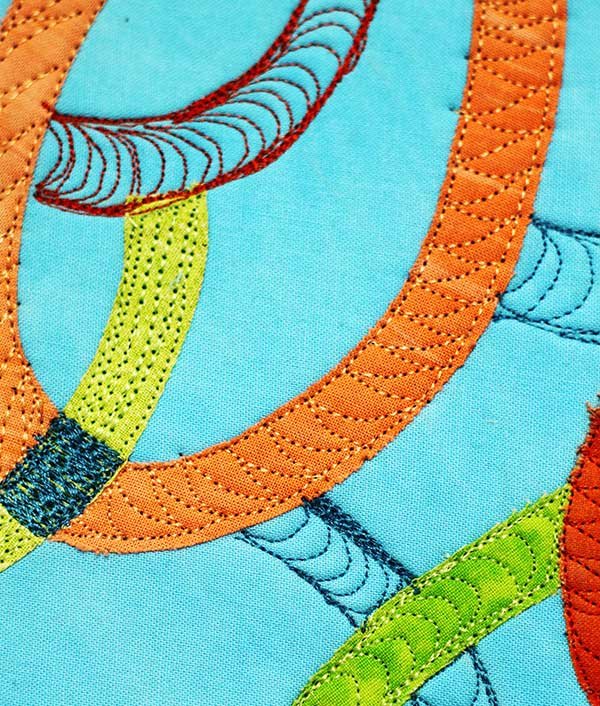
In that vain of “fitting into a recognizable pattern” – as all work in a series should – I repeated the circular block shapes. And I used a variety of thread sketching techniques to add texture and interest to the piece.
I’m still not quite satisfied that I achieved my aim of keeping these last pieces very simple. I do like a minimalistic look. And I often try and shoot for that in some of the abstract work that I create. But until now, I haven’t quite hit it yet.
Why Would You Want to Work in A Series?
Thankfully, I’m working in a series and this is where one of my favorite benefits of working in a series kicks in. That is, I get to refine, repeat, and reorganize my ideas in the next piece. So although, “Blue Nodes” didn’t quite make it in terms of a minimal design, the next piece might just do that.
And this might just answer the question that sometimes folks ask about working in a series. “How can you work on the same thing for a long time without getting bored?” I think it’s because every subsequent piece in the series, you’re trying to achieve something new. You’re trying to explore a different angle. Working in a series might seem limiting but it’s actually liberating.
This quote from the painter Chuck Close sums it up very well.
“When everything in the world was a possibility, I only tried three or four things over and over …once I decided I was going to have relatively severe limitations, everything opened up”
I’m looking forward to “everything opening up” as I limit myself by refining, repeating and reorganizing the basic elements in my design.
Your Turn
What new projects have you begun working on this year? Are you refining, repeating and reorganizing some stuff or are you starting completely new?
Warmest Regards,

Watch all the Thread Sketching Videos and Learn the Thread Sketching Tips & Techniques.
A negative space is the space that surrounds the subject in a piece of artwork. It’s easy to forget or ignore the negative space when designing artwork. And that’s exactly what I’d been doing for the past couple of weeks since I started working on the circular blocks series. I’ve been so intent on finding out different ways to present circles that I’ve completely ignored the negative space around them. So in this series, I set out to rectify that.
#1 Negative Space Idea
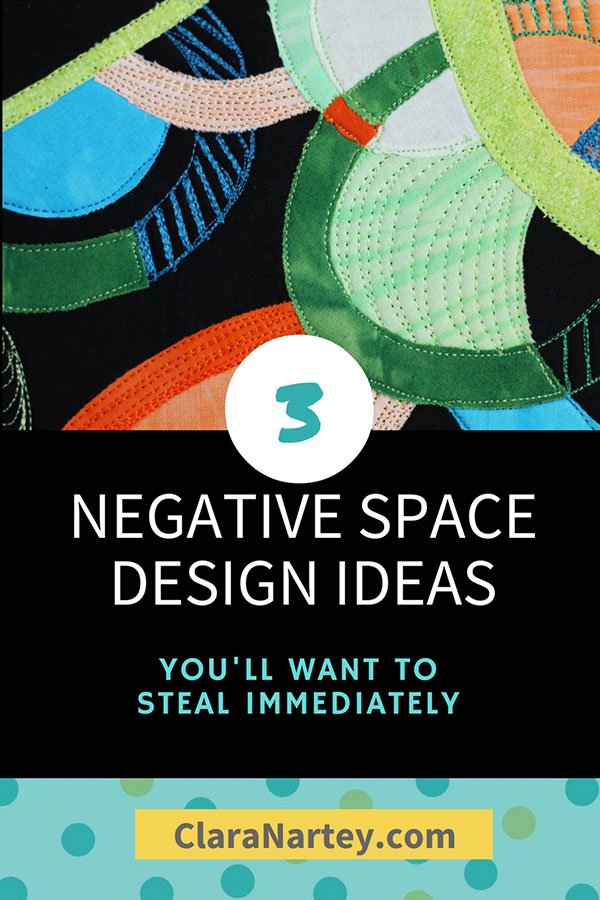
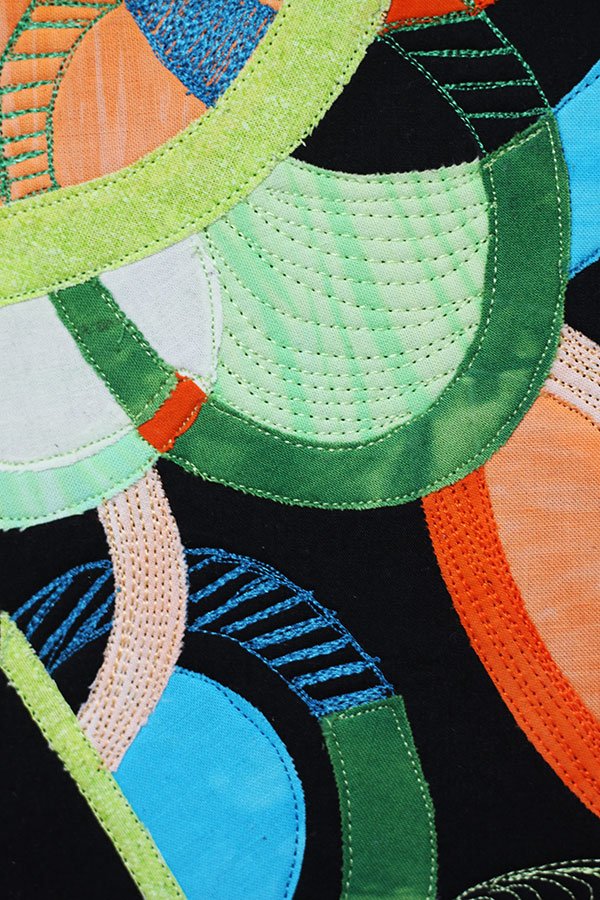
To achieve a more interesting design where the negative space is not an after -thought but, planned for and incorporated in the design, I chose to use different color fabric collages in the negative spaces. When previously, I’d have simply left them bare.
Highlighting the negative space in only certain areas and not everywhere in the entire piece really added some mystery and interest to the piece this time. I think that the reason, the negative space in this piece had such an impact is because the subject (circles) is predictable and you can easily follow their curvature with your eyes. However, with the negative spaces, you can never tell what you’ll get. The negative space that is created depends on the sizes, shapes, and arrangement of the shapes of the neighboring circles.
#2 Negative Space Idea
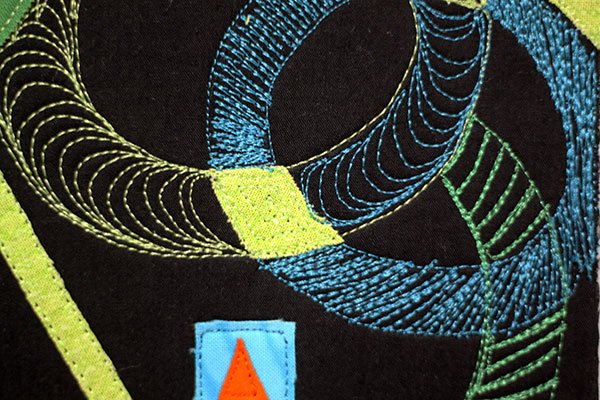
In the same vein of exploring negative spaces, I experimented with a shading technique which didn’t involve stitching closely together. Rather, I stitched thick parallel lines a little distance apart from each other. Thus allowing the space in between the lines to show and be part of the design. This in my opinion also worked well in adding interest to the design.
#3 Negative Space Idea
Finally, working along the same lines of focusing on negative spaces, I approached dividing the entire workspace differently. I allowed a lot of the background fabric to be left alone in the lower third of the piece. I used a narrow piece of fabric collage to form a diagonal line to add movement to that space and left that space entirely free of any art elements.
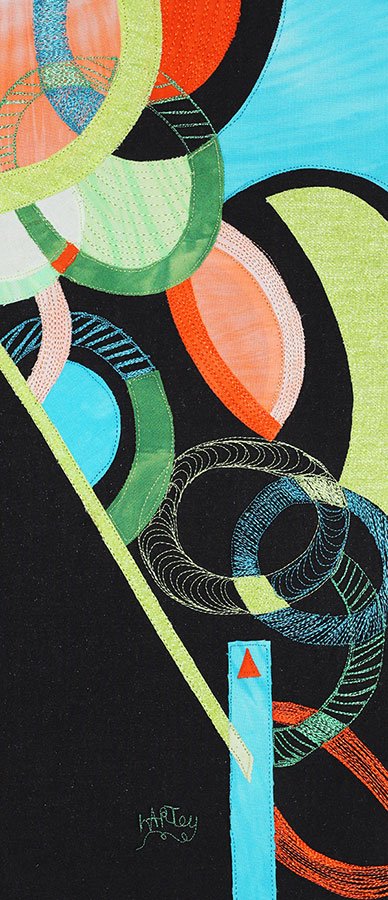
You’d notice that in this piece I did go back to one of my favorite color palettes – blue and orange. And let’s just say I wasn’t at all disappointed with my choice of colors.
I’ve got the video below for you to see how I stitched it all together.
Question: Have you considered focusing on negative spaces in your artwork?
Warmest Regards,
Watch all the Thread Sketching Videos and Learn the Thread Sketching Tips & Techniques.
Number 30!!! Yippee!!! Seriously, I really do need to spice it up a bit. I’ve been thinking design variety. You know, different ways to introduce some variety in my stitched drawings. Specifically, I’ve been looking at how to create pencil-like sketches with some color in them. That’s not to say, the stitched drawings without color I’ve previously created lacked design variety. I did incorporate design variety in those earlier pieces by doing things like varying values of thread colors and stitch density.
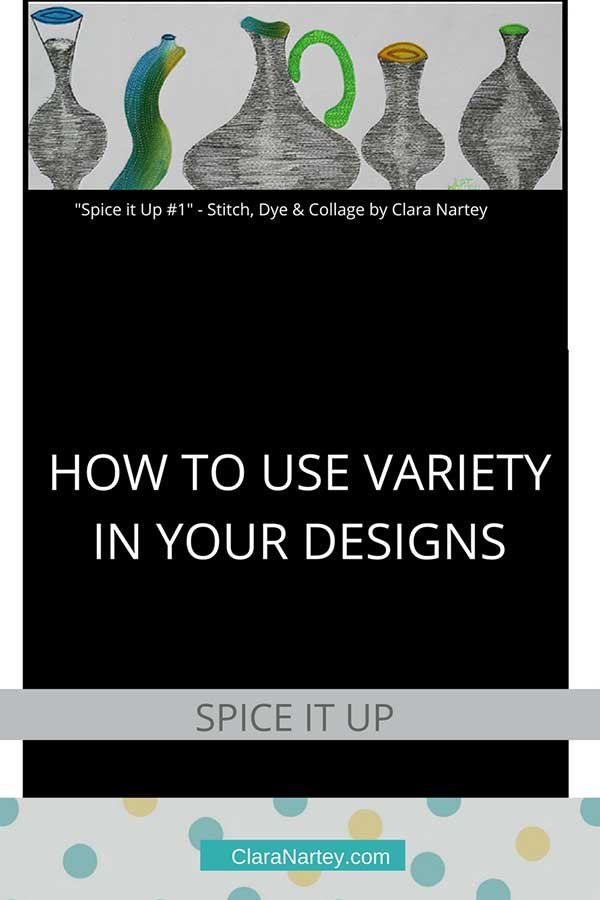
But I think it’s time to bring it up a notch. If you noticed, starting in episode 27, I began to introduce color to the black and white stitched drawings. I’ve been exploring that angle somewhat. So this episode is all about introducing color to my black and white stitched drawings.
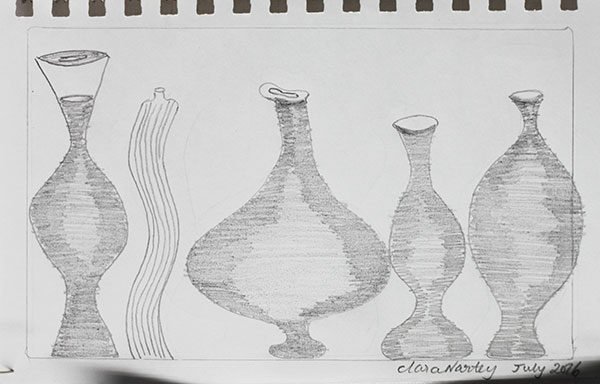
I started with this pencil sketch. As you know, I like to draw in pencil before fabric because it offers many benefits, including the opportunity to learn the details of my drawing. The sketch is not of any realistic scene. It’s just a set of odd-shaped jars. It reminds me of the kind of assortment of shapes you’ll find in a spice cabinet. How very appropriate to be thinking spice cabinet when I want to spice up my stitched drawings.
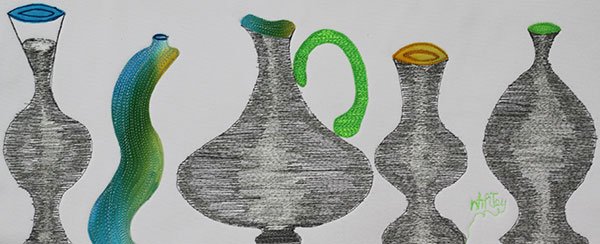
In recent days, I find myself thinking more design than technique. For the most part, I’ve figured out the technique of creating stitched drawings. Of course, there’s always something new to learn.But I find myself itching to go back to basics and to concentrate on what makes a strong composition.
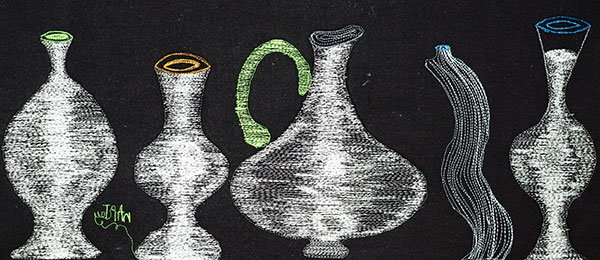
In that vain in the previous episode, I wrote about how I focused on design unity to create a stronger composition by using fewer rather than more colors. To spice it up in this design, I’m thinking design variety. The purpose of design variety is to add interest. So instead of using only greyscale thread colors, I’ve decided to color part of the design using both fabric and thread colors other than greyscale (specifically neon green)
I think I’ve managed to achieve a good balance between design variety and design unity. The similar shapes of the jars create unity in the piece and also, the predominantly greyscale color scheme reinforces this unity. Variety is achieved by the different heights and sizes of the jars. Shapes although similar, are not exactly the same, thus introducing another element of variety. Finally I used color to spice it up and take design variety up a notch.
Tips, Tools & Techniques: Design Variety
Design variety can be hard to achieve when you’re thinking design unity. They’re like opposite to each other. The way to achieve design variety without sacrificing unity is to keep some things constant, repeating them to create unity, while slightly varying a few things without breaking the unity. Breaking the unity will result in a confusing design. It’s a balancing act.
Elements You Can Vary to Create Design Variety (interest) in A Stitched Drawing
- Distance between stitch lines
- Thickness of stitches
- Values of Thread Colors (Have more values and less colors to balance unity)
- Color
- Shape (straight lines versus curved lines)
Questions: How have you used design variety in your work? Do you consider this principle when creating a piece of work? Share your thoughts below.
Warmest Regards,
Watch and read about the entire Stitch The Sketch series.
Design unity is one of the principles of design we seek to follow when creating artwork. Just as in general terms, the word unity means oneness, when we talk about design unity, we’re also talking about oneness or singleness in the design.
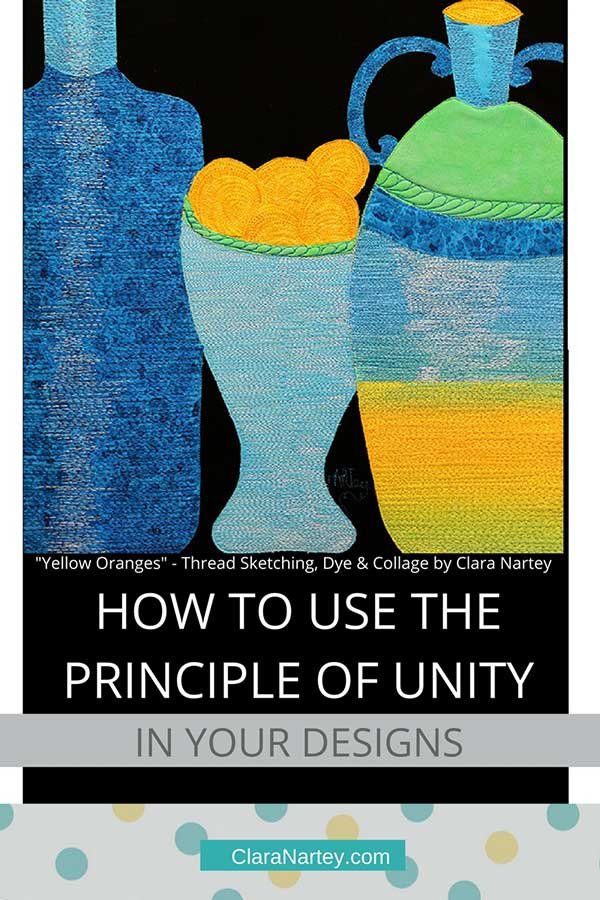
The different elements of the design should be working in harmony with each other. They shouldn’t be disparate or doing their own thing.

You can achieve design unity in a multitude of ways. One of the easiest ways to pull design pieces together or to unite them is by repetition. When you repeat a color, shape, or any other thing in your design, it creates design unity. That’s easier said than done though. As a creative person, when you have lots of “yummy”‘ fabrics and shiny threads it’s hard to repeat the same things when you can add some more design elements instead.
For this piece, I’d decided to use four colors – yellow, orange, blue and green. But as I proceeded to work, I realized that there weren’t many opportunities for me to include the color orange. This happened because I didn’t have a whole lot of small collage pieces. I had just a few large pieces. Since there were only a few pieces to work with, I couldn’t repeat each piece more than once or twice, thus making my piece lacking in design unity. The elements in my design weren’t in harmony with each other. Each one looked as though it was doing their own thing. There wasn’t a common thread between them.
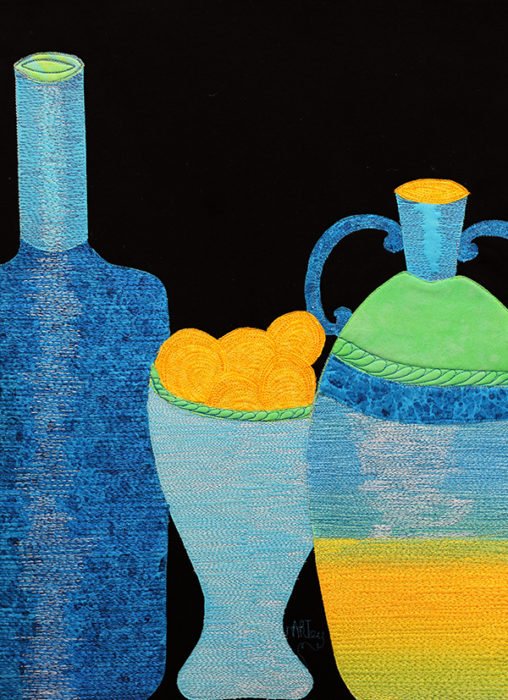
So I dropped one color. Yes, I had to let go of the color orange. I consolidated the collage pieces around the three remaining colors, making sure that each color had been repeated at least once. This way the piece was unified by color and design unity is achieved.
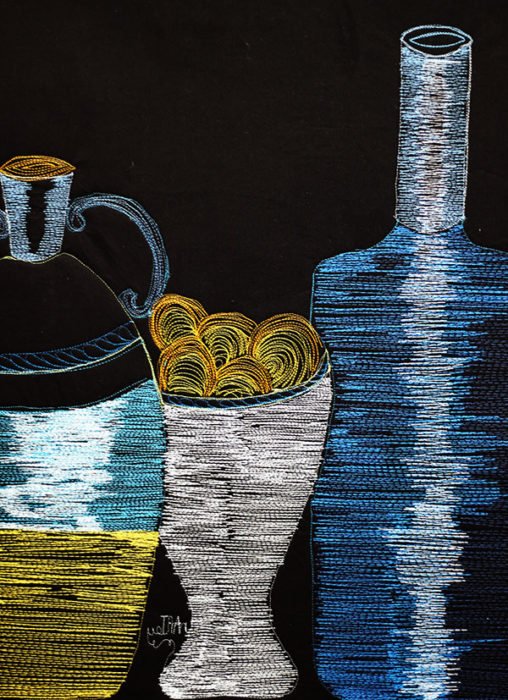
Design variety is another laudable goal to aim for in your work and sometimes it can seem to be at odds with the need to have design unity. The way I’ve discovered to balance these two principles of design is by exercising restraint. You should restrain variety (how many different elements you use) by increasing repetition, that way you satisfy both design unity and design variety.
VIDEO
Tips, Tools & Techniques: Design Unity
Check your design for consistency. When you find that variety of elements is getting out of hand, then design variety has taken over where design unity should be. What you should do is, limit variety (Different elements in your design) by increasing repetition of what you already have. This is when less becomes more. I know it’s tempting to add more design elements (fabrics, threads, beads, free motion stitching) but that doesn’t a great design composition make.
Question: Do you find yourself sometimes overdoing the number of things you add to your design? What have you done to combat that? Share your thoughts below.
Warmest Regards,
Watch and read about the entire Stitch The Sketch series.