
Challenge Yourself Daily
The other day, my son was watching Teen Titans Go on Cartoon Network as I sat in the couch working on my laptop. Little did I know I was about to learn some drawing tips from his TV show. But as I worked, I saw a guy come across the television screen. I mean a real guy, not one of the cartoons. So, I thought it was a commercial break but it wasn’t.
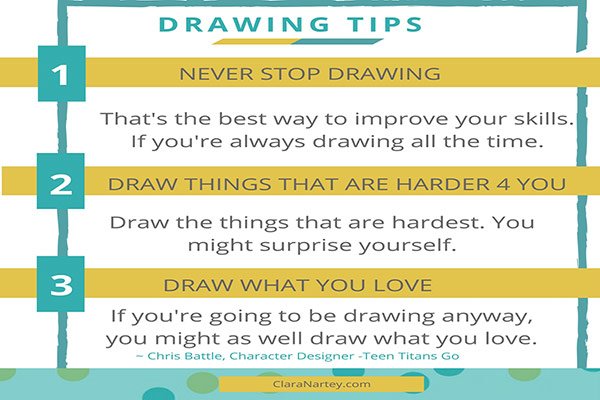
The guy was Chris Battle, the Character Designer for the cartoons – Teen Titans Go. He was showing the kids how he draws the cartoon characters in the show. At the end of his demo, he had three drawing tips for the kids on how to improve their drawing skills.
I wasn’t really paying attention to the show because I was working on my laptop. But when I heard him go through his drawing tips, that’s when I raised up my head and asked my son to rewind the television. I wanted to hear the drawing tips again. Because I thought they were great tips for all ages.
Chris Battle’s Drawing Tips
You can actually listen to him explain it here in this video. Start at the 1:23 – minute mark, if you aren’t interested in watching him draw his cartoons.
I made my son rewind and then play that clip several times. Because I wanted to write down both the drawing tips and the name of the character designer – Chris Battle.
But what I found really fascinating about his drawing tips was point number 2: –
Draw Things That Are Harder for You.
That certainly piqued my interest. I know the importance of challenging myself beyond my abilities. That’s why I took on my drawing with thread challenge.
But sometimes, knowing something doesn’t mean you always do it. Thus, every so often, we need to be reminded of what is important. And that’s what these drawing tips did for me.
In recent weeks, I’ve gone back to sketching regularly again. Yay!!! So, I’m doing what Chis Battle says in #1 of his drawing tips – Never stop drawing. Check.
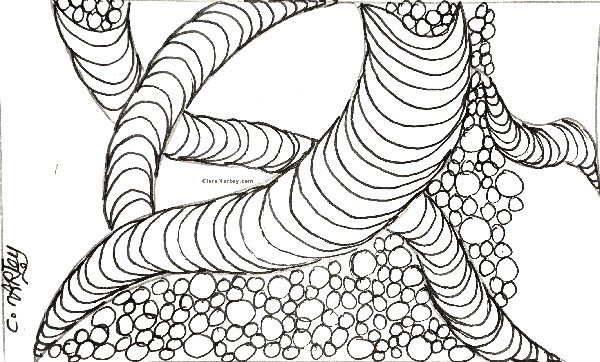
And I’m really loving drawing every day. I doodle simple shapes and make random marks most of the time. So, #3 of his drawing tips is also checked off for me.
But let’s take a closer look at drawing tip #2.
Draw things that are harder for you.
I’m not doing that enough.
3 Levels of Difficulty in my Sketching
Without having to think, I know off the top of my head what’s easiest for me to draw – needle doodles. I’ve drawn them for so long that I can do them with my eyes closed. Well, maybe not quite. But you get what I mean.
When I get tired of staring at a computer screen, I pick up my sketchbook and doodle. That’s how often I doodle. So it’s the easiest for me to do.
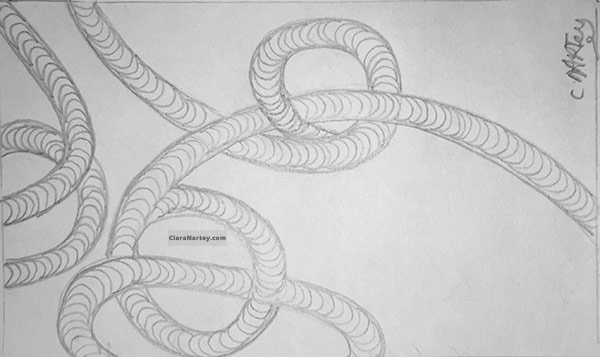
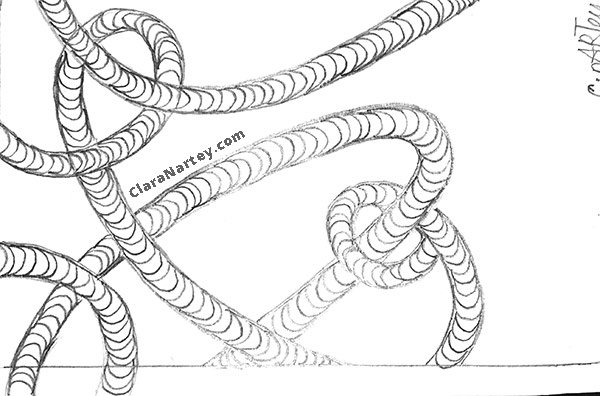
Next, to that, I find my abstract loopy loops more challenging. I love to do them but they’re not as easy as my needle doodles. It takes me some time to create a balanced composition. If I want to be intentional about drawing, I spend time creating loopy loops.
The next in difficulty are realistic drawings. I love to draw architecture, like the house I sketched last week and also, I like to draw the human hands. These two are really hard for me. And so, they give me the greatest satisfaction when I complete one of those drawings.
Do I do draw them enough? No!!! Why? Because they’re the hardest for me to draw.
After watching Chis Battle talk about his 3 drawing tips, I looked through my sketchbook (I didn’t need to look to know, but I did all the same) and I knew I should start drawing more buildings and hands.
I know the beginning of everything is hard. But it gets better with practice.
There are many reasons to challenge yourself daily. One of them being if you don’t challenge yourself you’ll not scratch the surface of what you’re capable of.
Three or four years ago, I didn’t know I could draw anything at all- not even needle doodles, loopy loops, let alone buildings and human hands. If after a few years of consistent sketchbook practice I can draw needle doodles and loopy loops so well, what will I be able to do if I challenged myself to practice drawing architecture and hands?
What will you be able to create if you challenged yourself daily?
Your Turn
When was the last time you checked to see if you’re challenging yourself enough? Let’s talk about it.
Warmest Regards,

There is Nothing Childish About Visual Storytelling:
Doodling, Sketching & Coloring

The other day, I came across this interesting piece of information and I thought to myself: who better to share this with than all of you here on the blog. This is what I discovered- Adult coloring books are on the rise!! Say what? Yes, adult coloring books are on the rise and two of the top ten selling books on Amazon (at the time of writing) are actually adult coloring books.
Let me just start by saying, I wasn’t even aware that there was a demand for adult drawing books. So to discover that they are so hot that bookstores can’t even keep up stocking their shelves was a surprise to me.

Most people are getting into doodling, coloring, drawing because it is relaxing and gets them to take a break from the electronics. Go figure!!

Doodling, drawing and creating all sorts of art is not for creatives only. They are very useful ways of keeping the brain active and sharp. Putting pen or pencil to paper (whether drawing or writing) helps us think. It can make you become fully aware of ideas, concepts, and emotions. It is a great tool for enhancing creative thinking.
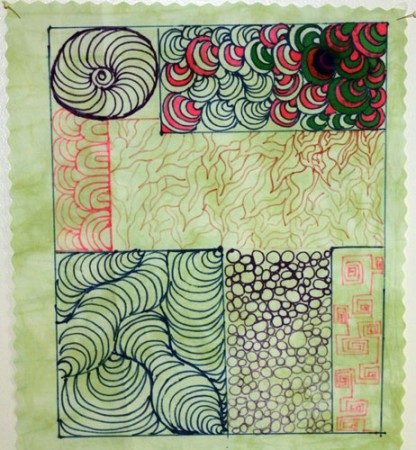
Looking back on how I learned to draw with the sewing machine, I see that doodling helped me a lot with practicing to stitch designs. I simulated stitching on a sewing machine, by doodling without picking up the pencil till the design was complete. Throughout his article, you’ll see some designs I doodled in my sketchbook and directly onto fabric.

Doodling Fosters Creative Thinking
Doodling, sketching, and coloring are different ways of creative thinking for adults and children alike. Sunni Brown is a woman on a mission to get adults to do more of that. She leads a “revolution” (her word, not mine) to get people to communicate more visually. Get this! Her focus is not on creative types- No way! It’s in corporate America because we all (creatives and non-creatives) need to think creatively. She teaches that there are significant connections between doodling and thinking, sketching and problem solving, and visual language and creativity.

Sunni argues that as children, no one teaches us to doodle and draw – it’s inborn. And then, when we go to school, we’re taught to forget that way of thinking to learn the new and unnatural way of thinking and communicating with alphabets and words.

Doesn’t she sound totally convincing? She does and so I’ve decided to embrace my doodling some more- not so much for creating art – just for thinking and expressing myself.
Your Turn
Are you doodling, sketching or coloring? Share your thoughts in the comments section below. As always, I love to hear what you’ve got to say.
Warmest Regards
