
I’m very excited to bring you another Business Interview. This time we have an artist who creates her work from an embroidery collage mixed with other materials. You’ll remember that recently, I was enamored with the work of another embroidery artist and how she frames her embroidery collages behind glass.
Well, our guest today – Laura Bundesen- also creates vivid works of art with embroidery floss and fabrics. Her current focus is on the human brain.
In this interview, Laura and I will be talking about:
- How she got started on her brain series and got involved with the neuroscience community
- The compelling reason why you should offer art prints for sale in addition to originals
- The difference between giclee art prints and digital art prints
- Laura’s 5 favorite tools and resources and her business tips to help you create your own art prints
Let’s get to it.
CN: Hi Laura, welcome to the Clara Nartey Blog. Thanks for accepting my invitation to come talk to us about your Art Print Business
LB: I’m very pleased to be here!
CN: Please tell us a little about your background and how you got into fiber art.
LB: I’ve had a love affair with fabric and thread for over 30 years.
I was the kid who embroidered all of her friend’s jean jackets in high school and my quilting mother taught me the art of crazy quilting when I was in college and gave me my first sewing machine.
I’ve been at it ever since. Over 20 years ago I developed the embroidered painting technique I still use now. It happened when I was working on a fully embroidered piece and couldn’t quite get the detail I wanted in a face. I picked up a paint brush and the rest is history.
Laura Bundensen’s Embroidery Collage Technique
CN: Laura, can you tell us more about your “embroidered painting technique” that you talk about? I figure you’re using embroidery threads and fabric scraps and adhering them together with spray adhesive. Are you also using paints? If so in what ways?
LB: First I lay down the basic brain image, using fabric scraps in an improvised collage directly onto artist canvas. A temporary spray fixative holds each piece in place.
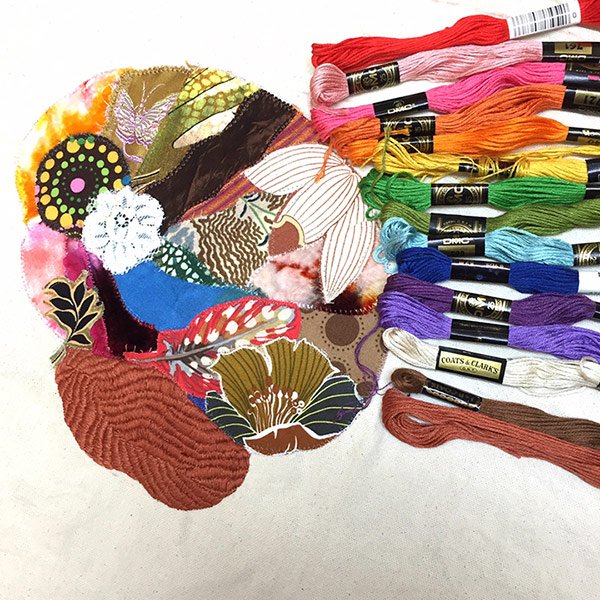
Next step is to machine stitch the fabric into place using an invisible thread.
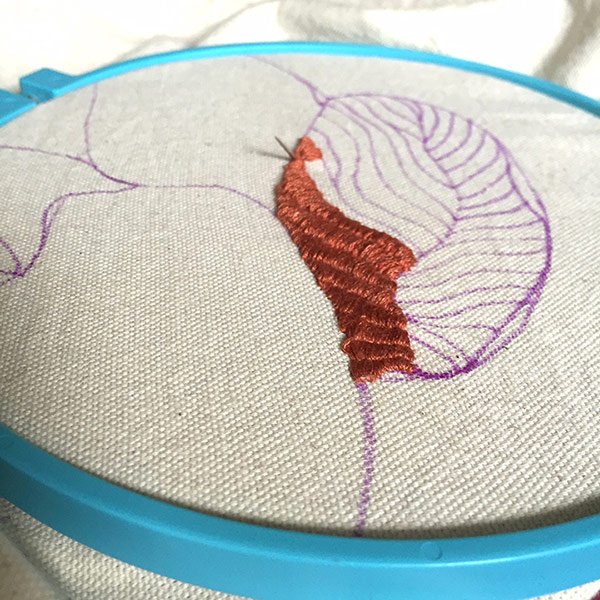
Then, I begin embellishing the brain by hand with embroidery thread, trims and sometimes I even add beads.
Once the brain is just the way I want it, I stretch the artist canvas onto stretcher bars and paint around the fiber work first laying down a gesso ground and then using acrylic paints.
Working around the fabric and thread requires a small brush and a steady hand. Most of my pieces are on gallery wrap stretcher bars with edges that are painted so they don’t need framing and are wired to hang in the back.
CN: Do you create 3D work or only 2D?
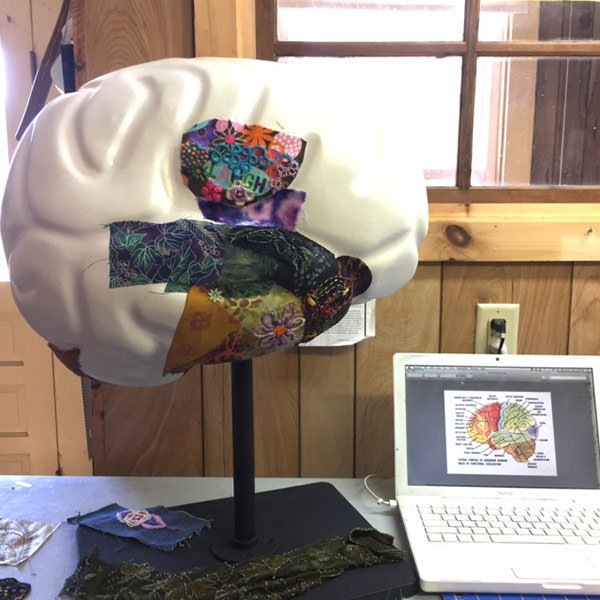
LB: Predominantly I make 2D Neuro art wall pieces. Occasionally I work in 3D, embroidering the fabric first before adhering it to a sculptural form using a permanent adhesive.
CN: Very fascinating!! I’ve seen some of your older work and they are beautiful. But when I look at your newer work, which is a series of brains, they make a much bolder statement. And they immediately make you stand out as a professional. My question is, what made you decide to work in this series?
How Laura Began Her Brain Series of Embroidery Collage
LB: I began the brain series almost accidentally. The first two were created for a fiber art invitational in a local gallery and I wanted to produce new work just for the show.
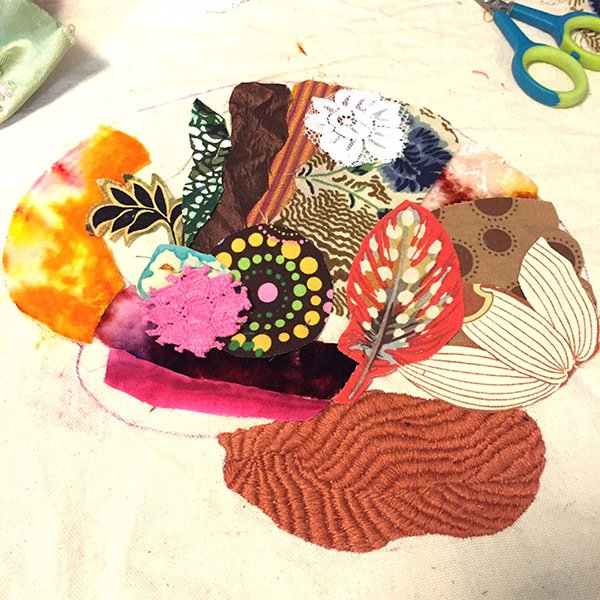
My boyfriend actually said “Have you ever thought about doing a brain?” and I went with it.
Soon after, I was commissioned to do another brain piece by a woman whose daughter had half of her brain removed when she was 11 in order to stop seizures that could not be controlled in any other way.
While working on these first three pieces I started researching the brain and how it functions and became fascinated with it. It really has been that and the response from the neuro community that has kept me working on this series.
I have a collector who is a pediatric neurosurgeon and I‘ve also sold to neuroscientists, neurologists, and individuals who are survivors of traumatic brain injury and brain cancer.
Hearing these people’s stories, and how my art inspires them really touches me and keeps me going.
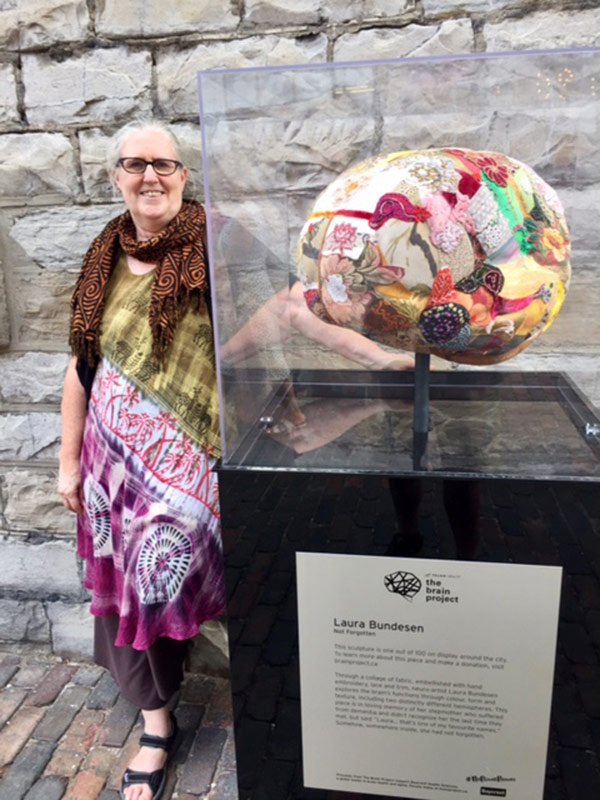
Most recently I’m participating in the Brain Project in Toronto. I’m one of 100 artists who created a brain sculpture that is on display on the streets of the city now through August 31st.
At the end of the show, the brains will be auctioned off in support of Alzheimer’s care and research. And, in November I will be participating in the Art of Neuroscience show hosted by the Society for Neuroscience at their annual conference in Washington DC with approximately 20,000 attendees.
Why Make Art Prints out of an Embroidery Collage
CN: I can see you’re now totally immersed in the neuroscience community. Oh, the places our art can take us. Very exciting, indeed!!!
Your original artwork is mixed – embroidery collage, fabric collage, and paint. But you create art prints of them for sale. Why did you decide to offer art prints of your originals?
LB: The handwork that is in every original piece is very time-consuming and because of that my originals have a high price point. Offering prints of the work allows a much broader audience to own and enjoy it.
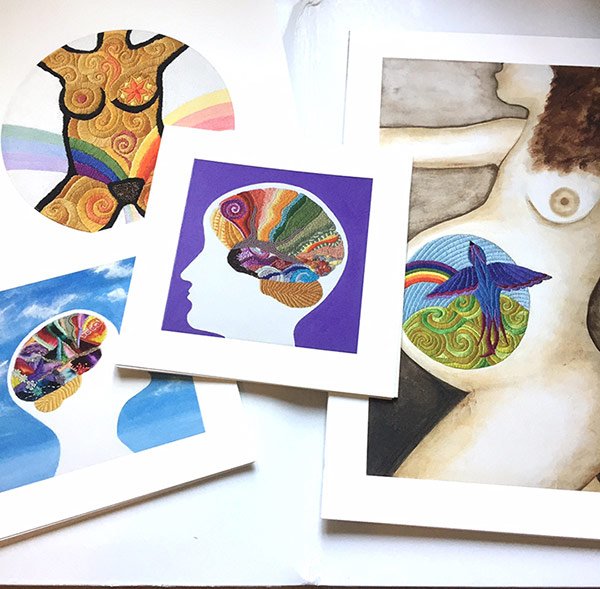
CN: I see you create limited editions of your prints. Why is it important not to sell as many reproductions of your original work as possible but to limit them to a specific number of reproductions?
LB: I limit the number of editions to create value for the purchaser and I sign each one and number it to record its place in the series. This also differentiates a limited edition from an image downloaded and printed from the internet, something artists need to be concerned about in the digital age.
CN: That’s a very important point. A signed copy is different from one that is downloaded and printed off the internet.
I see you use giclee printing for your reproductions. It’s a more expensive process than digital printing.
Why did you choose giclee over digital printing and can you explain to our readers what the differences are in these two types of printing?
The Differences Between Giclee and Digital Printing
LB: Generally, giclee prints are archival while digital prints are not – they use archival inks and archival papers and are usually printed from high-quality digital images.
I’d like to think my giclee prints will be around and bring joy to my customers for many decades and even generations.
CN: Laura, what is involved in creating your art prints? You must need a high-quality image to get a good reproduction. Do you hire a professional photographer or do you do it yourself?
LB: I use a professional photographer, John Polak. He is local to me and specializes in art photography.
Getting the best possible photograph to work with is especially important for fiber work so that the detail of the thread comes through.
Some print houses ask you to send them your original but I’ve never felt comfortable doing that so I went out of my way to find a local photographer. And, it’s always fun to watch him shoot.
CN: How did you ensure you’re going to get a high-quality printer? Did you request samples from different printers? Are you printing locally or online?
LB: I’ve tried several online giclee printers by ordering just a small number of prints the first time around to make sure I am happy with the printer’s job on my work.
I’ve been planning on trying out some local giclee printers too. And recently, I was extremely happy with an order of blank notecards I got from a local printer. And I was surprised that their price was competitive to online printers of notecards.
Pricing Art Prints
CN: Pricing is hard for a lot of artists. How do you price your art prints relative to your originals? Which of the two (originals or prints) do you find more lucrative?
LB: Yes, pricing is hard, especially for my originals, as the time-consuming hand embroidery means even small pieces can be expensive.
I actually keep my pricing for prints standard to size and presentation (not relative to the original piece) and it is also a reflection of the printing cost with a profit margin built in such that I can afford to offer them in a shop that will take 40-50% commission.
That usually translates to – The cost of print x4.
Making sure you capture the full cost of the print, including photography, shipping etc…is key.
Various Presentations for Art Prints
CN: Laura, since you just mentioned presentation, why don’t we delve into that? Are you selling your prints framed behind glass or unframed? And what’s your reasoning behind your choice?
LB: I mainly offer a canvas print and a framed paper print behind glass.
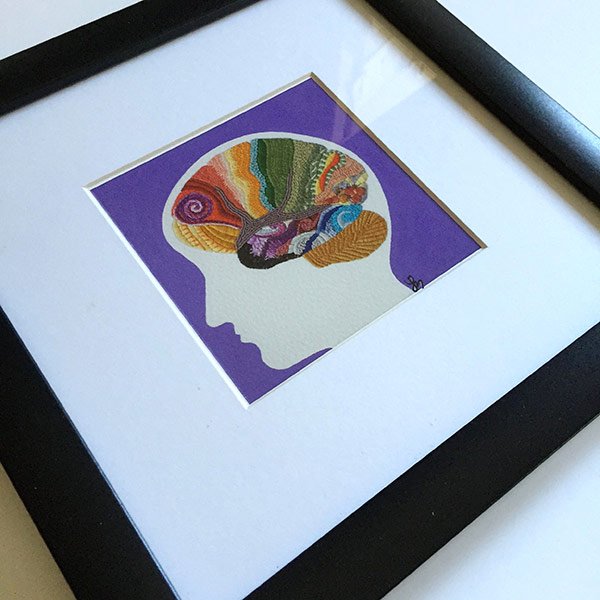
The canvas prints are the closest to replicating the original and I love the way the framed prints look.
Also, I can buy the frames at a bulk discount and the consumer ends up paying less than if they buy the giclee print and frame it themselves.
It also presents better in person at art shows. I usually keep some of the paper prints available to sell without the frame but I don’t heavily promote those or display them in a prominent place.
Laura, I ask every guest on this blog to share their favorite tools and resources with us. What are yours?
Laura Bundesen’s Favorites
- The Human Brain book by Rita Carter – fabulous information about all aspects of the brain plus great pictures! Laura you’re right! It’s got fantastic pictures. I actually own this book and the Human Body Book both by DK Publishing.
- Embroidery Pocket Guide a laminated pocket-size encyclopedia of the most popular stitches and much more – for inspiration when I get stuck or am looking for a perfect stitch for a certain area.
- Lots and lots of fabric donated to me by a bevy of quilter friends – I can use the smallest scraps!
- My large cutting mat, rotary cutting tool, fabric spray adhesive (no favorite brand) and Gutermann’s invisible sewing thread (that’s the only brand I use)
- Instagram – best social media platform for artists and a great place to make friends – find me @laurabundesen.
CN: Now, what’s your advice to someone who wants to start offering, prints of their original fiber artwork for sale?
Laura’s Business Tips
- Start engaging with people on social media, network and pay attention to what other artists in your sphere are doing and don’t be afraid to ask for help or advice.
- Think about what and how you are going to offer reproductions. You’ll need to decide about pricing, signing, limited runs, etc. before you offer the first print for sale.
- Find a GREAT photographer – not only will you not need to send your originals out but you can use the digital images you get back on social media and your website too – so think about the cost of a photographer in terms of investing in your brand/image/appeal.
- Set up internal record keeping for the number of prints sold and current inventory as well as costs, profit margins, etc.
- Start a mailing list if you don’t already have one – I love MailChimp – easy and free to start. Make sure you add to it at every opportunity including art shows, networking, online, etc… I try to send out a newsy email just once a month and my list grows every time I do an event. This gives me an avenue for sending out notices of new products that are available.
- Don’t order too many prints before you’ve tested the market. These days, you don’t need to order 100 prints up front for an edition of 100. As long as you do these things:
– keep track of the number you’ve sold,
– be careful with numbering the new ones and,
– stick to your original number of prints available.
CN: Laura, thanks for taking time to do this interview. I’m sure my readers have learned a lot from all that you’ve shared with us.
LB: My pleasure!
Finally,
To see the step-by-step process Laura uses to create her work, check out this blog post chronicling the process. To learn more about Laura, visit her main website.
Interview Highlights & Quotes
- I was the kid who embroidered all of her friend’s jean jackets in high school
- The canvas prints are the closest to replicating the original fiber artwork
- Don’t order too many prints before you’ve tested the market
- When it comes to pricing, making sure you capture the full cost of the print, including photography, shipping etc…is key.
Your Turn
What have you learned from Laura’s embroidery collage and mixed media art and her way of doing business? Share your thoughts in the comments below.
Warmest Regards,

I’m sure you’ll enjoy my other business interviews.
In this episode of Textile Art Business Interview, I’m happy to be joined by artist Dawn Allen. Dawn has a unique “techy” technique she uses to create digital art on fabric and on other surfaces. Today, I’ll be talking to Dawn about her business and her art prints in particular.
Here’s a look at what Dawn and I will be talking about in this interview:
- How raising a family affects your ability to create and build a creative business.
- The set of personal challenges which helped Dawn decide to make this her career
- The unique technique Dawn uses to create her digital drawings
- Dawn’s tips for successfully creating and selling art prints
- Links to Dawn’s favorite tools and resources (lots of techy tools you’ll love)
Let’s get down to it.
CN: Dawn, it’s my pleasure to have you here.
DA: Thanks for having me.
CN: Let’s start with an introduction. I’m sure everyone would like to know who you are. Can you tell us a little bit about yourself and how you became an artist?
DA: I have always loved color. My favorite toy when I was five was a box of crayons. I often didn’t even color with them, I would just spend hours arranging them in color families.
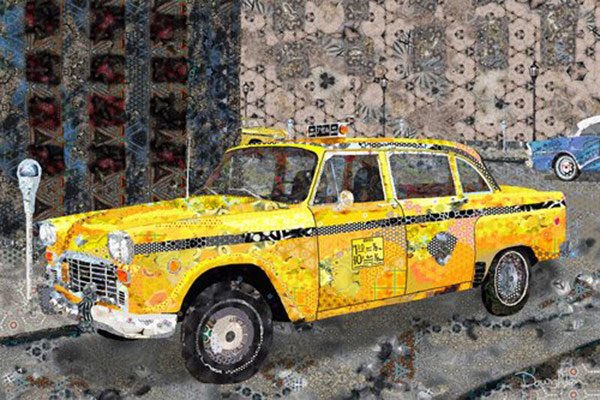
I can’t say when I became an artist because art is what I have filled my days with since I was young. I played with a few different mediums, and most recently my love is digital art and the combination of digital and fabric art.
Someone once said to me, “Art should make you think.” When I heard that I thought “No! I prefer art that makes me feel.”
Also, I think way too much, and sometimes I want a break. I want to look at my wall and see art that makes me feel happy. When I look at my finished pieces I feel joyful. Having bright colors and happy images on my walls and all around me is so wonderful.
In addition to being surrounded by beautiful art, I also live with a wonderful family- a husband and two daughters, plus a rabbit, 2 cats, 2 donkeys and 1 talented pony (she plays the piano- true story!).
CN: Oh wow! You’ve got a full house. What are some of the challenges you face as a mother of young children, running such a full household, creating art and growing a creative business?
DA: When they were really little, I had to find a way to fit art into the schedule of being with small children. For a few years I switched away from studio art into food art- because I had to feed my kids anyway- why not make it an art project. I ended up writing a cookbook with all of my recipes and food art
Then when they went to school I got back into the studio.
Now I face the challenge of time. And guilt- you know- the “Am I spending enough time with my kids” guilt.
CN: I know, Dawn. I’ve got three young ones of my own. I know about the guilt too. And you’re right. Time is a challenge for most of us creatives irrespective of our family situations. That’s why I wrote the FREE ebook “Shave Time Off to Create”. So that I can help creatives make time for their projects.
Facing such time constraints in your life, how could you possibly decide to switch from hobby-mode to career mode? It doesn’t sound like the thing that’ll come to the mind of a busy person.
DA: I started selling beaded jewelry when I was in high school. I think I never really accepted my art as a hobby- I always wanted it to be more. I wrote the cookbook and a couple of children’s books… and sold several hundred copies of each, but nothing to call a career.
In 2014, I was very sick and no one knew why. We eventually found out that I had a visual issue that was giving me the symptoms and I started to get better with glasses and vision therapy.
Everything was changing at that time with my vision and I felt really distressed about my art. It was then that I realized I needed to embrace the situation and make better art and really make a business out of it.
CN: That’s a truly inspiring story (fun fact: I also created and sold beaded jewelry after college).
So, Dawn the health difficulties you experienced in your life caused you to take a hard look at your art and your life. And to make a decision about which way you wanted to go.
I must say, I’m not surprised by that. Because I find that most creative business owners are able to identify a particular point in their lives where they made the decision to build a creative business. It always starts with a conscious decision.
So, apart from selling art prints, which we’ll be talking about a little later, what other income-generating activities do you use to grow your business?
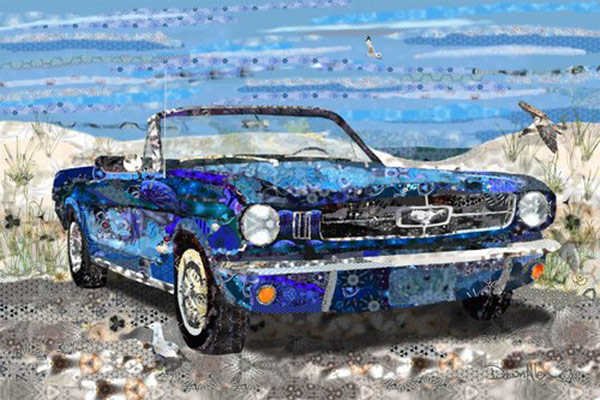
DA: Right now I am focusing on commissioned portraits of classic cars and pets. I do sell some of the art I made in the past two years before starting my current series. I have cookbooks, handbags, and small art quilts.
CN: Dawn, let’s dig deeper into the topic of selling art prints. Shall we? First things first. How do you create your digital art?
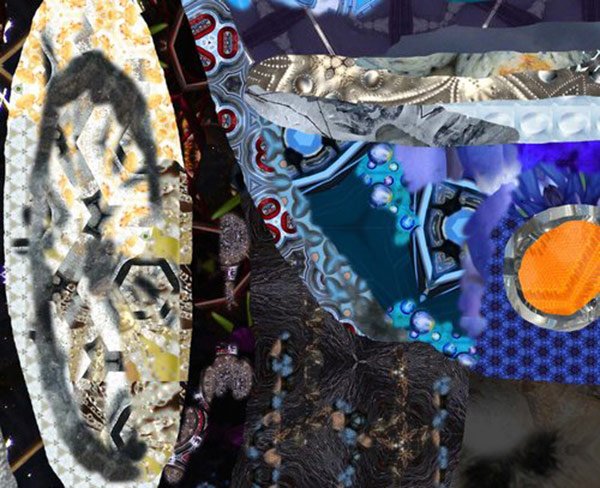
DA: I created a technique for drawing images that look like they have been made from fabrics. First, I create repeating patterns and save them in Photoshop. Then I use a stylus pen (on a Wacom pad) and using my pre-saved patterns, I draw pictures. When the pictures are finished and saved as a jpg I can print them on anything I want including, fabric, metal, t-shirts, mugs, photo paper, etc.
CN: Very creative!! It must be hard to decide since there are so many options available. How did you choose which printer to use for your art prints?
DA: A photographer recommended White House Printing and I also found Bay Photo by the recommendation of another photographer.
CN: Cool. Recommendations are always a good way to go. I love asking for recommendations and I read reviews a lot. What about surfaces to print your art on. Here also, there are so many options to choose from; ranging from canvas to different gallery-grade paper choices. How did you decide which materials to print on?
DA: I just went with what I like the look of- metal and metallic paper. The metal is my favorite- it looks a lot like a computer screen (my art is digital), so it looks like the “original”. The metallic paper is more affordable and beautiful with a shine as well.
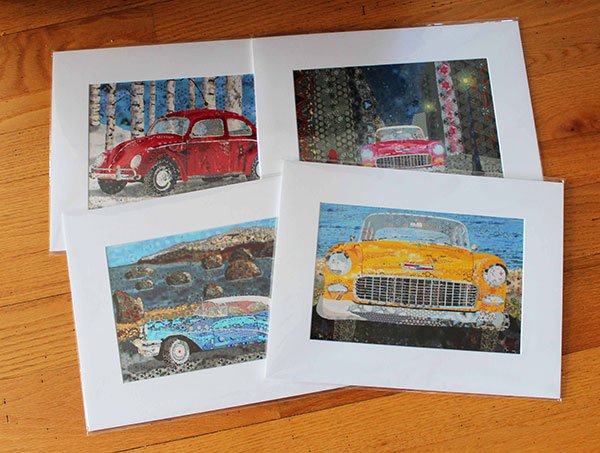
CN: Dawn, quality photos must be important for what you do. How do you prepare your images for good quality printing?
DA: I am a digital artist. My images are digital from start to finish so no preparation is needed. I just save my PSD file (PhotoShop Document) as a JPEG and I am good to go!
CN: Oh I see. So Photoshop – the photo editing software by Adobé – is your primary design tool. Neat!! That right there is the very definition of creativity – connecting the dots between seemingly unrelated things.
First, can you tell us how you came to connect digital drawing to fiber art? And how did you learn Photoshop? There must be a story there.
DA: I taught myself Photoshop when I wrote a few children’s books and while doing the layout for my cookbook. If I got stuck with something I would ask my computer savvy husband for help (although I think I know a little more Photoshop than he does now!) I had a desire to create my own fabric designs so Photoshop was a natural place to start. At first, I was drawing on fabric pattern but then I got the idea to combine the repeating patterns into pictures on Photoshop then print them on whole cloths to quilt.
CN: Very fascinating!! So, what are your suggestions for creating art prints?
DA: Well, if you are photographing or scanning original pieces to then print, I would start with a professional to help get good quality jpegs.
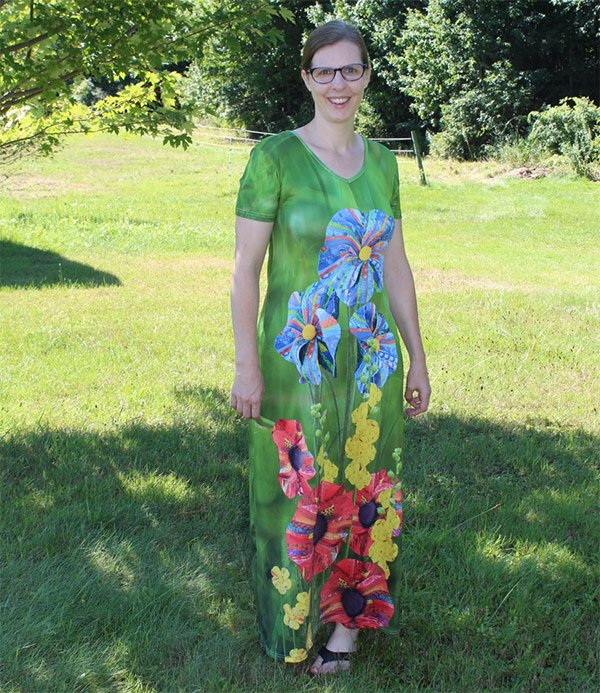
CN: In your opinion, is it better to sell through a print on demand store or buy prints wholesale and sell through your own online store?
DA: I guess my actions speak to that- I only sell on my own website. Quality seems a bit low with print-on-demand and the markup means the artist gets much less than buying wholesale. However- I am not opposed to print-on-demand and would consider it in the future. (Get a Free copy of the ebook “Win at Work & Play to see a list of Print Stores)
CN: Do you find that people are more receptive to buying your art prints than your originals? How has your sale of art prints impacted other aspects of your creative business?
DA: Because my art is digital, there is no original. Think of it like art photography. I do create one single edition art quilt with some of my prints, so although it is not an original it is a one of a kind. I haven’t sold one yet- but I hope to!
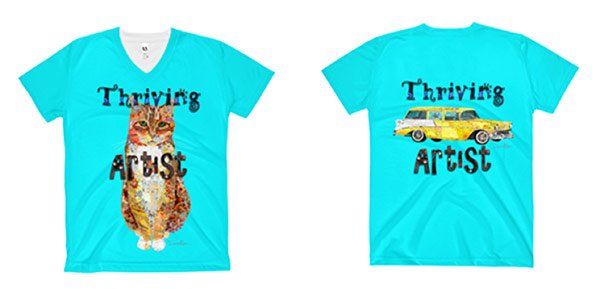
CN: Thanks for clarifying. I guess I was asking about your one-of-a-kind art quilts, where you print your digital art on fabric and then free motion stitch details into it.
Dawn. what is the one big mistake you’ll tell someone who’s starting to build their textile art business to avoid?
DA: Thinking that something you try with marketing will work- it often doesn’t. Feeling like quitting when things don’t work- you just need to try something else.
You know I always ask my guests to share their favorite tools with us. Dawn has been generous to share hers with us.
Dawn’s Five Faves
- I love printing my artwork on clothing to wear to art shows. My favorite place for printing my artwork on clothing is Printful
- I love SquareSpace for creating websites
- The Abundant Artist – Cory teaches art marketing
- Adobe Photoshop is my digital design tool
- I print my artwork on fabric with Spoonflower
Furthermore, we’ve got specific business tips from Dawn.
Dawn’s 6 Tips for Successfully Creating and Selling Art Prints
- Exhibit your work- ask local venues to host your solo exhibit
- Sell at craft shows or other venues (I sell at car shows)
- Post and interact on your own business Facebook page, also cross post in groups on Facebook.
- Have an email marketing list and write fun emails twice a month.
- Make beautiful art- seriously it helps if your art is good.
- Do your own thing with your art and your business- only you can be you.
Dawn Allen’s Services and Business Offerings
CN: Finally, Dawn, how can readers purchase your prints and get access to your other business offerings?
DA: On my website, DawnAllen.net
Thanks, Dawn. I appreciate you taking the time to talk to us about your business and to share your creative journey with us. Your knowledge about the art prints business has been very insightful.
In conclusion, here are the highlights of today’s interview.
Interview Quotes and Takeaways
- Do your own thing with your art and your business- only you can be you.
- If you need help with getting good quality jpegs ask a professional.
- Make beautiful art- seriously it helps if your art is good.
- Don’t think that something you try with marketing will work- it often doesn’t. Don’t feel like quitting when things don’t work- you just need to try something else.
Your Turn
What have you learned about art prints that you didn’t know before? Which part of the interview with artist Dawn Allen did you enjoy most?
Can’t wait to hear your comments.
Warmest Regards,
PS: Read my other textile art business interviews.
This post contains affiliate links. I receive a small percentage of sales made using affiliate links at no extra cost to you. Thanks so much!