
Continuing along in our series on Art & Entrepreneurship, we’ll talk about several practical ways to actually monetize your creative works and earn some money from what you create.
Running a business and creating art are two separate but important issues creators and makers face.
The demands of creating make it easy for us to ignore the business side of your creative practice. Thus, making us creators, feel helpless and uninformed about what opportunities exist.
Luckily, I have taken the time to do the research for you on how to monetize your creative passion. This way, you have options to consider.
Often you’re burning through money purchasing supplies and expending all your energies on creating. I bet you don’t want to be left feeling exhausted, broke and unhappy. :-). Right?
So if you’re ready, let’s dig deeper into how to monetize your creative passion and get compensated for what you do.
Specific Ways to Monetize Your Creative Passion
- Selling Original Work: Selling your work is the most obvious option available to us. But when you decide to monetize your creative passion you’ll quickly notice that even here, there are several options available.
Some places we can sell our work include
- Open Studios, Trade and Craft Fairs, & Art Exhibitions
- Art Gallery Representation
- Personal Website
- Art Marketing Sites like Artful Home, Amazon Fine Art, Fine Art America
- Craft and Handmade Sites like Etsy
- Art Licensing: Just like art gallery representation, using art licensing to monetize your creative passion is a topic that requires a lot of knowledge to navigate its intricacies.
However, simply put, art licensing is about our intellectual property as artists. It involves giving someone permission to use your copyright to reproduce, distribute or otherwise use your creation under limited conditions.
There are various examples of that for the textile art, quilt and sewing industry. An example is VIDA design, which I explained over here in this post. Basically, they print your artwork on scarves, pocket squares, totes etc. Other places will create prints of your original work onto different substrates for sale. Examples are:
Alternatively, you could have these places make prints for you to sell yourself.
3 More Ways to Monetize Your Creative Passion
- Building Authority: An option to monetize your creative passion that hasn’t been widely explored by creative types is building authority. Doing this involves writing, publishing & selling books. It also involves doing speaking gigs and presentations for groups of people.
This option requires a lot of investment in time and may be the reason why it’s not explored more often.
- Teaching Workshops: Teaching workshops is a good option for textile and quilt artists and all creative types. It’s not only an option for you to monetize your creative passion, but also a source of energy, especially in person-to-person workshops. Includes:
- In-Person Group Workshops
- One-on-One Coaching Sessions
- Teaching Online Courses
- Selling Patterns & Kits: Another viable option to monetize your creative passion is to make it easy for others to create similar things to what you create.
Doing this involves documenting your process step-by-step and then creating a blueprint or pattern so that someone else can recreate what you do.
You can take this further by providing the supplies that are needed when someone is using your pattern. That’s when it’s said that you’re providing kits for customers to use to create your designs.
2 Final Methods to Monetize Your Creative Passion
- Commissions: Accepting commissions as a way to monetize your creative passion involves accepting custom orders to make things for other people for a premium fee.
Typically, your orders for commissions will come from individuals, public and state organizations and from corporations.
- Designing Fabrics: Finally, an option that has become within the reach of many makers and creators, because is the ability to design your own fabrics. Designing fabrics to monetize your passion is something more people are getting into in recent years because of the internet. Here are online sites which make this possible for the ordinary person, without the need to go through the big-name fabric companies.
So now here you have it. Seven different ways to monetize your creative passion as a textile artist. I know that finding time to do the research is hard so I did that for you. But you still need to take action on the information, investigate for yourself, and decide which of these options to explore.
Finding time is hard but if you don’t make time to take action, then nothing happens. Take a careful look at the businesses of some of the successful artists you admire. You’ll notice that their businesses are made up of at least two of these income sources.
If you’re not satisfied with the status quo, then you need to take action. Explore the various options and discover which ones will work best for your personal situation.
I’m exploring my options. I hope you do too.
Your Turn
Have you explored any of these options? Which of them and what was your experience? Do you have any more to add to the list above? I can’t wait to read your comments.
Warmest Regards,

You may also be interested in the other parts in this series
1: Making the Decision to Monetize Your Creative Work
2: The Truth About Art and Creative Passion
3. The Secret to Maintaining Your Creative Focus
4. Seven Practical Ways for Textile Artists to Make Money
5. Art & Entrepreneurship – Interview with Melanie Brummer (1)
6. Art & Entrepreneurship – Interview with Melanie Brummer (2)
PS: If you found this info valuable, please share with your friends and family. Find share buttons below.
The Untold Story of How Money Affects Your Creative Passion
“Making money is art and working is art and good business is the best art.” ~ Andy Warhol
I’m certain you’ve heard the statement that making money from your passion kills the passion. How true is this?
Just like you, I’ve heard this statement bandied around many times. And I’ve taken it at face value without critically examining its merits and demerits.
As a result of this line of thinking, many of us creatives are torn between seeking out viable ways to monetize our creative works and sticking with just creating as a hobby.
But as I came to the end of writing part 1 of this series on Art + Entrepreneurship, the question came to my mind again. “Does money kill creative passion?”
So why don’t we critically consider this question now? First off, what is a passion?
“Passion is a strong feeling of enthusiasm or excitement for something or about doing something”
So our original question can be reframed this way: Does money kill our strong feelings or enthusiasm about creating?
Scott Adams, the creator of Dilbert’s cartoon, in a Wall Street Journal interview, explains that passion ebbs and flows because as our definition above has just shown, passion is about feelings.
For example, I heard a guy on the radio talking about how when his sons were younger, they got into different sports. And they’ll spend money buying expensive sports gear and uniforms only for his sons to lose interest and change their minds after a while.
I’m sure we all have similar life experiences which can make us relate to his sons. So one thing we can definitely say about our interests is this:
Passion is not enduring and therefore cannot be relied on.
Does Money Kill Creative Passion?
The truth is whether you make money or not, your passion for whatever it is you create, may come and go as it pleases.
There are several reasons why we lose interest in something. Scott Adams argues that failure is something that kills your passion.
The [projects] that didn’t work out – which was most of them – slowly drained my passion as they failed. The few that worked became exciting as they succeeded.
The easiest way for your passion be drained is therefore not by making money from it but to repeatedly fail at doing that thing. I find this quite interesting because it means passion does not guarantee success. Success, on the other hand, can fuel your passion.
Scott Adams puts it this way,
In hindsight, it looks as if the projects that I was most passionate about were also the ones that worked. But objectively, my passion level moved with my success.
He goes on to say:
Success caused passion more than passion caused success.
Put that way, it sounds jarring to the senses but I happen to agree with Adams. However, I approach this concept quite differently.
I call my concept, “the gift of progress” which I explain in this blog post. The summary of my concept is this. Making progress (or success if you will) motivates you, it fuels your passion for doing more and makes you accomplish bigger tasks.
Money does not kill passion otherwise, we’ll not have superstars. But failure can.
The Bigger Question About Money and Creative Passion
Having said all this, I think the bigger question we’re trying to answer is not whether money kills passion. It’s “how do we find meaning or fulfillment in our lives”?
We’ve somehow tied having a meaningful life to our passions. So it’s not surprising anything that appears to be a threat to our passion gets us all anxious about losing our life’s meaning.
The founder, Benjamin Todd, of 80,000 hours ( FYI: that’s the total number of hours you’ll work in your lifetime), believes we’ve got the order all wrong.
In a TED talk, Todd explains that we think our interests/passion matter more than they do because we underestimate how much they change.
Adams agrees:
“For most people, it’s easy to be passionate about things that are working out, and that distorts our impression of the importance of passion. “
The current order we follow in deciding on our life careers is this:
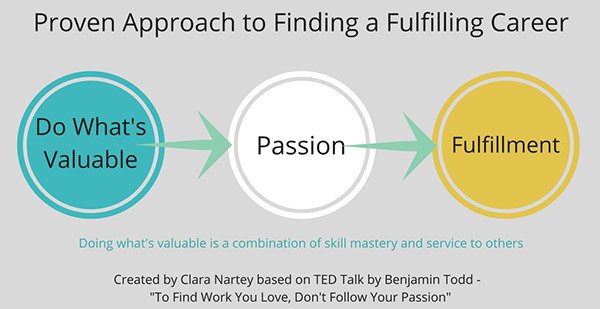
Todd argues that finding a fulfilling career does not start with following your passion. Rather, true meaning in life is found when you master a skill and use it not for only yourself but for the good of others.
Answering The Question About Money and Creative Passion
Dilbert creator Scott Adams and 80,000 hours founder, Benjamin Todd, are separated in age by probably a few decades. And while Adams speaks from a lifetime of experience, Todd speaks from a short youthful experience backed by loads of research, yet they both come to the same conclusion.
Passion is not what you focus on when you want to build a meaningful career. Start with skill/ mastery and working for the greater good.
Neither money nor passion give our lives meaning. It’s how our skills benefit others that gives us true meaning.
In conclusion, if you decide to monetize your creative work and turn it into a career (not a hobby), do what’s valuable.
That’s to say, focus on getting good at something you like that genuinely helps others. Then your success will fuel your passion and in turn, give your life meaning.
Part 4 of the series will be on “The Secret to Maintianing Your Creative Focus in a Commercial Environment”
Your Turn
What are your thoughts about money and creative passion? Does the fear of killing your creative passion stop you from going professional with your creative work? Do comment. I really want to hear your opinion.
Warmest Regards,
You may also be interested in other topics in this series:
1: Making the Decision to Monetize Your Creative Work
2: The Truth About Art and Creative Passion
3. The Secret to Maintaining Your Creative Focus
4. Seven Practical Ways for Textile Artists to Make Money
5. Art & Entrepreneurship – Interview with Melanie Brummer (1)
6. Art & Entrepreneurship – Interview with Melanie Brummer (2)
This conversation we’re going to have today is a very sensitive and uncomfortable one in many ways because artists don’t usually like to talk about money. It’s going to be a multi-part series on Art & Entrepreneurship. Should artists try to earn a living from their work? How much are you allowed to make when you monetize your creative work? When does making money from your creative work become a “sellout”?
All of these are “hot button” questions. Questions which many creative people feel uncomfortable talking about. while many more will engage in heated arguments over.
Stereotypes About Art and Money
So let’s start with the stereotypes? Why is there a belief that artists should be poor and starving? A belief that is so widely held by both creatives and non-creatives alike. Something which has become further compounded by the hard evidence of many struggling artists living in our societies.
It’s a sad stereotype – which has resulted in many loving parents steering their children away from pursuing their dreams in the arts. But a stereotype that persists in our societies, nonetheless.
Why Artists Create
So if this is a belief that is ingrained into the fiber of our societies, why do we creatives go against all the predictions to the contrary and choose to do what we do?
I can say for certain, I do this for the fulfillment it brings and I’m convinced it’s pretty much the same for many creatives. Creating is a soulful journey. It provides nourishment for the soul of the creator. Sharing our creative works with the world to enjoy becomes the icing on the cake for us.
But then sooner or later, we’re faced with the hard questions of survival. When we become very passionate about creating, we soon start to spend countless hours on honing our craft. Time which has been taken away from other money-earning activities.
When Money Becomes Part of the Equation
However, being an adult means having responsibilities which include financial ones. You’ve got to pay the bills. That’s just the way it works. It’s the price you pay to live. It’s a decision every creative needs to make at some point in their creative life.
How do you finance your creative life? Since many of us get into doing creative work to fulfill a passion we obviously don’t think ahead or plan how we’re going to answer this question until we’re faced with it.
Even when the question eventually comes up, we often shoo it away onto a book shelf to gather dust till the next time it comes up again.
Stephanie Halligan – a motivational cartoonist in a podcast interview with Jeff Goins (Best selling author of the Art of Work) admits that it took two mindset shifts for her to finally begin to accept that she had to make money from her creative work.
2 Mindset Shifts That will Help You Decide to Monetize Your Creative Work
Mindset Shift #1: “If you give you’re allowed to receive”. (A concept that is reiterated in Amanda Palmer’s TED talk – “The Art of Asking”).
In response to the question “How did you make all these people pay for music?” Amanda Palmer said: The real answer is,
“I didn’t make them. I’d connected with them, and when you connect with people, they want to help you. It’s kind of counterintuitive for a lot of artists.”
The argument here is this. When you’ve poured yourself into giving and sharing your work and selflessly helped your audience in diverse ways, it becomes okay to receive their support.
It’s ok to make money from the creative work you share with them. Really, it’s fine to monetize your creative work after a while. In fact, they want to see you succeed.
They want you to give them an opportunity to support your work.
This really hit home for me. I hadn’t thought of it in this way before. But thinking of it now, it’s so true. I get blog readers writing to thank me for sharing so much with them and they’re literally telling me ways I can monetize my creative work and earn some money for all that I share.
Here’s a snippet of one such email:
“Your website and blog are terrific!!! Your free tutorials have us loving you!!! However, you could make some $$$ by …..”
Yes, I do get these emails asking me to monetize my creative work. But like the typical artist, I shoo them off to the bookshelf to gather some more dust.
What is noteworthy here is, when your creative work has been about giving, you certainly do get permission to also receive. In fact, your fans demand that you receive.
So the point here is:
- First you start by focusing on learning the craft, and honing your skills
- In the meantime, generously share your work and talents with others. (All of this is based on the gift economy notion that art is a gift to be shared with the world.)
- Then as part of the process of sharing, you build trust and you receive permission to make money from your work ( aka monetize your creative work).
Artists fall short by not providing their audience with opportunities to support their work
Where most of us artists fall short is when our audience starts wanting (sometimes demanding) to help us share our work to a wider audience, we don’t provide them viable opportunities to let them help us.
Here’s the second mindset shift that helped Halligan decide it was okay to monetize your creative work.
Mindset Shift #2: It’s Ok to make money in a different way, while you focus on building your creative business.
So first, you’ve got to make the decision that it’s okay to make money from your creative work. Then when you start to see your creative business grow, give it room to breathe.
Take on a second job as you build your art business so you don’t put undue pressure on your creative work. That way your creative business gets room to grow naturally.
Then you can transition to full-time art career when your creative business has matured to support you financially.
“Stephanie says,
“I’m going to do that full-time thing but at the same time it’s just my job to exercise patience and make sure that I’ve got some money coming in from other things in the meantime so that I can support this growth.”
So what about the argument that making money from your passion kills the passion? Stay tuned for the next installment of Art & Entrepreneurship
Your Turn
Have you made the decision to monetize your creative work? If yes, what are the things you took into consideration? If no, why have you decided not to monetize your creative work? Let’s have a discussion. Shall we? I can’t wait to hear your views.
Warmest Regards,
You may be interested in the other topics in this series
1: Making the Decision to Monetize Your Creative Work
2: The Truth About Art and Creative Passion
3. The Secret to Maintaining Your Creative Focus
4. Seven Practical Ways for Textile Artists to Make Money
5. Art & Entrepreneurship – Interview with Melanie Brummer (1)
6. Art & Entrepreneurship – Interview with Melanie Brummer (2)
 Recently, I was looking for an image to represent the concept of success so I went to the Internet to search and to my amazement what I saw challenged my view of the word.
As I usually do when I’m challenged, I began to think. For weeks, I pondered over the word success and asked myself what it meant to me. At what point do I call myself successful? Who do I see as successful? What do those successful people think of themselves? I mostly chewed on this, mused over it and turned it around in my brain.
The images I’d seen when I went to www.morguefile.com, where I sometimes download free photos for my work, indeed got me thinking. When I searched for the word success I got pages upon pages of mostly bank buildings and cash (dollar bills and coins). Granted, this website is not as widely sourced as Google is, but there is still a great number of people from all around the world who have posted images here. Does this imply that the meaning of success to this wide array of people is mainly about money?
I’d like to ask you what you think about success? Do you describe success in relation to finances or not. Have you made a decision about the point at which you will feel comfortable describing yourself as successful? What are the things that make you feel successful?
When I was thinking up names of people, I consider successful, two names that came to mind were Mother Theresa and Malala Yousafzai. In my mind they are successful woman. But as I thought of it, I also acknowledge that they didn’t have much money. I know money is important, don’t get me wrong. There’s a lot of things I could do with money.
So what really is success? Does it have to be based on or around money? My personal conclusion is good success is knowing to do the right thing and doing it. In my opinion, there is also bad success, which is more about notoriety. This is when someone goes so much against the grain that they become famous. Everyone gets to know them, not because of the good they do, but because of their ability to shock the senses and get attention.
So what do you think success is? I’d love to hear what you’ve got to say about the subject. Leave a comment below.
Thanks for reading.