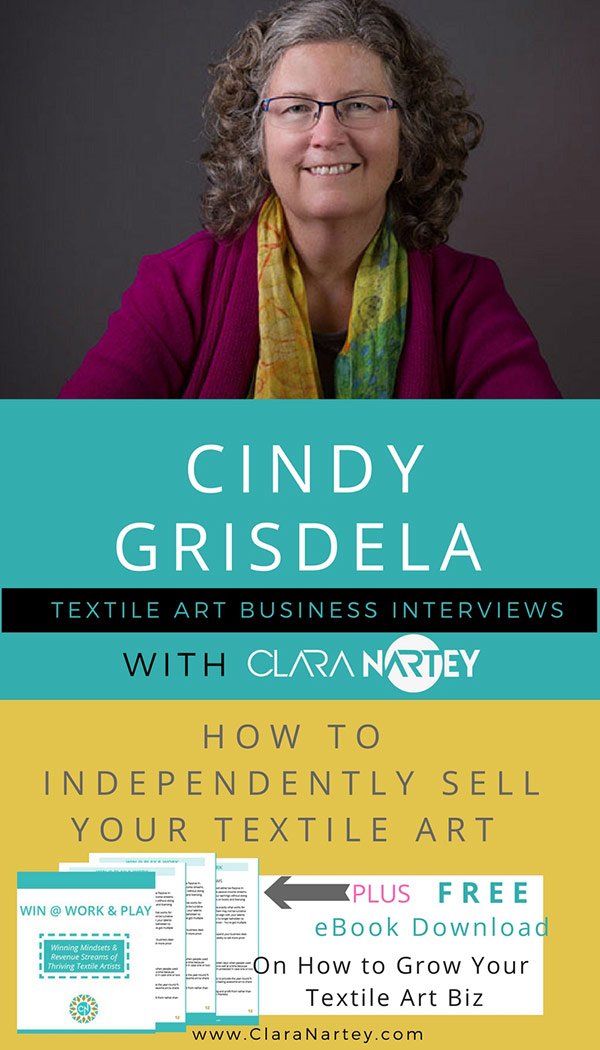
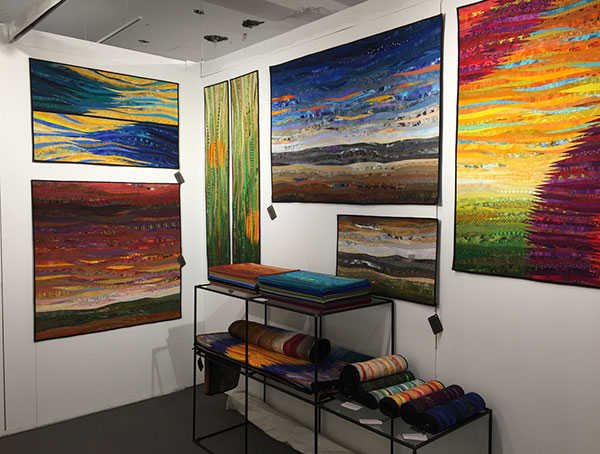
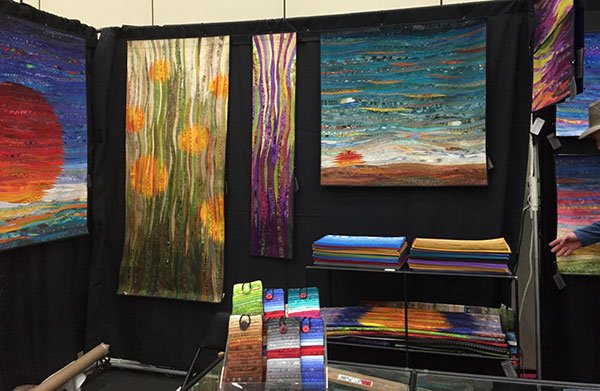
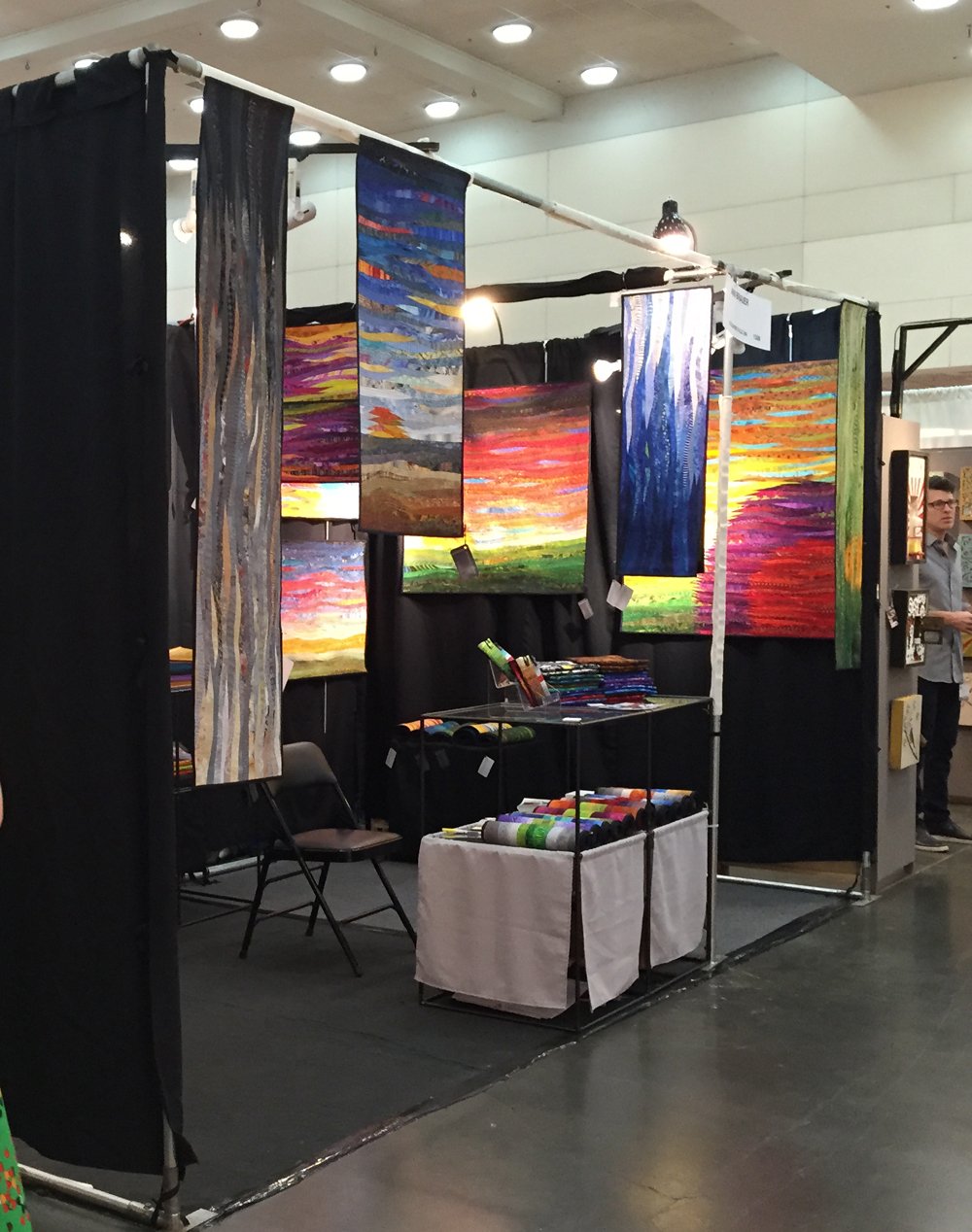
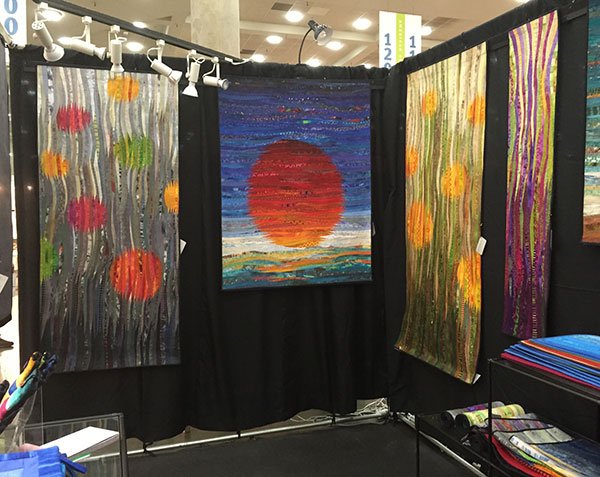
In this episode of Textile Art Business Interview, I’ve got Cindy Grisdela with me.
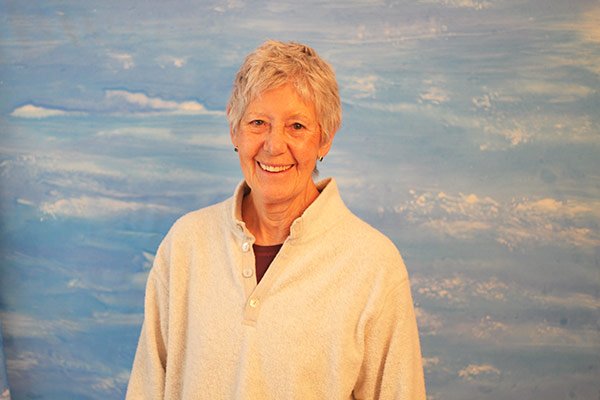
Cindy is an award-winning artist, an author, and a teacher. Her formal education includes a BA in Fine Arts and an MBA. She improvisationally designs colorful abstract art quilts without a preconceived pattern in mind. It’s my pleasure to welcome Cindy Grisdela to the blog today.
Save to PINTEREST
Cindy and I discuss:
The two paths for selling your artwork
The number one reason artists have difficulty with selling their work
How to promote your work without being salesy.
Her favorite tools and Tips for selling your artwork
Short on time, but still want to check out the interview? Grab the free PDF Cindy Grisdela’s Interviewand enjoy at your convenience.
CN: Hi Cindy, welcome to the Clara Nartey Blog for this episode of Textile Arts Business Interview CG: Thank you Clara, it’s a pleasure to be here.
CN: Can you tell us a little bit about yourself and how you came into textile art? CG: I’ve been sewing since I was old enough to reach the pedals of my Mom’s Singer, and I made most of my clothes as a teenager and young adult.
How Cindy got Started with Art Quilts
I don’t come from a quilting tradition since there weren’t any quilters in my family, but I was always encouraged to be creative. In my early twenties, I fell in love with quilts after I saw an article in a magazine.
I assumed that since I knew how to sew already, making a quilt should be no big deal. My first quilt was a queen size Trip Around the World, and I realized I had a lot to learn! But I was hooked on quilting and never looked back.
CN: Cindy, give us some insight into your creative process and how you come about making your beautiful art quilts. CG: I started out making quilts using traditional patterns, but somewhere along the way I got tired of using patterns and decided to see if I could come up with my own style. I love improvisational quilts because each design evolves organically as my choices of color and shape influence each other. It’s sort of like putting together a jigsaw puzzle, but I get to decide what the picture on the box looks like.
I love improvisational quilts because each design evolves organically as my choices of color and shape influence each other.
It’s sort of like putting together a jigsaw puzzle, but I get to decide what the picture on the box looks like.
Typically I don’t make preliminary sketches or drawings first; I just cut into the fabric to make shapes, put them up on my design wall, and play with them until I have a design that speaks to me.
Why Cindy Chooses to Work with Fabric And Not Another Medium
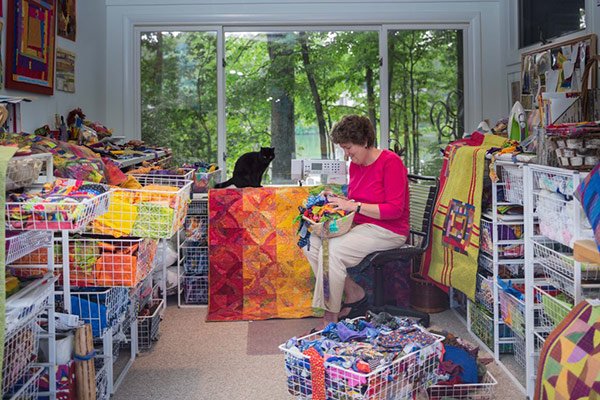
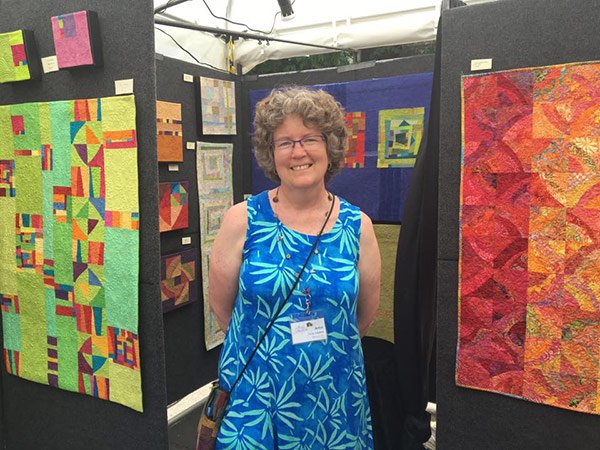
Cindy Grisdela in Her Studio
CN: I’m often intrigued to hear what made artists who’ve been exposed to different forms of art media chose textiles over the other media. What is it about fabrics that makes you like working with them? CG: I’ve tried a lot of different media over the years–drawing, painting, sculpture, pottery–but what I enjoy most about working with fiber is the tactile nature of the medium.
I can create an interesting composition with color, line, and shape, and then I can add another layer or dimension with dense free motion quilting. My stitching is more than just a way to hold three layers together; it’s an integral part of the design itself.
CN: That’s exactly how I feel about my stitching too. One question I hear very often from art quilters is, “how do I sell my work”?
The Two Paths to Selling Your Artwork
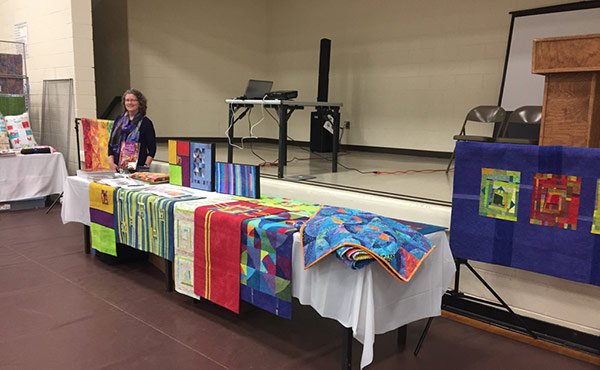
Cindy Grisdela Giving a Lecture
To my mind, there are two paths. The traditional path, which is the Art Establishment Path – through galleries, art consultants, art shows and more.
And the second path which is the Independent Artist Path, where an artist sells their work directly to collectors, through fine craft shows, open studios, personal online stores etc.
My question is two-fold. First, do you agree with my assessment of these two paths and second, which of the paths have you pursued in selling your art and why?
CG: Yes, I agree with you.
I’ve tried a number of different ways to sell my work–some from the first path and some from the second.
I found that I like selling my work directly to the customer through fine art and craft shows, open studios and through my website. The reason for this is that I believe that collectors buy the artist and his or her story as much as they buy the artwork itself. And no one can tell my story as successfully as I can.
The Number One Reason Artists Have Trouble Selling Their Work
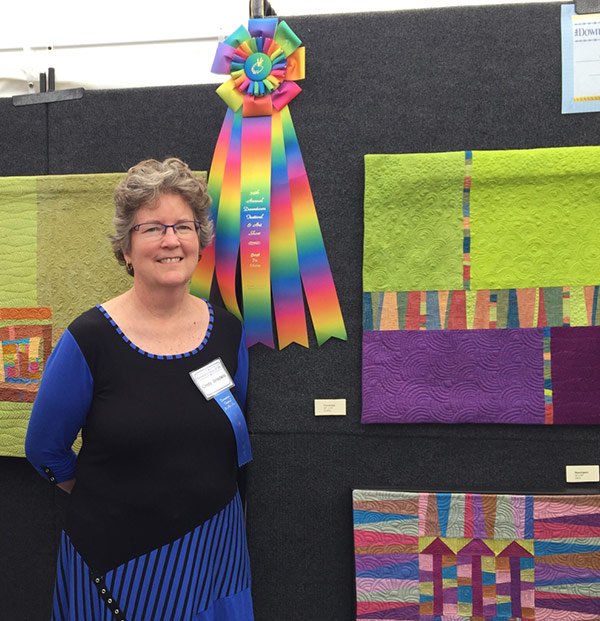
Cindy Grisdela An Award Winner
You have to market yourself to be successful, but you can do it in a way that makes people happy to hear from you.
CN: A lot of people struggle to sell their work. In your opinion, what’s the number one misconception quilt artists have about their ability to sell their work? What is the mindset that holds people from being successful at selling their artwork? CG: The number one reason artists of any medium have trouble selling their work is they don’t want to market themselves–they don’t want to seem “pushy.”
Yu have to market yourself to be successful, but you can do it in a way that makes people happy to hear from you by being active on one or two social media sites and collecting email addresses at your events for a regular email newsletter.
CN: How do you balance producing your art and promoting it? CG: That balancing act is really tough. I probably spend 50% of my time making art and 60% marketing it. Yes, I know that adds up to more than 100% and that’s the problem. To be successful, you can’t just say “I’d rather be in the studio” and not be willing to put in the time to have a blog, a robust social media presence, write a regular email newsletter, and get yourself and your work out in the world. Nobody is going to beat a path to your door, no matter how good your art is.
CN: Well said Cindy, well said. So, what’s been your biggest challenge in selling your art and what have done or are you doing to overcome this?
The Biggest Challenge of Selling Art Quilts
Get it now!!!
CG: The biggest challenge to selling my art has been educating customers about the idea of putting a quilt on the wall instead of on the bed.
When I’m out at a show, or anywhere else with my work, I think of myself as an ambassador for the art quilt. Because we’re involved in the art quilt world, we tend to think that everyone knows about it, but they don’t, and you have to be willing to explain why anyone should be interested in quilts as art.
This is not something most painters have to deal with. To help overcome this problem, several years ago I started mounting my smaller quilts on painted black canvas. That gives the piece more of a presence for the wall and allows me to offer a variety of price points in my booth for people who enjoy my work.
We Can’t Run Away From History
CN: You make a good point, Cindy. The concept of an art quilt as wall art is foreign to most people. However, that hasn’t stopped you from selling a lot of art quilts. Do you think there’ll ever come a time when art quilters will enjoy the acceptance painters have and they’ll not have to explain why they or their artwork should be taken seriously? CG: Unfortunately, I doubt it. Painting, has such a long history that many people feel it’s the only “real” art. That’s hard to combat, but I’ll keep trying!
CN: So, what exactly do you say to a buyer by way of an explanation as to why they should purchase an art quilt? CG: I emphasize the warmth and texture hanging textiles on the walls gives to a room, as well as the more intimate feel a quilt has compared to other types of wall art. Sometimes people are concerned about how to clean an art quilt, and I reassure them that a lint roller will do the job just fine. Most of the time it’s not a hard sell–if people aren’t interested in textile art they don’t stop in my booth, and if they have stopped and expressed interest in a piece, then they are already part way to taking it home.
Making Time For Creativity
Cindy Grisdela at the Ann Arbor Art Show
Making art is my passion and putting my work out there is my job….
CN: You’re a pretty busy woman. You teach, you travel extensively, and you maintain consistent open studio hours. How do you make time for it all? CG: I think of myself as a small business and every day I’m working at some aspect of my craft.
Making art quilts is my passion, and putting my work out there by teaching, lecturing, writing my book–Atful Improv, and traveling to shows is my job. I’m incredibly fortunate to be able to do what I love.
Each day I make a list of the things that have to get done that day and use that to organize my time. It helps that my boys are grown and out on their own now, and my husband is very supportive of what I do.
CN: You’re exactly right. I used the same concept for the title of my free ebook – “Win @ Work & Play”. Because I believe there are two parts to our creative lives. First of all, we have creating and following our passions, which falls under the play part. In addition, we’ve got promoting your creations so you get paid to play some more and follow your passion which falls under the work part of it.
Finally, Cindy before I let you go, there are two segments I include in every interview because readers really enjoy these segments.
(a) The first is this: “What are your five favorite tools, supplies and resources”?
(b) The second is, “What are 6 Tips you can give to someone who’s struggling to independently sell their textile artwork”.
Cindy Grisdela’s Five Favorites
Cindy Grisdela’s Five Favorites
My Bernina Sewing Machine
Instagram–a great way to connect with people who like your work
Cindy Grisdela’s Tips For Independently Selling Your Textile Artwork
Cindy Grisdela Business Tips
Make the best art you can.
Have a good looking website and keep it updated.
Choose one or two social media outlets and be actively involved in sharing your work and interacting with your followers.
Collect emails from people interested in your work and send out a regular email newsletter. These are people who WANT to hear from you.
Make work in a variety of sizes and price points.
Get yourself and your art out in the world as much as possible by doing things like these. Entering shows and hanging your work in the library. Furthermore, participate in an art group in your community–even if you’re the only fiber artist. Moreover, submit proposals, and say yes to opportunities that come your way!
Thanks Cindy for coming on to share your business insights with us. To learn more about Cindy Grisdela’s art quilts and her workshops, visit her website.
Interview Quotes & Highlights
I assumed that since I knew how to sew already, making a quilt should be no big deal.
I believe that collectors buy the artist and his or her story as much as they buy the artwork itself. And no one can tell my story as successfully as I can.
You have to market yourself to be successful, but you can do it in a way that makes people happy to hear from you
I probably spend 50% of my time making art and 60% marketing it.
Making art is my passion and putting my work out there is my job…
Warmest Regards,
SaveSave
SaveSave
SaveSave
SaveSave
SaveSave
SaveSave
SaveSave
SaveSave
SaveSave
SaveSave
SaveSave
SaveSave
SaveSave
SaveSave
SaveSave
SaveSave
I’m happy to be here again with Ann Brauer to pick up where we left off talking about her creative journey and creative business.
Save to PINTEREST
In this second part of the interview we’ll be talking about:
Why Ann chose to build a creative business rather than continue in her trained profession
Overcoming the pressures of society’s perceptions on starting your own creative business
How to use fine craft shows to sell art quilts PLUS a list of such craft shows and
Considerations for choosing which craft show to participate in
Pushing Through Society’s Perceptions Against Creative Business Ownership
Ann Brauer’s booth at the OOAK Craft Show – 2016
CN: Ann earlier in this interview you mentioned that you had a fallback position you could have gone back to. Yet you still made sure your art quilts business worked. There must have been plenty of opportunities for you to fall back on your legal business, especially at the start of your art quilts business. Why didn’t you? AB: Was it Thomas Wolfe who said you can’t go home again.
I knew that if I were to continue doing legal research I would need to push myself to explore new options. Did I want to teach? Work for a firm? It would require taking more steps and probably moving back to the city.
I found that even though it was difficult living by myself in the country and making quilts, I liked the challenge and so I decided to make it work.
One of the hardest parts though was when getting chided by others that women had worked so hard to get into law schools and I was letting others down by my decision.
Those statements though did spur me to make the best quilts I possibly could to help calm those fears.
CN: Thanks for that honest answer, Ann. I know that a lot of us creatives struggle with society’s perceptions of what is a right or wrong way for us to earn a living. In my interview with Melanie Brummer, she talks at length about how we need to stand up to societal perceptions. Good for you that you were able to make it work for you.
CN: Do you have any regrets for not going back to legal research? AB: As to regrets–as you may have figured out, I like to make a decision, have a reason for it and then move forward.
I do on occasion let my mind wander to imagine how different my life would be if I had continued as a lawyer but I like my life as it is.
I do on occasion wonder if I made the right decision to continue making smaller works. Would I be treated more seriously if I did not make the potholders and eyeglass cases?
And yet for the first part of my career, I needed to make the smaller items to support myself. After that, I realized I liked having items that were accessible to many people.
I liked the freedom it gave me to shift with the marketplace and I felt an obligation to my customers.
In addition, I like to sew.
Making Time to Focus on Creating and Running a Business
Ann Brauer’s Booth at the Baltimore Craft Show- 2017
CN: Earlier you mentioned “being focused and stubborn”. Making time to focus on creating as well as running a business is another one of those things a lot of us struggle with. How do you structure your days so you’re able to do both? AB: Because my studio in Shelburne Falls is open to the public, I do have regular hours. I try to get to the studio an hour early so I can work on various business tasks before I am “open”. I also do some work on the computer in the morning before I leave for work. Some days I will work on more business tasks when I am in between quilts or taking a break.
CN: Do you teach or engage in other activities to make money from your artwork? And if so, what are they? Do you find them as profitable as selling your original work on Etsy? AB: I support myself by making and selling art quilts and decorative accessories. I use Etsy as my online shop to help with this activity.
I participate in a number of fine craft shows each year. Etsy is a good way for people to follow up when they are in a position to purchase.
I also get some postings from people who would not otherwise find my work. My marketing is a whole.
How to Choose A Craft Show to Participate In
Ann Brauer’s Booth at the Baltimore Craft Show – 2017
CN: Smart!! I see your marketing strategy is multi-faceted. Which craft shows do you participate in and how often do you do them? AB: The craft shows I participate in vary every year depending on
Which ones I get into,
How frequently I have done a particular craft show,
The ease of doing the show,
My schedule and whether I have a good rationale for doing the particular show
If I feel the promoter does a good job?
Whether my market there?
If my customers expect me to be there?
People I know who are doing the craft show?
What my friends who have done the craft show before say about it?
A List of Fine Craft Shows
Ann Brauer’s Booth at the Baltimore Craft Show – 2017
The Berkshire Craft Show—such a sweet little show with good quality work that I can actually drive home from every night
The Morristown Craft Show in New Jersey where I do have a large mailing list in an area that I haven’t shown at for a couple of years
The Memorial Art Gallery Show in Rochester NY—another sweet show with a limited audience that I haven’t shown at for about 10 years and
The OOAK Holiday Show in Chicago—huge attendance in the center of the city and a market I hope I can build.
Next year—who knows although I have already begun considering possibilities.
The Relationship Between Participating in a Craft Show and Your Online Sales
CN: Oh wow, that’s quite a busy craft show schedule!!! With your heavy participation in craft shows and multi-pronged marketing approach, would you say craft shows have been the biggest source of client referrals to your Etsy store? AB: Actually, according to my statistics my largest source of referrals to my Etsy store is Etsy.
I also get referrals from different social media, my blog, my website and of course craft shows.
When I do a craft show, I do often notice a rise in purchases from that location. I also presume that some of my sales on Etsy are from people who know my name and recognize it on Etsy.
CN: Ann, since you’re getting clients from different places – craft show, social media and other places to your Etsy store, are you photographing the work for your Etsy store yourself or are you using a professional photographer? AB: I have a professional photographer who takes images of my larger quilts for shows and my website, however, I do take my own pictures of the smaller items using my iPhone.
It can be a bit of a challenge to take 5 images of a piece that convey the essence of the piece and I do have stock shots that I use frequently.
Other people take much more interesting photos of their work and I do sometimes aspire to make my smaller items more part of a tableau.
Setting Up A Craft Show Booth
CN: Ann, from my experience setting up my first outdoor exhibition, I know set up at a craft show forms a major part of the work involved in selling at a craft show. How do you usually set up your booths? AB: I normally use my booth I purchased from Flourish.com. It consists of 1-inch steel poles with drapes. I then add light fixtures, a rug and the Abstracta stands. This arrangement is sturdy and gives me flexibility regardless of the size of the booth I get. I fit it all in my Honda Odyssey with the middle row of seats removed and the back ones folded down.
CN: Sounds great. Now, could you share your five favorite tools with us? We love to learn and use what other artists are using.
Ann Brauer’s Five Favorite Tools and Resources
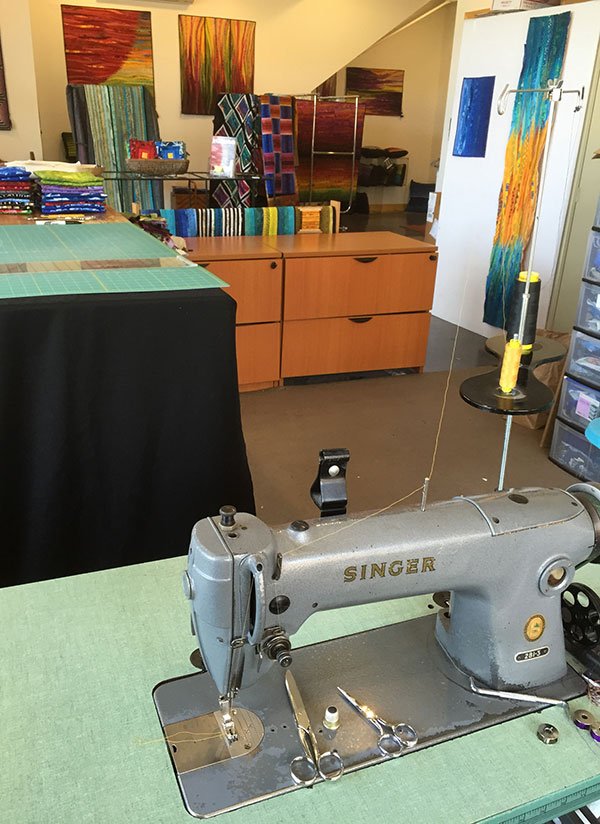
I love my Singer 281-3 Industrial Sewing Machine from 1965 with its Servo motor. I have had this machine since 1983. It has a wonderful table. When I lost my studio as a result of Tropical Storm Irene, my husband was able to pull it out and friends reconditioned it. I design my quilts around my sewing machine. Watch this quick video to see how awesome this sewing machine is.
I love my studio. It has north and east light, 10-foot ceiling, polished cement floors and allows me to work here and also display my complete quilts.
My anti-fatigue rubber floor mats in the work area are great. They let me stand as I cut fabric without wearing my feet out on the cement floors.
My display counter which doubles as my work and cutting service. My studio is not really large which means I have to work very efficiently. The display counter is just the right height without causing my shoulders to ache.
CN: Was there any time in your life when you struggled with making this a career? And what did you do to overcome it? AB: Supporting myself as an artist is a constant struggle. The market is always changing and it is important to listen to your customers and ask what is happening.
It is always a puzzle. I try to figure out the next step, make a decision that I can rationalize and then try it. Sometimes it fails and then I move on.
One practice that I developed many years ago is to keep moving forward. If I have had a bad craft show, I try to move some of the work in other ways so that I do not feel burdened by too much work that I thought would sell but that I still own.
CN: How does it feel to be able to support yourself doing what you love? AB: I feel very lucky.
Ann, I so appreciate you for being so open about your business and the mindset and reasoning which led to the decisions you made. It’s been wonderful. Thank you.
I hope you’ve enjoyed my interview with Ann Brauer as much as I have. Visit Ann’s website.
Here are the highlights of today’s interview.
Quotes and Takeaways
Even though it was difficult living by myself in the country and making quilts, I liked the challenge and so I decided to make it work.
One practice that I developed many years ago is to keep moving forward.
When I do a craft show, I do often notice a rise in purchases from that location.
My marketing is a whole.
I do on occasion let my mind wander to imagine how different my life would be if I had continued as a lawyer but I like my life as it is.
Your Turn
Have you participated in a craft show before? What are your tips for successfully participating in a craft show?
I have Ann Brauer here with me today. Ann is an attorney turned award-winning artist. Her work is in numerous museums, institutions and private collections including the American Museum of Art + Design.
Save to PINTEREST
Textile Art on Etsy With Ann Brauer
In this interview, Ann and I talk about
Her small beginnings and how that helped her start her own businesses
What to consider in deciding to build a textile art store on Etsy
Marketing techniques and tips to help you succeed on Etsy
CN: Ann, Welcome to the Clara Nartey Blog and to this episode of Textile Art Business Interview. It’s my pleasure to have you here. AB: Glad to be here.
Ann’s Creative Journey to Art Quilts
Ann Brauer in her Studio
CN: Tell us a little about yourself. Who or what inspired you to do what you’re doing now? AB: I grew up on a farm in Illinois surrounded by quilts. When I was born, my grandmother made me a postage stamp quilt from feed sack cloth that I slept under for years. I always found some different design she had included in the quilt.
I loved to sew but never thought I could make a quilt. Instead, I made most of my clothing, lots of costumes for the high school musicals and almost anything else I could think of.
Indeed, one of the best ways my mother had to bond with me when I was a teenager, was to take me to one of the many fabric stores in the adjacent towns. I think I knew them all.
Eventually, I quit sewing as I was no longer wearing the clothes that I liked to make. Although I still knew all of the fabric stores in Boston where I was then living.
Then, I had a roommate who made quilts. I realized that if I made quilts, I could buy fabric. The rest, as they say, is history.
Soon I ran out of friends to give my quilts to and began selling them. I decided to move to western Massachusetts and see if I could support myself making quilts.
I have done this for the last 36 years.
The Audacity to Build and Live off an Art Quilt Business
The Exterior of Ann Brauer’s Studio in Shelburne Falls, MA
CN: Ann, that’s simply impressive. I’ve got to ask. What gave you the audacity to believe you could make a living off your art quilts when most people cannot envision making art quilts as a viable business path? AB: By training, I am actually an attorney and I had my own business doing research for other lawyers for seven years. When I decided to see if I could support myself making quilts, I did know that I had a fallback position if I ever needed it.
I was also helped because I grew up on a small farm. Having that small business background gave me practice in dealing with the vagaries of small businesses and hunting for alternatives when the business market changed.
In addition, as my husband will tell you, I am very focused and more than a little stubborn.
CN: Let’s talk about your Etsy store. What was your reasoning in choosing to build a store on Esty.com and not any other place? AB: For a long time, I resisted having any online store.
Then in 2011, I lost my studio to Tropical Storm Irene. Although I was able to find a suitable rental, I realized that I did want to rebuild my space. This would require more sales than I was currently getting.
I also knew that the website I was using at that time was dated but I did not have the mental energy to build a new website and I did not want to hire someone to create a website that I could not maintain.
The Reasons for Building an Online Store with Etsy
Inside Ann’s Studio
CN: Umm, two very valid points for not getting a new website created. AB: Yes. So, I then began considering many of the alternatives. I wanted a website
with an existing track record that would give me access to more customers.
that would be relatively easy to use and intuitive.
that would have the possibility of making money with it.
I checked out lots of sites and asked my artist friends. I was in a unique situation since I not only make a selection of art quilts but I am also known for my collection of more affordable items that I count on for sales.
Ann Brauer’s Etsy Shop
Initially, I was leery about using Etsy thinking that much of the work was not of the quality that I might like. On the other hand, the fee arrangement was good.
Finally, a friend of mine whose work I respect said that he had an Etsy shop and did quite well with it. After doing more investigating I found that there a number of people I knew on Etsy. At that point, Etsy was more of a community than it is now which also helped.
Is Etsy the Ideal Place to Sell Textile Art?
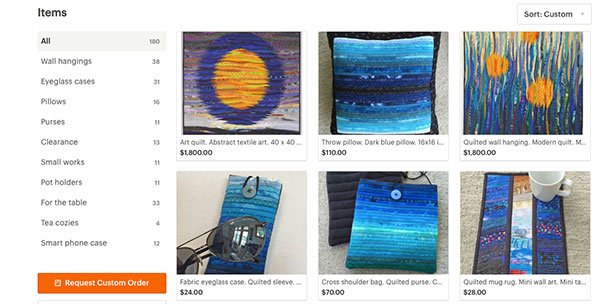
Items in Ann Brauer’s Etsy Shop
CN: I find recommendations from people who’re already using a service very valuable. That’s one of the reasons when I do interviews I ask people to recommend their five favorite things. Back to your reasons for choosing Etsy, what is their fee arrangement? Do you mind sharing? AB: While I don’t know the precise fee structure, basically I pay $.20 per listing and 3-4% of the purchase price when an item is sold.
The listings are live for 3 months and then if an item does not sell, it can be renewed for an additional 3 month periods as often as necessary. The fees do add up if you have sales but that is high-class worries.
CN: Would you say Etsy is an ideal place to sell textile art when buyers cannot clearly see the colors and especially feel the textures of your work? AB: It is always hard when buyers cannot see your work in person. Of course, it is necessary to have good images and to work with buyers who have questions about colors or textures.
Etsy does allow you to have images of your work. In addition, I use Etsy for the buyers who see my quilts at one of the fine craft shows I do throughout the year. These buyers already know my work.
The Importance of Images on Etsy
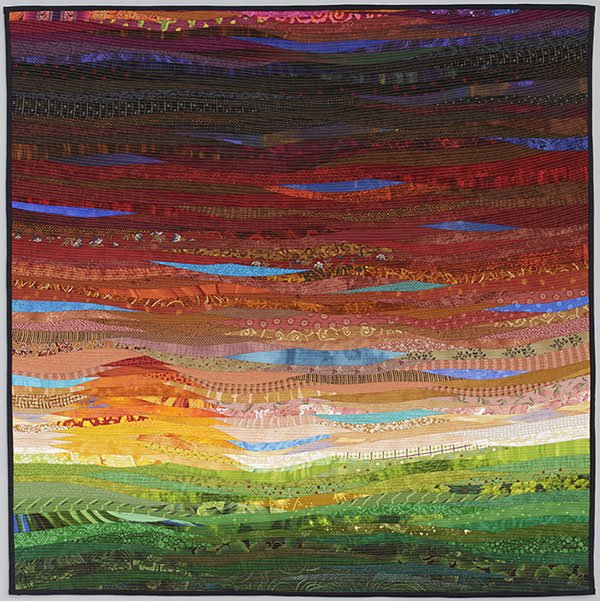
Autumn Sunset-40″x40″ by Ann Brauer-2016. Photo by John Polak
CN: How would you characterize the importance of images in one’s success on Etsy? AB: Etsy wants five pictures of your work. This is one good way to attract interest in your work.
Try to make sure you have clear images that illustrate the questions people will have of your work.
Pretend they are looking at it in person. Do you have great detail work? What is the back of your work look like? Although I tell people that the back of my glass cases is black, I have found that an image that illustrates the back is helpful.
Look at the images of others and find the ones that capture your attention.
CN: Some artists have expressed frustration at not getting enough activity on their artwork in their Etsy stores. What have you done differently to make your work more visible? AB: Although Etsy keeps changing its format, it is actually good about providing insights to help sellers get more viewers I put a fair amount of work into maintaining my shop.
Branding is very important. I suggest looking at a number of shops to see how others are doing it and then figuring out what works for you. It also helps to bring customers in from other locations—I include my Etsy address on both my hard copy and my social media while trying not to be spammy.
CN: In your experience, have you noticed that there’s only a limited price range of work that sells on Etsy? Are you able to sell high-priced artwork on Etsy? AB: I am constantly amazed at the amount of high-end work I sell through Etsy. I know that when I am purchasing something I frequently like to browse and get ideas. I believe Etsy lets my customers do just that.
Opening and Maintaining an Etsy Shop
Desert Scene-35×57′ by Ann-Brauer-2017 Photo by John Polak
CN: For someone who wants to sell on Etsy. What is involved in opening and maintaining an Etsy store? AB: First, you have to decide what you are selling and if Etsy is indeed an appropriate market. If your aim is to work with art galleries, interior decorators or to get teaching assignments, Etsy is not for you.
The basic process is fairly simple. Make sure you have a bio section and have determined your terms. I suggest starting and committing to working on it regularly since there is work involved and a learning curve. I try to do one task every day so I don’t feel overwhelmed.
As you work on your shop, it is important to think of what your “brand” is.
What are you selling?
How do you want images to look consistent so that if someone sees an image of your work, they know it is you?
What is your market?
What do you want the look of your shop to be?
Since this is true for any method of selling, it is a great exercise.
Don’t forget to grab your free copy of the textile art business handbook
There are forums where you can post your site and get feedback. Reading the comments about both your site and those of others will also help you refine your shop.
After you are satisfied that the shop is moving in the right direction, then you need to start publicizing your shop.
Link it to your website,
Include it on your postcards or other literature,
Cross post on social media.
Obviously, you don’t want to overdo it so use your discretion.
People do not like being “sold” to but they like to buy from a person.
Many people do not have many sales during the first six months or so. Keep at it and keep updating your shop.
Effective Business Strategies on Etsy
CN: In addition to all you’ve said, what are some of the most effective business strategies that have helped you to grow your business on Etsy? AB: All of my above answers. Also, I suggest figuring out how to ship your work in a timely fashion. I use USPS Priority Mail for all but my largest works. I’ve got a stock of free boxes from the Post Office and tissue paper to wrap the work. I try to ship in a timely fashion.
Ann’s Tips for Successfully Creating and Selling Textile Art on Etsy
Keep your shop stocked. The more items you have, the more customers will come to your shop.
Learn SEO. I use Etsy’s SEO Ranking (EtsyRank.com) to give me hints of the tags which work best for my items. Switch them up since you never know who will find you using which tag.
Cross post. You want to bring in your own customers.
Don’t give up. Any marketing technique takes time and persistence.
Work on your site. Do you need to reorganize it? Work on your statement? Rewrite your descriptions? What is selling? Listen to the marketplace.
Finally, Etsy is not for everyone. Figure out if it might work for you and then try it but also keep an eye on what is happening in the general market for quilts.
That’s a lot of good information on Etsy to unpack. Let’s take a break here and come back later with part 2 of this interview. In part 2, Ann and I will talk about craft shows, how she left a stable professional career to start her own business in textiles, and society’s perceptions about what a worthy career path is. I wouldn’t miss part 2 and you shouldn’t either.
In the meantime, here are the highlights of today’s interview.
Interview Quotes and Takeaways
Every experience in your life (small or big) has value in helping you accomplish big things
Figure out how to ship your work in a timely fashion
Don’t give up. Any marketing technique takes time and persistence.
Many people do not have many sales during the first six months or so on Etsy. Keep at it and keep updating your shop.
To find out more about Ann Brauer’s Etsy Shop, click here. You don’t want to miss out on part 2 of this interview where I’ll have some more candid business talk with Ann Brauer.
Your Turn
Do you have any questions about Etsy which have not been answered in this interview? Let’s talk about them in the comments section.
Warmest Regards,
SaveSave
SaveSave
SaveSave
SaveSave
SaveSave
SaveSave
SaveSave
SaveSave
SaveSave
SaveSave
SaveSaveSaveSave
SaveSave
SaveSave
In this episode of Textile Art Business Interview, I’m so honored to have with me, Mickey Lawler. Mickey is an award-winning artist, an author, an educator and a business owner.
Save to PINTEREST
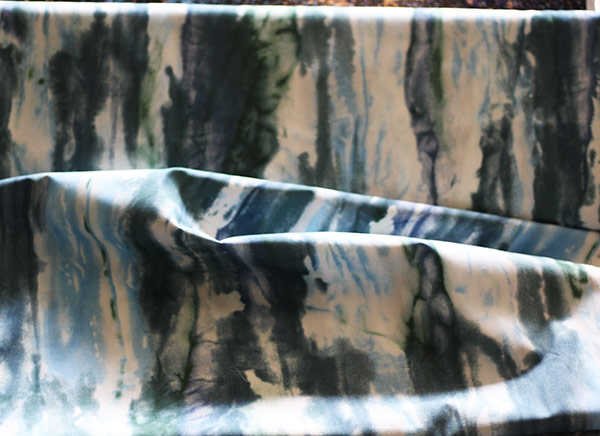
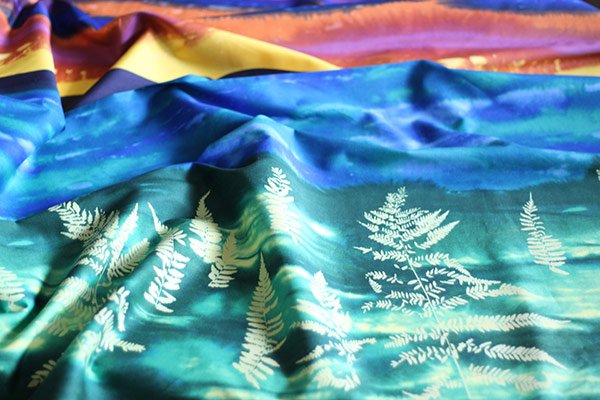
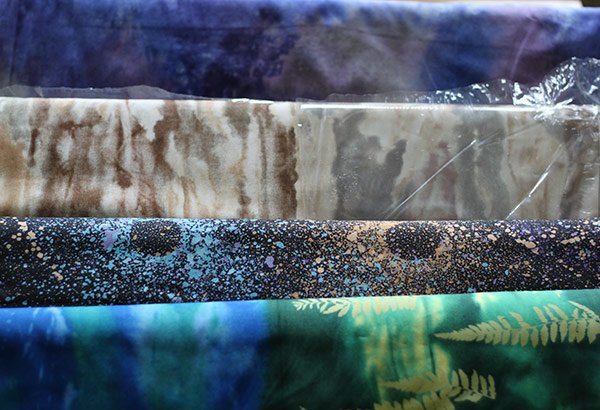
Mickey Lawler is famously known for her fine hand-painted landscape fabrics, called Skydyes. She paints skies, water, rocks, and landscapes. Her fabrics have been used in the artworks of some of the best textile artists you can think of.
Recently, I met with Mickey in her home to talk about the business of art. Over a cup of green ginger tea and some yummy brownies, we had a beautiful conversation about creativity, life, fabrics, and business. I had such a fabulous time with Mickey and I can’t wait to share it with you.
The importance of having help when you run a business
Mickey’s tips for successfully vending at shows
How she created 5,000 yards of fabric a year – by hand.
Mickey told me how she got started in the textile art business. She’d opened a quilt shop in town because she loved quilts and there were no quilt shops around. When a quilt teacher came to teach landscape quilts in her quilt shop, she fell in love with them. But at the time, it was impossible to get landscape fabrics to use as backgrounds.
Then Mickey’s friend who was also a quilt shop owner started carrying a line of fabric paints in her quilt shop. So Mickey began experimenting with them to create her own fabrics. Later, she sold her painted sky dye fabrics in her own quilt shop. And the response was phenomenal. Her Skydyes were selling faster than the regular fabrics. She closed her quilt shop and moved the fabric painting business home.
Here’s how the rest of our conversation went.
Mickey Lawler’s Hand-painted Water Fabric
CN: Mickey, tell me how you got into vending your fabrics at shows.
ML: I began by vending at all the local shows. I started doing the bigger shows probably 1990 – Houston, Padducah, and California shows by Mancuso Brothers (Pacific International) which was just so much fun. Houston was fun but a huge amount of work.
The neat thing about Houston was, the first time I went, I took a friend with me (my husband was still working). And we were just so excited. Because people were coming to the booth and they were just buying this fabric like crazy. And I was like “oh my gosh”. We just had the best time.
At the time, Houston was in the Shamrock Hotel – downtown Houston. And we had such adventures.
Then from then on, I did the Houston shows and my husband took early retirement and did all of this with me. We had a ball.
CN: Did you find that having someone with you when you’re vending was helpful?
ML: Absolutely!!! You had to. For big, big shows you had to. We finally ended up with a huge booth in Houston for many years. You know, to set that up and pay the shipping and pay the guys to bring the fabric over to the booth. It was a very big deal. Two of my daughters actually worked with us that time.
So one year we wanted to go to Houston and we wanted to go to the California show and they were at the same time. And so, one daughter – Terry- went with my husband to the California show. And another daughter – Katie- and I slugged our way to Houston. That ended up being a very tiring show. A lot of fun but still exhausting. You’re busy all day and you end up eating at 9:00 pm in the night. It was exhausting but we enjoyed it tremendously and it was very lucrative too.
Mickey Lawler in her Studio in front of a Skydye
My husband –Dan- called one time and he said we’re having a great show. Their show was in Palm Springs. And he said in the afternoon we’re going for a massage. Then, we’re going to do this and this. And we were like, what? But umm, you know, little memories like that are really fun.
He passed away in 2004 so I don’t do the big shows anymore. As a matter of fact, I do very few shows anymore. I’ve taken on one show during winter when I visit a friend in Florida. Everything ,…., all my sales are now through the website now.
CN: So how do your website sales compare to your days of vending at shows?
ML: There’s no comparison. The shows will be more lucrative than selling through the website. When I was selling at Houston, I did 5,000 yards of fabric a year. And most of it went to Houston.
Grab your FREE copy
CN: Wow. You did 5,000 yards of fabric by hand a year? Did you sell most of it?
ML: I sold probably, at least 60 -70% of it. Yeah. But that was because Dan could help me also. It was such an interesting arrangement we had.
CN: So how did you set it up to be able to create so much fabric in a year?
ML: We’d set it up so that I’d paint the fabric on three separate tables- 7 yards each. And he’d come out and stamp the fabric with our little stamp, then fold it and take it to the person who does the color setting- you know the setting of the paint. And then, I’d be ready to put the next piece on. So, I was doing a hundred yards a day of painting by hand!!!
CN: Oh my gosh, Mickey. You were doing if my calculations are right. You were doing an average of 5 runs of the entire process every single day.
ML: I was much younger (laughing) and much more energetic then. Having that extra person helped. And he did the website and handled the website, which was great. Because it didn’t take me away from the painting at all.
Full-LengthLandscape Print Combining Different Scenes – by Mickey Lawler
But my body can’t do that anymore. You know, it’s just too intense. It’s kind of fun now just to do just what I want to do, remembering that people want skies and I have to create it for them.
CN: That right there makes me think that we have to look into the future and realize that we won’t be able to keep going at our current pace. We need to plan what to do with our future creative lives. Right?
ML: You can think of that but it’s in the abstract. You go into denial when you get there, though (laughing). I did say to Dan. “Dan, when I’m 70 years old (and I’m beyond that), I envision myself in a wheelchair running up and down the tables painting fabrics. That still comes to mind. And I’m very grateful that I’m not doing that. But it is physically demanding and the shows were so physically demanding too.
CN: What are you spending your time doing now?
ML: I do a fair amount of custom work now. You know people who have taken David Taylor’s class need a background for a bird or whatever it might be and they place an order for it.
CN: So do you collaborate with David Taylor? (David Taylor is an award-winning quilter who loves hand-applique. See David Taylor’s work)
ML: No David tells them to get in touch with me which is very nice. We’ve taught at the same time together. And I really like doing that kind of custom work. It’s more like somebody is coming up with a different idea than I have. So it’s more challenging and has some energy and excitement about it, —, usually.
Mickey Lawler Licensed Fabrics
CN: I find that interesting. I know some people don’t like doing commissions because they don’t want to take artistic direction from anyone.
ML: When someone comes with specific instructions to reproduce the exact background of a painting they’ve seen somewhere. I find that I do tell them “No, I can’t do that”. But most people want to create a certain “feel” or a similar “feel” as some other scene. Then it’s fun. It’s a creative challenge and I enjoy that.
CN: Tell us a little bit about your process. I know many of my readers love surface design.
ML: It probably takes me twice as long if not longer to actually mix the colors than to paint the fabrics. I test them to see how they look together. To see what mood I want. Does it want to be a pleasant sky or a stormy sky? And then I try to get some kind of inspiration. Sometimes from my photographs. I go to the Cape on and off in the summer time. And I try to do some photographing there. So, a lot of my stuff is beach-oriented.
CN: Cool, so you’re inspired by the beach. Mickey, since you spent a lot of time vending at shows, what are six success tips you can give someone who wants to go that route or someone who started not too long ago vending their creative works?
Mickey Lawler’s 6 Success Tips for Vending at Shows
Have a good product that isn’t duplicated by other vendors.
You have to like talking to people and be excited about your product.
Simple, uncluttered display, letting folks know exactly what you are selling and, if possible, how it can be used in a finished project. (A sample or two)
Ask, before committing to a show, how many attendees the producers expect and how many vendors there will be. The ratio I used for big shows was 100 attendees to every vendor. Remember that there are only so many sales to go around!
Check out the map of the vendors’ booths. You don’t want to get stuck in a corner where there won’t be traffic flow.
It’s always a plus if the vendors’ booths are among quilts in the show, not off in a separate room
Well, this is a good place to take a break. I’ll come back with the second part of my interview with Mickey Lawler about textile art business. You don’t want to miss that. In that part, we talk about teaching, book publication, how she decided to make a career out of her textile work and oh, she tells us her five favorite tools and resources.
In the meantime, here are the highlights of today’s interview.
Interview Quotes and Takeaways
“It probably takes me twice as long if not longer to actually mix the colors than to paint the fabrics.”
“When I was selling at Houston, I did 5,000 yards of fabric a year.”
To be successful at vending, “You have to like talking to people and be excited about your product.”
The help of family and friends is invaluable when you start a business.
Don’t forget to pick up your free copy of the ebook below: “Win @ Play & Work”