One hour. Your questions. My experience.
Sometimes you don’t need another blog post, YouTube video, or generic piece of advice.
You need to talk to someone who has actually navigated the situation you’re facing.
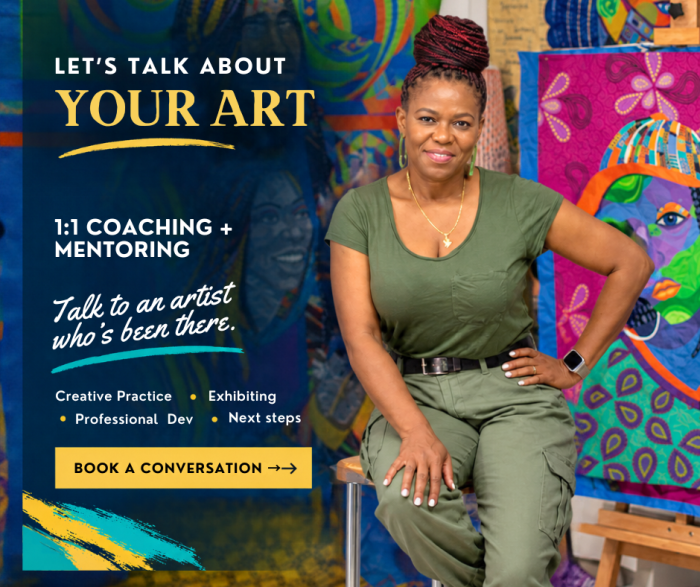
In this 1:1 session, we can focus on whatever is most important to you right now — your exhibitions, career direction, professional development, income, opportunities, or your next move.
I’ll bring my experience as a working artist, exhibitor, educator, and arts leader to the conversation and help you think through your options, clarify your goals, and identify practical next steps.
We can talk about:
- Exhibitions — preparing for an exhibition, deciding what to show, creating a strong body of work, approaching galleries or institutions, or getting more out of an exhibition opportunity
- Career direction — figuring out where you want your art career to go and what to focus on next
- Professional development — building your CV, portfolio, artist statement, bio, website, or professional presence
- Opportunities — thinking through residencies, grants, exhibitions, collaborations, and other opportunities
- Making a living as an artist — exploring income streams that can support your art practice
- Getting unstuck — when you have too many ideas, too many possibilities, or simply don’t know what to do next
- Your specific situation — bring me the question or challenge that’s been on your mind
This is not a one-size-fits-all coaching session.
You set the agenda.
Come with one specific question or use the hour to work through a larger career decision. I’ll listen, ask questions, share what I’ve learned from my own experience, and help you leave with greater clarity about what to do next.
Book your one-hour session and let’s work through it together.
I am delighted to share that my textile artwork, Feeling Good, has been selected for Patchwork: Connecticut Artists Consider 250. This is a juried exhibition at the Florence Griswold Museum in Old Lyme, Connecticut.
The exhibition opens June 27 and remains on view through November 8, 2026. It brings together Connecticut artists whose work reflects on American identity, history, and the many stories that have shaped the nation over the past 250 years. It is inspired by the Museum’s historic Bicentennial Quilt, Patchwork . The exhibition explores the idea that history is not a single narrative. Rather, it is a collection of many voices, experiences, and perspectives woven together.
This theme resonates deeply with my own practice.
Throughout my work, I explore migration, identity, cultural memory, and the connections that bind communities across generations. Working with textiles allows me to draw upon traditions of quilting and West African cloth, while creating contemporary narratives about belonging, resilience, and shared humanity. Thread becomes both a physical material and a metaphor—connecting people, histories, and places.
About the Exhibit
Feeling Good reflects these ongoing interests. It asks viewers to consider how identity is shaped by personal experience while also being stitched into larger cultural histories. I am honored that the piece will be part of a conversation that invites audiences to think about the many ways artists help us understand our collective past and imagine our future.
The Florence Griswold Museum occupies a unique place in Connecticut’s artistic history. Once it was home to the renowned Lyme Art Colony. The museum still continues its long tradition of supporting contemporary artists while fostering dialogue between historical and contemporary art. It is especially meaningful to exhibit work in a museum that has played such an important role in the state’s artistic legacy.
If you are in Connecticut this summer or fall, I hope you’ll have the opportunity to visit the exhibition. You’ll enjoy experiencing the remarkable range of work by artists from across the state.
Exhibition Details
Patchwork: Connecticut Artists Consider 250
Florence Griswold Museum
96 Lyme Street
Old Lyme, Connecticut 06371
On View: June 27 – November 8, 2026
For more information about the exhibition, visit the Florence Griswold Museum’s exhibition page.
I’m starting something I haven’t done in a long time. I’m back on YouTube.
About 10 years ago, I had a channel there. I eventually stepped away because I didn’t have the bandwidth to manage YouTube, a blog, Instagram, and a full studio practice at the same time. I chose to focus on the work and on one platform.
Now I’m starting a new textile art YouTube channel.

This channel is a way to slow things down. To show more of the real work. Not just the processes. The whole practice with its varying facets. And to create more space for connection.
Why I’m Coming Back to YouTube
After years of making and exhibiting my work, something has become very clear to me.
One of the best parts of this life is the people.
I love the conversations I get to have at exhibitions and events. I love meeting people who care about art in general and fiber work specifically. That sense of shared interest and exchange matters to me.
I also want a better way to share my actual process.
I often get questions about how I work and what my studio practice looks like day to day. Short-form content doesn’t leave much room for depth. I wanted a place where I could slow down and show more of the real work.
I’ll be honest. I don’t fully know how this will fit into my life yet. I haven’t posted on YouTube in years. There’s a lot to relearn. I won’t always know what to film. I won’t always have much time. But I’m committed to trying and seeing what this can become.
That’s why I decided to start this textile art YouTube channel.
What You’ll See on My Channel
This channel is a vlog.
I’ll take you behind the scenes of my studio and my days. Sometimes you’ll see me making work. Sometimes you’ll see everything that supports the work. Planning, organizing, thinking, writing, meetings, and problem-solving are all part of the process.
This is not a channel about being perfect or productive all the time. It’s about showing what a real art practice looks like over time. How my art practice looks like.
The channel will evolve as I go. I’m open to learning and changing things as I learn.
My First Videos
In my first video, I’m sharing a studio reorganization project I started this year. It’s a real behind-the-scenes look at how I’m reshaping my workspace to make room for the new materials that I’m incorporate into my practice. This is the first part of a two part series. It’s a great way to get introduced to my studio.
If you’d like to follow along, you can subscribe here:
Subscribe to my YouTube Channel
Final Thought
This channel is about textile art, process, and building a practice over time. It’s also about community. Please join me in this new community and comment on my videos with questions, ideas, suggestions and more so we can have a dialogue going.
Until next time, create something beautiful and share it with someone.
In a recent exhibition, I showed a series of works titled: Motherhood: Sweet, Sour, and Strong. This series is inspired by a West African song I first heard as a little girl: “Sweet Mother.” The song is a tribute to the songwriter’s mother, celebrating both the joys and the hardships of motherhood. That duality – its sweetness and its struggles – became the heart of this body of work.

In this series, I explore the layered realities of motherhood: its tenderness, its sacrifices, and its quiet strength. To do this, I designed a collection of fabrics using fruit as recurring motifs. Each fruit carries symbolic meaning.

I chose a pineapple for sweetness, lemon for sourness, and orange for strength and resilience. Additionally, throughout the fabric designs that I created, I weave the Ghanaian Adinkra symbol called Obaa Tan Pa, which represents the “good mother” into them.

Motherhood: who, truly, is a good mother?

That question opened up a deeper inquiry for me. If society views motherhood one way from the outside, how do mothers themselves define what it means to be good? This tension, between the idealized image of motherhood and the lived experience, became the central thread of the work.

From my own experience as a mother, I’ve come to understand that sacrifice alone is not the only way most mothers would like to live their lives, nor should it be the standard used to honor them. Mothers need rest, gentleness, and the freedom to be fully human. They do not need to be superhuman or to “do it all” at the cost of their well-being.

To give form to this contrast between the ideal and the real, I created two groupings within the series.

The pieces in this post belong to the first grouping: the idealized notion of the “Good Mother.”
I’ll soon share with you the second grouping which is rooted in the realities of everyday motherhood. They’re in contrast to these pieces shown here, both in technique and in intent. Visually, there are also very different from these ones showed here.
I can’t wait for you to see this second grouping of works that were in my exhibition “Restitching the Narrative“.
Thanks to all of you who attended my exhibition – Restitching the Narrative at the Faye & Ben Manger Gallery in Stamford, CT. The art exhibition was on view at the JCC until the first week of November.
It is always fulfilling to see my work through the eyes of the audience. Hearing your stories, answering your questions, witnessing your enthusiasm for the work is encouragement to wake up everyday and keep making more work and telling stories.

If you weren’t able to attend any of the events or see the show I still appreciate your support.
My exhibition draws inspiration from a favorite West African song titled Sweet Mother.
The works on view (which you can see here), were split into two distinct groups. In one group, I created colorful textile paintings in my signature style and techniques to honor the idealized “good mother”. While in the second grouping, I created delicate stitched drawings on handmade yarn paper. This group reveals a quieter truth about a mother’s need for rest, gentleness, and humanity.
Furthermore, this art exhibition allowed me to show the growth in my practice and my new yarn paper technique. Also, for the first time, I exhibited small works framed behind glass.

Each time I exhibit my work, it’s an opportunity for growth and connection. Having a specific project to accomplish has a way of pushing me to grow. Whether it’s the deadlines, the venue layout, the unique audience, they all push me in different ways. I’m grateful to all of you who are now part of my community for constantly showing up to either support me with your presence at my shows or to share the show details with your networks.
I look forward to many more events with you. And if you’re new here, come on over and join this art adventure.
I’m excited to invite you to a special exhibition walkthrough and artist talk for my latest body of work. It’s titled Sweet, Sour, and Strong.
This exhibition explores motherhood through the eyes of the African songwriter, Prince Nico Mbarga’s beloved song, “Sweet Mother.” It’s a song that transcends generations. It’s a song that praises the love, labor, and sacrifice of mothers everywhere. I started hearing this song when I was a little girl. I’ve probably heard this song several hundred times over. It is very popular in Africa, and at one point, supposedly, it was voted the most favorite African Music by BBC readers and listeners.
Restitching the Narrative

In this series, I translate those lyrical emotions into visual form using a material I developed called yarn paper. Onto this delicate surface, I then embroider portraits. Half of the portraits in this series are made with my new yarn paper material. While the other half of the portraits are made using my original techniques that you’re already familiar with.
During the talk, I’ll share how this process evolved. I’ll discuss why I have two distinct techniques in the same body of work. I’ll also delve into the various ways in which our perception of motherhood becomes evident. You’ll also get a chance to see the works up close and hear more about the cultural and emotional threads running through them.
As you know, there’s no better way to enjoy fiber art than to see it up close and in person. Below are the details of the event.
📅 Date: October 16, 2025.
🕓 Time: 11am – 12 noon.
📍 Location:
Faye & Ben Manger Gallery at
The Jewish Community Center,
1035 Newfield Avenue,
Stamford, CT 0690
The event is free and open to the public. Please RSVP to help us with planning.
If you’re in the area, I hope you can join me. I’d love to share the journey of this body of work with you through the song, the stories, and portraits of Restitching the Narrative.
This past summer was a season of discovery and creation. I found myself diving deep into a new material that completely captivated my imagination — “yarn paper“.

It started as an experiment, a curiosity about creating 3D fiber objects. “What would happen if I combined the linear qualities of yarn with the flexibility of paper”, was one of the questions I was investigating. The result is something magical — a hybrid surface that blurs the boundary between textile and paper. I call it “yarn paper.”
Works on Yarn Paper on Exhibit

I create this textile by hand weaving and stitching yarn into gauzy, lace-like sheets. Once dipped in water, the stabilizer dissolves, leaving behind a delicate, handmade-paper effect. Yarn paper allows me to stitch, and build texture all at once. It’s both delicate and resilient, mirroring the layered stories I seek to tell through my work.
Onto this fragile surface, I’m now embroidering portraits. The result is delicate, experimental, and unlike traditional fabric. Working with this new material opened up an entire new body of work for me — one that explores movement, migration, and the weaving of identities across time and place. Each piece invites the viewer to look closely, to see how stories are literally and metaphorically bound together.

I’m thrilled to share that this body of work is currently on view in my new exhibition, “Restitching the Narrative“. The exhibition opened recently to a wonderful, warm reception. The opening night was filled with lots of energy. Different people came together to experience the pieces in person. It was such a joy to see them engaging with the textures and layered meanings in the work.
Viewers at Restitching the Narrative

If you couldn’t make it to the opening, don’t worry — there’s more to come! I’ll be hosting an artist talk and walkthrough soon, where I’ll take you behind the scenes of this process and share more about how yarn paper came to be. Stay tuned for details in my next post!
Until then, I hope your summer has also brought you moments of inspiration and discovery.
In the meantime, check out the exhibition here at the gallery at The J.
Over the past five months, I’ve been able to give myself a gift that I’m finding so meaningful. A gift that I’ve been holding off of. It’s the gift of indulging my curiosity. It’s something I’ve wanted to do for a couple of years. I dipped a toe into it in 2023, but never made the space to fully explore. However, my creative brain will not let me be. The ideas kept swirling around in my head and the desire to test them out will not go away.
Eventually, I gave in.

From Flat to Form (2D to 3D Textile Art)
I dropped everything to follow my curiosity. To push the limits of fabrics and threads. My quest? To create sculptural forms from the materials I love and know so well.
And let me tell you – it’s vulnerable, it’s raw, it’s frustrating. To literally, start from scratch. And to move from 2D to 3D. To think in form and space when you’ve spent years thinking in line and plane. It’s not easy.
No. I’m not leaving my 2D work behind. Not at all. I’ll continue to create in two dimension, for sure. But this new 3D work requires a whole new way of thinking and I’m just beginning to build the muscle for that.

The Burden of Potential
Starting anew is scary. To have nothing to stand on, requires courage. Because when in doubt, there’s no past work to look to. No finished reference. No validation to rest on. Just pure unfiltered bravery.
And still, not doing this feels worse.
That pressing desire to do more is always there in the back of my mind. It doesn’t let up. I’ve coined a term for it. I call it the “Burden of Potential”. It’s that feeling that you’re capable of more than you’re currently doing. That something inside of you is trying to emerge. And the unrelenting pressure inside of you to make space for it. And that, not giving it space is what really steals your peace.
So,I’ve jumped in. I’m creating space for experimentation.
A Messy Process of Experimentation

But let’s be honest—it’s messy.
Figuring out what supplies to use? It’s a full-blown expedition.
Every other week I’m testing new tools, materials, and techniques.
I place orders, experiment, then discard them. I fail very often.
But when something tiny works?
Oh, there’s joy.
Studio-dance joy.
You know, the kind that makes me forget the many failed attempts.
Only to be reminded that I’m nowhere near where I want to be. The work doesn’t yet look like what I envisioned. Not even close. But this is the process. Fail, Succeed, Fail, Fail. Fail. And for me, the lesson here is this:
Success is not a period. It’s a semicolon. And so is failure.
And now, there’s also this. I’ve got stuff everywhere.
My studio, once a neatly organized space for 2D work, is now bursting with new tools, unfamiliar materials, half-formed ideas. There’s hardly room to move some days. I’m constantly stepping over something. Rearranging all the time.
It’s part chaos. Part calm.
It’s uncomfortable—and yet it’s exactly where I need to be.
And I wouldn’t have it any other way.

A Long Journey to 3D Textile Art
I’ll keep sharing this journey.
Because the burden of potential doesn’t go away.
But walking through it, day by day, one experiment at a time that’s how it will eventually transform into something real. I know the road is long. I’ll have patience. And I’ll try to enjoy the journey. Resisting the urge to fixate on results.
Ultimately, this isn’t about switching from one way of working to another. It’s about honoring the quiet voice that whispers, “You can do more.”
Stay tuned.
Last Saturday, I stepped into a room glowing with silver.
The Ely Center of Contemporary Art was turning ten.
To mark the milestone, we gathered for a benefit gala.
The theme—silver, tin, and metal—reflected a decade of strength.

Familiar Faces and Fresh Connections
The space buzzed with familiar faces and new introductions.
Artists, collectors, friends, and supporters filled the wide spaces at City Seed in New Haven.
There was so much warmth in the room and in every conversation.
It felt like a reunion of the local art community.

The night flowed with ease and energy.
Caterers served delicious food and poured celebratory drinks.
A live band added rhythm to the atmosphere.
Later, the after party kept the guests dancing even longer.

One of my proudest moments came early in the night.
I took the stage to welcome our guests.
As the new co-chair of the Ely Center of Contemporary Art,
I introduced myself and my fellow co-chair to the room.
It was a chance to thank everyone for supporting contemporary art in New Haven.

Then came the art auction—a highlight of the evening.
Renowned auctioneer Guy Bennet brought humor and heart.
He teased and encouraged, nudging bids ever higher.
It was entertaining and effective in equal measure.

I had the honor of donating a piece to the auction.
When the bidding ended, my artwork had found a new home.
A prominent collector and respected art advisor placed the winning bid.
She is known for her thoughtful, powerful collection.
Knowing my work is now part of it is deeply meaningful.

More than that, I’m proud to support the mission.
Proceeds from the sale go directly to local contemporary art.
They help the Ely Center of Contemporary Art continue to serve artists
and create space for bold, creative expression.

The evening was more than a party.
It was a celebration of community, creativity, and connection.
We honored the past and looked toward the future.
Together, we lit the way for the next ten years.
A story of joy, struggle, and the connective power of New Haven
New Haven, Connecticut has long been a place where paths cross—where people arrive, find community, pursue knowledge, and move forward. New Haven isn’t so far from New York City. And it isn’t as suburban as you’d think. It’s quite urban. And you’ll be surprised to know that the New Haven art scene is quite vibrant too. It’s got a lot of cultural overlaps with New York city.
I was reminded of this recently during the opening reception of my exhibition in New York.

The room was buzzing, but noticeably, there were very few people of color in the crowd. Then she walked in—graceful, thoughtful, and observant. After a while, she approached me and said, “Thank you for putting us on the walls.”
Joy in the Midst of Struggle
We began to talk. She shared that she had gone to college in New Haven at Yale and loved her time there. The diversity. The people. The cultural energy.
Now, in graduate school at the outskirts of New York, she felt out of place. Disconnected. She’d recently moved and was still in the process of finding her footing. Yet, something in my work sparked joy for her. A sense of home. A feeling of belonging.
That conversation stayed with me.

A Historical Parallel
When I was invited to create a piece for the Ely Center of Contemporary Art’s fundraising auction, I started researching its origins. I learned about Dr. and Mrs. Grace Ely—both born in New York, but were ultimately drawn to New Haven.
Dr. Ely left the “rush and bustle” of New York to pursue a more meaningful life in New Haven. A quote in this book described it this way:
“The distractions of New York were many and increasing, the spirit of materialism was widely pervasive, and the life of the scholar which was his choice was not easily to be maintained in the rush and bustle which he might not escape.”
So, when the opportunity to return to Yale as the Chair of Medicine arose, he embraced it, finding fulfillment in a life of learning and service in New Haven. Ultimately, he and his wife made New Haven their home.
After the devastating loss of her husband, Mrs. Ely found joy through generosity—turning her personal grief into a gift for the artistic community by transforming their home into an arts center. The similarities between this story and that of the woman I met in New York wasn’t lost on me. They are both connected by these two places. And she too had found a moment of joy in my work, in the midst of personal struggles navigating the challenges of relocation and disconnection.

The Making of The New Haven Art Piece
The young woman’s story and Mrs. Ely’s generosity share a truth: joy doesn’t require a life free of struggle. It often emerges because of it. These intertwined experiences—of searching, struggling, and ultimately finding joy—are at the heart of The New Havener.
Moreover, this idea—of New Haven as a place where people arrive, grow, and radiate outward into the world—inspired The New Havener. The circular shapes in the piece reflect how lives converge in New Haven before radiating outwards in different directions. Some people stay and build legacies; others carry their experiences with them to new places.
In The New Havener, I depict a woman who embodies this spirit of connection, joy, struggle, and excellence. She reflects the young woman I met in New York and the many people who have found joy in New Haven. Through this piece, I honor the city as a multicultural hub where the pursuit of excellence is interwoven with the feeling of belonging.

A Rare Opportunity for New Haven Art
I create only a few original works each year—and as many of you know, they tend to sell quickly.
The New Haven art piece is now available exclusively through the Ely Center’s fundraising auction. This is your chance to collect a unique piece that tells a powerful story of resilience, community, and the joy found through New Haven.
👉 Get your Tickets and Bid on The New Havener
Thank you for reading,

Clara Nartey
Textile Artist & Visual Storyteller of Black Joy