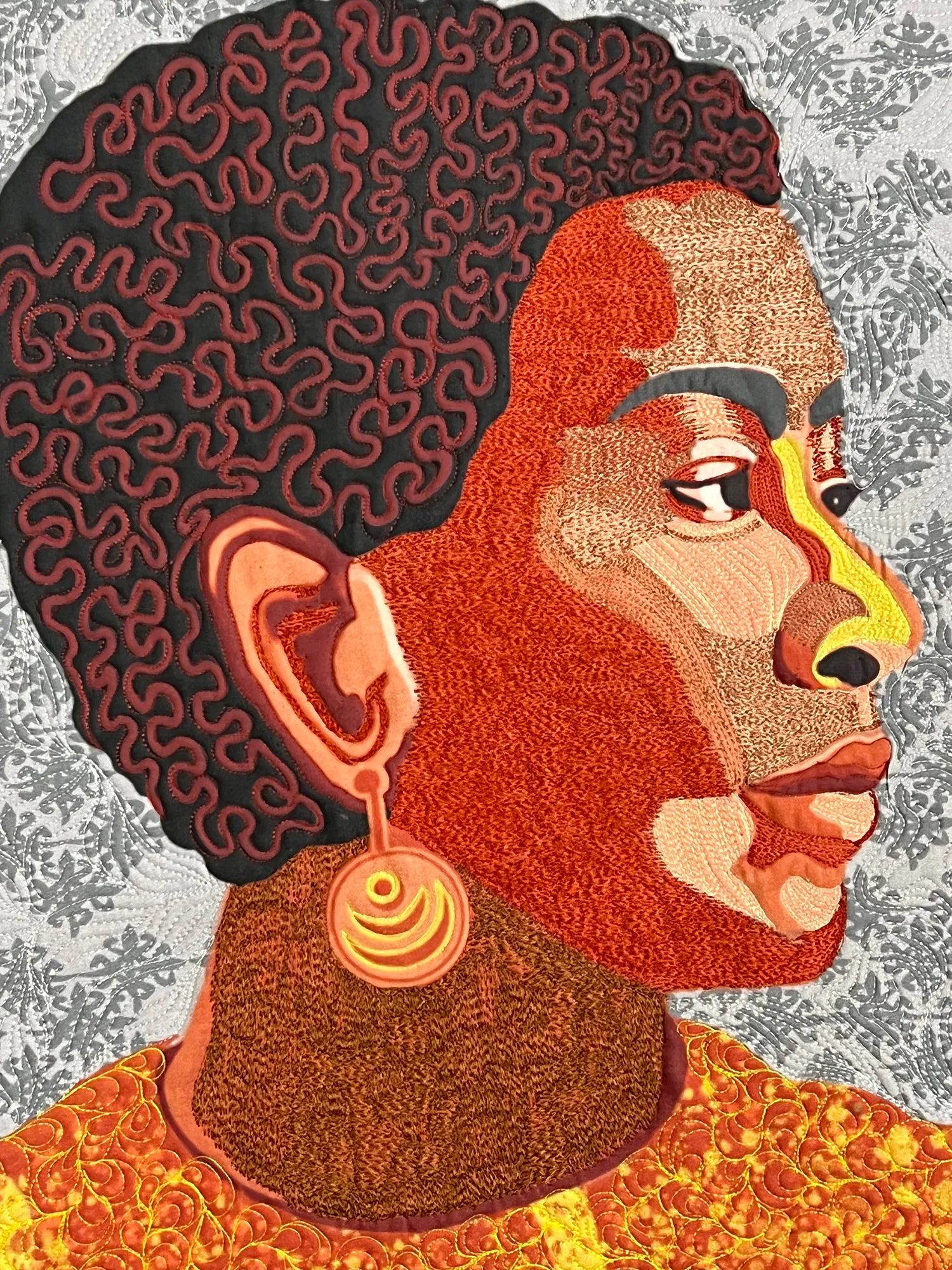
Continuing with the Gem Series which I started last Spring and exhibited at Metro Art Studios, in the show All Things Being, today, I introduce to you a new piece called “Citrine”.
“Citrine” is currently showing at Heather Gaudio Fine Art in New Canaan, CT until the end of January.
About Citrine
As with the other pieces in the series, my intention is to show that although we’re all different, each of us is precious. Different doesn’t mean LESS nor does it mean MORE. Just different.
Citrine is the birthstone for the month of November. Its color is pale yellowish to reddish orange. It’s a gem from the quartz family. As a result, in this portrait, I endeavored to show the different range of colors you’re likely to find in “Citrine”.
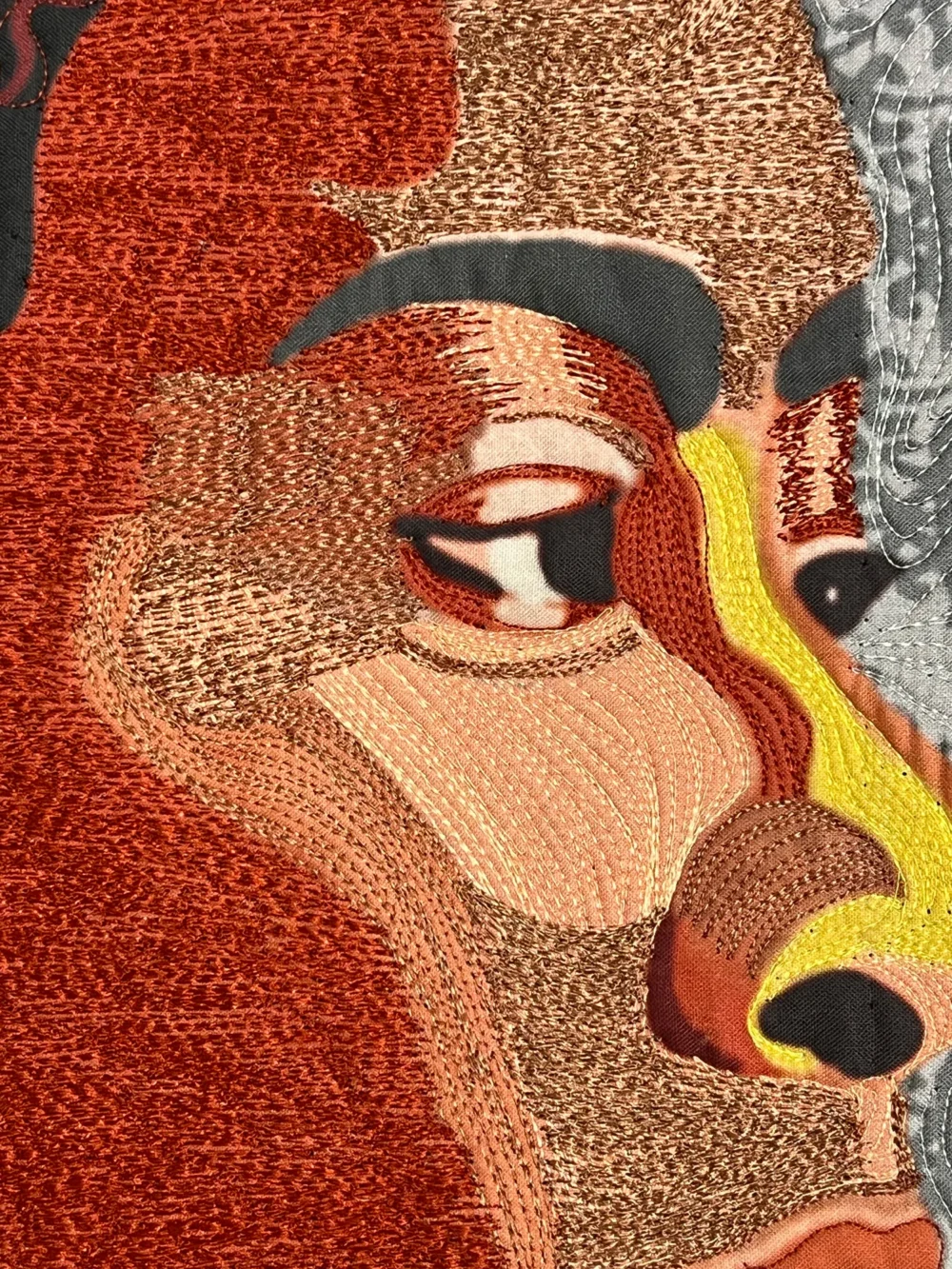
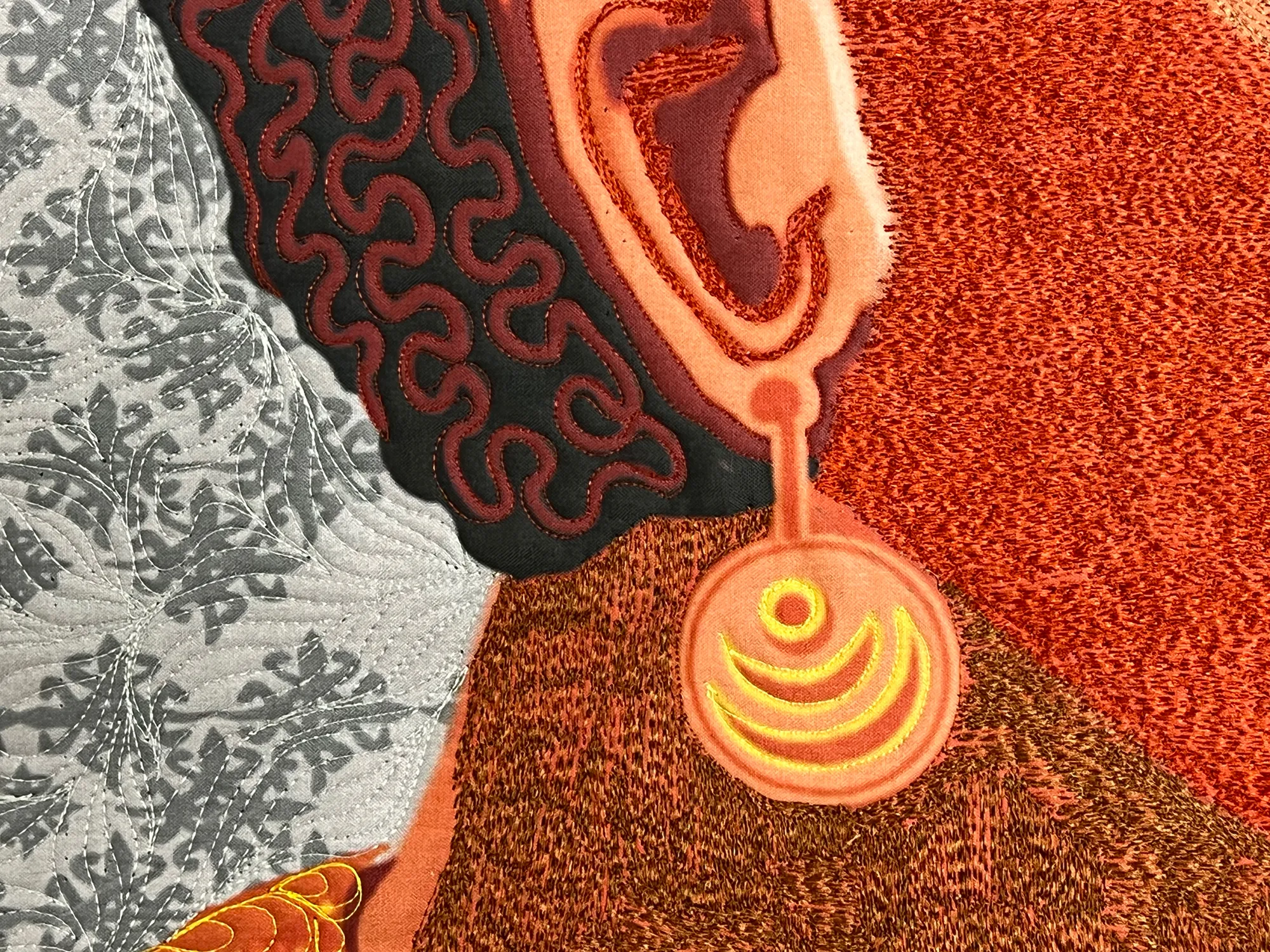
With hair being significant in my portraits, let’s talk about the hair in the portrait “Citrine”. This piece happens to be the first one in which I use a short hairstyle. Short hairstyles ranging from very short to bald, are common hairstyles worn by many Black women. I haven’t depicted any of these styles yet in any of my work until now.
Well, I thought it was about time, I made that happen. I’m happy with the way I depicted the coily Black hair so differently this time, yet so true to reality.
Where to View
The exhibition at Heather Gaudio Fine Art has been extended an extra week till January 28. So, if you still have the original dates on your calendar, please revise them. And please make time and go see the show. So far, no one I know who’s gone to see it has regretted it. It’s way better in person than on a computer or phone screen.
If you go see the exhibit, don’t forget to share photos and tag me on Instagram.
Clara Nartey, Citrine, 2022
Inks, and threads on cotton
40″ x 30″

Warmest Regards,

Hey friend, I have a new piece called It’s A Balancing Act. Remember when I told you about the story behind my piece “Breaking Bread“? Don’t remember? Here’s that story again. Anyways, my maternal grandma owned a bakery and that was the main source of income for my mother’s family.
Consequently, growing up, I spent a lot of my time behind the scenes in my granny’s bakery. You see, my granny’s bakery didn’t have a store front. It was a wholesale bakery for other business owners who’ll resell the breads directly to the public.

My grandma’s customers therefore were people who bought very large quantities of breads to resell. As a result my grandma baked a lot of bread and there was always a ton of work to be done around the bakery. She was always grateful to have an extra pair of hands to help around.

I fondly remember the weekends, summer breaks, and holidays I spent helping in the bakery. I would clean loaf pans, oil them, and prep them for baking. Other times, I’ll help carry dough from the huge mixers to the work tables. Then, I’ll cut, knead and shape dough into loaf pans. Next, I’ll help load the pans into the wood burning stone oven.

The oven was so large and so dangerously hot that children were never allowed to get too close to it. There was a boundary beyond which we were not allowed to go. An adult will pick up the baking pans from that point and load them into the oven. I remember very clearly that was the job of the younger of my mother’s two brothers. And he was really good it. No one was better at loading the pans in the oven, nor at stoking the wood to maintain the right baking temperature as my uncle.

Looking back, it’s amazing how they did it. The ovens had no thermometers, nor did they use individual thermometers to check the internal temperatures. However, they rarely burned the breads. I can’t ever remember that happening. Whenever it was time to get the breads out, they amazingly had well baked breads.

While we waited for the breads to bake, we’ll clean up, and chat. As soon as the breads were done, we’ll line up to transfer them out of the ovens; which were outdoor ovens; into the main bakery. By the time the breads were ready, we already had people waiting to buy for resale. And those resellers who lived nearby always knew when to come and buy because of the aroma.

As a young woman, what I found interesting was how these women built and run small businesses around my grandmother’s breads. Not only were they juggling the demands of running their own businesses, they also had homes to run as well. I learned a lot about work ethic, perseverance, and taking care of family by watching my grandma and all the women who she worked with balance the many aspects of their lives. These early examples gave me an immense admiration and respect for women.

As a person with African heritage living in the diaspora, my work tries to honor Black women both on the continent and in the diaspora. This newest piece of mine – It’s A Balancing Act”- is an acknowledgement of my deepest respect for the women on the African continent. Those women who came before me, paving the way for me to be here today, and those who continue to raise the next generation of amazing women, I say “Ayekoo”.

“It’s a Balancing Act” was a labor of love to create. This is a large piece in which I used some appliqué techniques I hadn’t tried before. This piece is part of my Joy of Everyday Living series. I’ve come to a place in my art practice where everything I create has a big chunk of myself in it. I pour my soul into my work. Every piece I make has to mean something to me. And I won’t have it any other way.
Friend, I hope you enjoyed learning the story behind – “It’s a Balancing Act”. If you’re interested in acquiring this piece, contact me here.
Warmest Regards,
Hey friends, I created this piece a while back but for some reason, I never shared it with you. It’s called “Readers are Leaders”. Here’s a look at this work and a few detail shots to help you appreciate the work.

This piece is one of my larger works. Back in 2021, I started venturing into creating large scale pieces. This piece measures 65″ x 54″, way too big for my domestic sewing machine. At the time I created it I didn’t have my Handi Quilter Moxie (aka Mimi). So, I had to wrangle this large piece through my domestic machine.

Due to its size it took a couple of months for me to finish it. During this period, I spent most of my time stitching the background. The size of the work and the time it took to create it, challenged me to come up with a wide variety of stitch patterns that will make the background interesting and keep the eye moving around. As a result, I found it really rewarding when this piece was finished. Because I got to push my technique a little bit further.

I created this piece to encourage the youth to pursue excellence. “Readers are Leaders” is a phrase that I often use with the youth in my life when I’m advising, encouraging and trying to get them to strive for excellence.

Consequently, I chose an Adinkra symbol which represents excellence to bring home this point. Then, I used the symbol to create the graphic black border you see around the edges of the piece. The interesting thing about this symbol is that it doesn’t just represent excellence. It references excellence in craftsmanship with regards to hand woven cloth. I need not tell you how much this connection to textile arts makes me love this symbol even more.

In addition to encouraging the youth to read, I wanted to help them find books they’ll enjoy reading. It’s not only important to read, it’s important to read books which act as both windows and mirrors. For all of us, not just the youth, we need to acquire knowledge (read books) which reflect us, that is books which affirm who we are. Additionally, we broaden our world view when we read about other cultures and people who are different from us. For young Black kids to fall in love with reading they need to find this duality in the books they read.

So, friend, this is exactly what I created this piece to convey. “Readers are Leaders” encourages kids to read. While at the same time encouraging authors, and educators to write/give books which meet these criteria. This piece has been featured in American Patchwork and Quilting magazine. Also, it’ll be traveling with SAQA Global exhibitions. It will premier at International Quilt Festival in Houston – Fall 2022.

Warmest regards,
Hey friend, I want to share with you “Breaking Bread“, a piece of work I recently completed. I’m happy to say it’s been juried into the exhibit – Harmony – at Broadway Galleries in Alexandria, VA. Please check my exhibitions page for more details about this exhibit. Now, let’s take a look at the piece and the story behind it.

I’m from a line of strong women who provided me with important examples for my own life. My maternal grandma was a small business owner. She owned a bakery for most of her life.

Grandma raised my mother and her 8 siblings from the revenues she earned from her bakery. As a result, growing up, I spent a lot of my time – summers, and weekends in the bakery. Let me tell you all about it.

I developed a love for bread simply by hanging around my grandma’s bakery. The phrase “Breaking bread” has biblical origins. It refers to making connections with people, building community, and fellowshipping with one another. Ironically, for my family, that’s exactly how we experience bread.

Our Family’s Love for Bread
Our love for bread is one of the things that connects us together as a family. Whether it was making breads, baking or eating it, bread had a way of making us gather together. When we were eating bread together in my Grandma’s house, we never sliced it with a knife. We just broke the loaf of bread and passed it around.
Bread was that thing we rallied around. We’ll eat bread with savory dishes as well as with sweet ones. As a child, I loved drinking tea with bread and butter. I’ll dunk my bread in my tea to enjoy it. And as an adult, that hasn’t changed much. I still enjoy my tea with breads and other baked goods. The only thing that has changed is that I now know it’s probably not healthy to eat as much bread every day.

However, I still love the smell of freshly baked bread. And I’ve got a nose for it. I can smell bread baking in the far distance before I’m close enough to identify exactly where. Given my history with bread, I’m sure it’ll come as no surprise to you that bread is a comfort food to me.
What it means to Break Bread

As a result, this piece “Breaking Bread” is a reminder of family bonds. “Breaking Bread” is my little token of joy, comfort and harmony. It’s not simply about food. It’s the memories this food evokes. I’m sure you’ve got such tokens in your life as well. Little trinkets, some dishes, a piece of jewelry that brings you comfort, reminds you of some meaningful connections with the people you love.
So, that’s what this piece – “Breaking Bread” is about. It’s about connections, loving relationships, and gathering together. It’s part of a new series I’m working on called the “Joy of Living“.

Warmest Regards,
Hey Creative Friend, here’s another piece in my ongoing Gem Series. I’m having a lot of fun researching them, creating, and then sharing their stories with you. This time, I want to introduce to you – “Emerald”. Emerald is the fourth and final piece in the set that was included in my show “All Things Being”

Although this is the last one I’ve created thus far, it wasn’t the last one I started. Since I had some issues with my machine, I had to set it aside for a while as I worked on the other pieces. However, I’m very pleased with how it turned out.

Emerald, unlike the other gems that I’ve created so far is a well-known gem. It’s the world’s most popular green gem. It was discovered as a gem by ancient civilizations in Africa, Asia and South America.

Its color ranges from blueish green through green to yellowish greens as you can see in this piece that I’ve created.

The World’s Most Popular Green Gem
The top three most valuable colored gems are Emerald, Sapphire, and Ruby , with Emerald being the most valuable of them all.

In this piece, like in all my other works, I paid particular attention to the hairstyle. I chose to use a headdress which is a common hairstyle among people of African descent. In years past, it used to be that the headdress matched the fabrics in a woman’s clothes. In recent years, it’s no longer so. You’ll find women wearing headdresses with just about any outfit; not necessarily African print fabric.

Emerald, like the other gems in the series is also a birthstone. For people born in the month of May, this is their birthstone.

Warmest Regards,
Hey friend, here’s another piece in the Gem Series. Meet Rhoda. Rhoda is short for Rhodolite. I’m sharing a little bit of the story behind Roda and tons of close-up photos for you to enjoy. Here’s a quick introduction to Rhoda. Currently, it’s on view in the show “All Things Being“. If you haven’t seen the show, it’ll be coming to and end really soon. So, I strongly encourage you to make the time and go see it.

Meet Rhodolite
Rhodolite is the name of a gemstone that’s sometimes referred to as Rhodolite Garnet. Yes, you’re right. It’s is a form of garnet. I explained a little bit about garnet and sapphire when sharing the piece “Sapphire” with you.

This gem is a form of garnet that is rose-red in color. Unlike garnet, Rhodolite has a more purplish color and its colors are lighter than traditional garnet.

Rhoda’s Origins
The name Rhodolite is derived from the Greek word “rhodon” which means rose. Obviously, the name references it’s beautiful reddish or rose-like colors. Its natural colors are used just the way they are in jewelry making. When you buy a piece of Rhodolite jewelry, you should expect that its colors have not been enhanced and that’s true for all garnet gemstones. Their natural colors are appreciated as-is.

Rhoda is similar to Amethyst in that it has purplish tones and shades. However, Amethyst lacks the reddish tones of Rhodolite.

So different, Yet so similar
Finally, as I bring you different pieces in this Gem Series, I hope you can see the essence of the story I’m telling with these portraits. Each portrait is so different, yet when you get to know them a little better you see that they’re all so similar. That’s us – humans.

Warmest regards,
Hey friend, let me introduce you to Sapphire. Sapphire is part of my “Hidden Gems Series”. This series is all about celebrating our differences and embracing our similarities as humans. Learn more and see the other pieces in the series here.

In this series, I’ve created figures of women looking strong, confident and sure of themselves depicted in various poses. This is in line with my art practice which is all about building confidence in young girls and women. As much as I personally love to smile, I don’t think that should be a measure of beauty or how “nice” someone is.

Often, I hear people argue over whether or not women need to smile in photos in order to look beautiful. Mind you, I don’t hear the same discussion about men. When a woman is not smiling in photos, people say she looks stern or angry. My question is: why should women always have to smile in order to look pretty? My take? Smile if you feel like it. Don’t smile when you don’t want to. Simple!!! My portraits do both – sometimes they smile, other times they don’t. That’s real life.

Moreover, some people feel really uncomfortable smiling for the camera. They’re more relaxed when they don’t have to put on a fake smile. More importantly, when you see someone smiling for the camera. it doesn’t mean that there’s no turmoil going on in their lives. Remember Princess Diana? She was one of the most photogenic and very well photographed women in her time. However, she was also very unhappy.
So, why don’t we just let people show up as their authentic selves. Let’s not require people to put on a show for the world in order to be acceptable.

This piece Sapphire, like the other pieces in the series, exudes confidence. It’s not ashamed to be different. It’s comfortable in its blue skin tones. At the same time, it embraces the similarities between itself and the other gemstones.
The gemstone sapphire belongs to a group of minerals called corundum. In fact, sapphires and rubies come from this same mineral type. (I didn’t know that until recently.) When the color is red, it’s called ruby. The blue version is called sapphire. When it’s colorless it’s called white sapphire. All other colors are called “fancy sapphires.” The difference in name lies in their colors. But at the core, they’re one and the same. Isn’t that something!

Sapphires range in colors from greenish blue to deep blueish purple. You’ll notice that with all the gemstones, their colors are not absolute. A blue gemstone will pull in colors from both green and purple. A purple gemstone will do a similar thing and pull colors from blue and magenta. And that’s why when I was doing my research, I decided that gemstones are a great metaphor for humans. As different as we look, at our core, we’ve got real similarities.

As a result of this Hidden Gems series, I’m learning a lot about gemstones. I hope you’re enjoying these nuggets of information about gemstones and the human race, just as I am.

Finally, as a birthstone, Sapphire is the birthstone for all those born in September. However, you don’t have to be born in September to appreciate this beautiful gem of a portrait. Sapphire is for you if you can enjoy beauty in different shades, shapes, and colors. Until next time when I bring you another gem portrait in the series.
Warmest regards,
Hey friend, the other day I told you about my new series of works which is currently showing in the exhibit “All Things Being” at Crown Gallery. I wasn’t able to show you the pieces in the series while I was working towards the show. However, now I can. Here’s “Amethyst“.
Since it’s the one which starts with the letter “A”, I decided to reveal her first. That’s not to say I’m planning to reveal them all in alphabetical order. This creative mind of mine will pick and choose where the inspiration takes me.

“Amethyst”, just like the rest of the works in The Gems Series, highlights the fact that different is beautiful. It is neither inferior nor superior.

As a gemstone, it is a purple variety of quartz. It can be found in various shades and tints of purple, ranging from pale lilac through blues to deep reddish purples.
History -Amethyst

Amethyst derives its name from the Greek word “amethystos” which means “not intoxicated”. In Ancient Greece it was believed that the gem had the ability to prevent its owner from getting intoxicated. This is a reference to its “wine-like”color.

According to history, this gemstone was worn by royalty as well as set as jewelry on their crowns, and clothings. Furthermore, it was also favored for religious purposes. It could be found in the gowns of bishops and as well as used as rings for them.

Today, this gemstone is widely used in jewelry making. Furthermore, it’s not as rare as it was originally believed to be. Large deposits have been found in various places in Brazil.

In conclusion, just as you don’t choose the month in which you’re born, you also don’t choose the color of skin you’re born with. Every human from every race born in the month of February calls this gemstone – “Amethyst” their birthstone.
Warmly,
PPS: Learn more about the entire series here.
Hey Creative Friend, I’ve completed another large scale piece. This one is called I am a Child. I shared the work in progress photos for this piece in another post. Check that out here. They’re truly awesome. As I always do here on my blog, I’ll give you the back story to this piece. So, go grab yourself a cup of your favorite beverage and let’s go.

So first, let’s start with my inspiration for this piece. During the year 2020 when we were having the national discussion on social justice and race, I discovered that there was something happening on Instagram. Many students of color in independent and private high schools started creating Instagram accounts usually called Black at — followed by the name of the school. Go ahead, try it. If you know a private high school in your area, type Black At NameoftheSchool into the search engine on Instagram. Chances are, you’ll find an account by Black students who attend that school.

What these accounts were primarily detailing were the experiences of being a Black person in predominantly White schools. I spent a lot of time reading the posts on these pages.
When Children Speak Their Minds – Listen!

Some of them were shocking, gut wrenching and unbelievable. Keep in mind these students are just but children. Their ages ranging between thirteen to eighteen years. That is how young they are. And to think that at those ages, they have already experienced some of the things they described, it was hard for me to bear.

As I kept following these pages, I noticed an interesting trend. A lot of the unpleasant interactions girls had, had to do with their hair. I was shocked. You couldn’t have convinced me that this was the case if I hadn’t seen it with my own eyes. Until then, I hadn’t realized the magnitude of the damaging effect negative perceptions people have of Black hair, has on Black children.

However, those who have researched the topic, already know this to be the case. In her book, Hair Story: Untangling the Roots of Black Hair in America, the author writes:
School is often the first place Black children learn survival skills when it comes to their hair. They’re forced to defend it, explain it, and often make excuses for it as White students and teachers remain unaware of their inner turmoil.
Lori L. Thomas, Hair Story: Untangling the Roots of Black Hair in America

As terrible as those encounters were, what was more disturbing to me, is the lasting effects they had on the girls. Some of them wrote about losing their self-confidence, and their sense of worth. Can you imagine that? At such early ages, these children had already been dealt a life changing blow by the society in which they live.

When Negative Emotions Are Internalized …
The death of self-esteem can occur quickly, easily in children, before ego has “legs”, so to speak. Couple the vulnerability of youth with indifferent parents, dismissive adults, and a world, which, in its language, laws, and images, re-enforces despair; and the journey to destruction is sealed.
The one lest likely to withstand such damaging forces because of youth, gender, and race ….. the most delicate member of society: a child; the most vulnerable member: a female
Toni Morrison, The Bluest Eyes [Affiliate Link]

I created this piece to bring attention to this issue. My intention is to highlight the fact that there are children in our midst. they move through the same spaces we adults move through. Consequently, our actions, our words, and our expressions all have lasting effects on who they shape up to become in future. As we model behaviors that are sensitive to these issues, so will children who’re watching us also do. Then, we’ll not have adults being insensitive to children and children not being mean to each other.

Next, let me tell you why I chose the symbol in the background of this piece. If you look closely at it (right image above), it’s the footprint of a chicken. The symbol is an Adinkra symbol which is from a proverb The Adinkra symbol I chose to use in “I am a Child” is the footprint of a chicken. The symbol is associated with a proverb that goes something like this: Although, the foot of a chicken often steps on its chicks, it’s careful not to kill them. The essence of this proverb is about nurturing our young with caution so that we don’t break or destroy them with our actions or words.
Finally, let me share with you a poem I wrote just for this piece:
I am a Child
I am a Child
Learning confidence
When you see me, do you smile

I am a Child
Please handle with care
When you see me, do you smile

I'm a Child
Trying to find my way; imbibing everything around me
Please don't sneer

I am a Child
Please be kind
When you see me, will you smile

Warmest Regards,
PS: Want to check out the work in progress photos for this piece? Go here.
Want more? Read other Stories Behind The Art.
Hey Creative Friend, I recently completed a piece that I’ve been working on for quite a while now. As always, I wanted to share the back story with you and show you tons of detail photos. So grab your fave beverage and come meet Amandla.

When I was born, I was given a middle name which when translated, reflects the sentiment that being born a girl is just as good as being born a boy. Let that sink in for a moment. (You can listen to my podcast interview with Abby Glassenberg to learn more about this)

Although it was an honorable affirmation of my self-worth as a human being, the fact that, this declaration needed to be made in the first place, wasn’t lost on me.

I’ve grown up carrying that name with me everyday of my life. Consequently, I’m acutely aware of the inequalities women face. How we perceive women, how we treat them, and the opportunities we allow them to have impact who they end up becoming. It goes without saying that I believe women and girls deserve to live to their fullest potentials. I believe it’s not just good for women, it’s good for men as well and our societies as a whole.

Empowered women, result in empowered societies.
It’s my mission to empower women to make time, create their best work, share with the world, let their lights shine and enjoy that glory.
The name Amandla is from South Africa. It means “Power” in Xhosa/Zulu. (Listen to actress Amanda Stenberg explain it). The name was used as a rally cry during the fight against apartheid in South Africa. I think it’s an apt name for how I perceive women and who I want them to be in our societies. I want to see women flourish. I’ll like to see them prosper and be well.

Women have so much to offer. We just need to create opportunities for them, support them, advocate on their behalves, and empower them.

That’s what this new piece is about – empowerment of women.
In conclusion, I want to leave you with a quote from a powerful woman, an author of many successful books.

But here is a sad truth: Our world is full of men and women who do not like powerful women. We have been so conditioned to think of power as male that a powerful woman is an aberration. And so she is policed. We ask of powerful women: Is she humble? Does she smile? Is she grateful enough? Does she have a domestic side? Questions we do not ask of powerful men, which shows that our discomfort is not with power itself, but with women. We judge powerful women more harshly than we judge powerful men
Chimamanda Ngozi Adichie

Oh, while I’m at it, here’s one more quote. This time, from an unknown person (most likely another woman)
Here’s to strong women.
May we know them.
May we be them.
May we raise them.
~ Unknown
Warmest Regards,
PS: Want more? Read other Stories Behind The Art.